Open agentic AI standards: our path to the AAIF award
How Vstorm went from production agent work preceding framework maturity to the Agentic AI Foundation award by building open agentic AI standards into every project we ship.

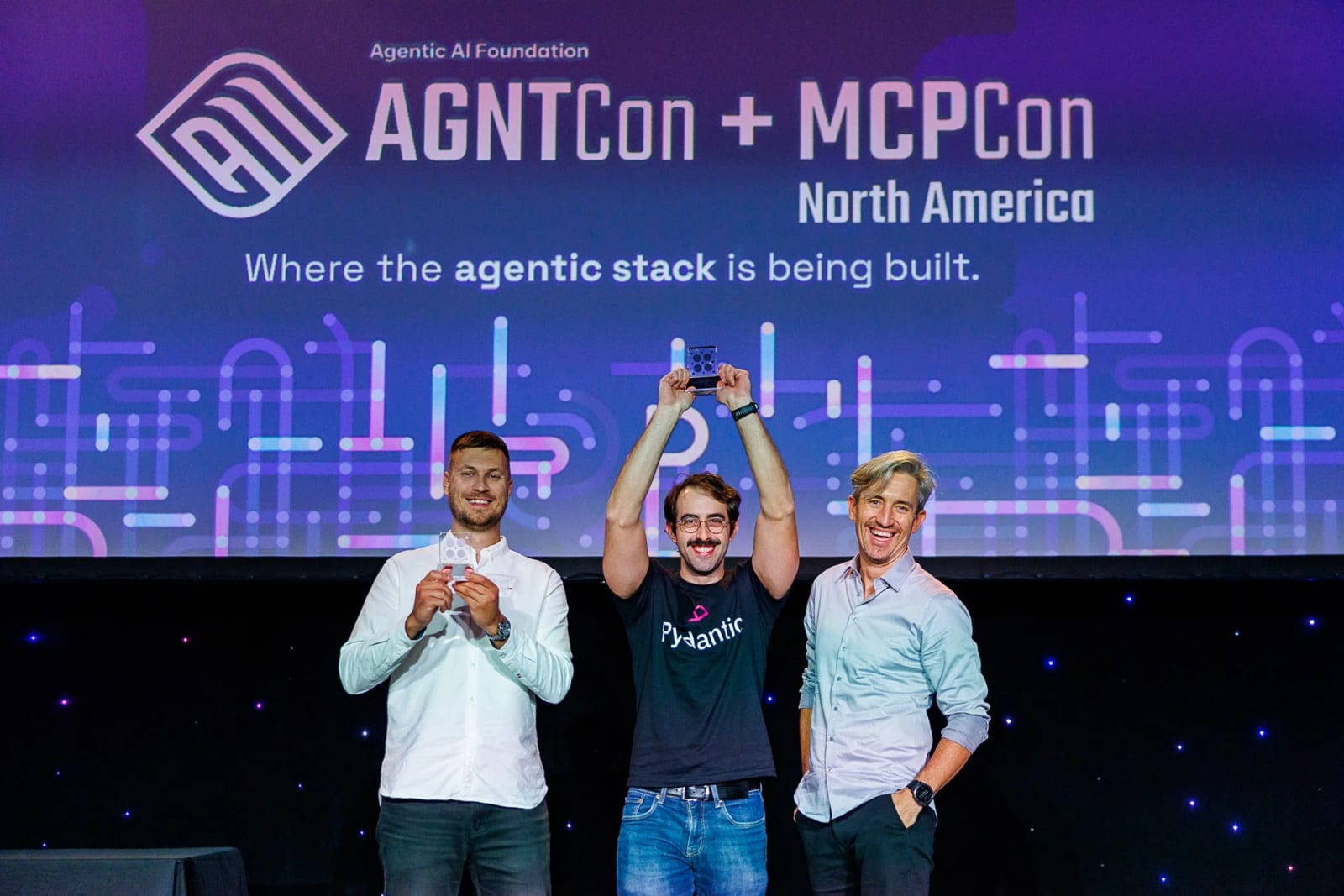
On October 23, 2026, the Agentic AI Foundation (AAIF) gave Vstorm its Open Agentic AI Innovation Award at the first AAIF Annual Technical Excellence Awards. The foundation recognized that Vstorm “put AGENTS.md into every project it ships” and built MCP support into our own open-source framework, AgenticOS, so the same project knowledge guides coding agents during development and agents running in production (AAIF).
Behind that citation is a choice we made early: to contribute to open agentic AI standards as well as build on them. An agentic harness is everything around the model that makes an agent work: project structure, instructions, tools and guardrails.
Under the lead of our engineer Kacper Włodarczyk, we turned what we learned in commercial projects, before the first agentic frameworks had matured, into an open agentic harness: templates that set up every new agent project with AGENTS.md, MCP and our production practices already in place. Anyone can use it, so every team that starts from it builds agents on applied standards from the first commit.
The award is the latest step on a path of firsts. We built production agents before the frameworks matured, we were the first agentic AI engineering and services company to join the AAIF, and we are among the first recipients of its awards for impactful contributions to the future of AI agents. This post follows that journey from 2017 to today.
2017 to 2022: learning on real business data #
Antoni Kozelski founded Vstorm in 2017. Our first projects covered the technologies that came before today's AI agents: natural language processing, data engineering and machine learning. That work taught us two lessons we still apply. Real business data is messy, and a working demo is a long way from a system people need to rely on every day.
2023 to 2025: building agents before the frameworks were ready #
After ChatGPT launched in late 2022, LLM APIs and the first agent frameworks opened up a new kind of work, and we moved our focus to building agentic AI. Around this time Bartosz Gonczarek joined Vstorm as co-founder, bringing executive consulting experience, so strategy and engineering sat in one team.
Our clients wanted agents in production before any agent framework had a stable release, so we built on beta versions and fixed what production exposed as we went. Pydantic AI, for example, only reached its v1 release on September 4, 2025. That work made us early contributors to frontier agentic harness frameworks: our engineers have contributed to Pydantic AI and to LangChain's Deep Agents.
In the same period, Vstorm was recognized as the fastest growing of the Deloitte Technology Fast 50. Today, the Pydantic AI team endorses our packages and works with us to bring some of them into its codebase.
Sharing what we build with the whole industry #
Every team that builds agents hits the same gaps: memory, guardrails, sandboxing, orchestration and context for coding agents. Most teams solve them privately, project by project, so each company pays for the same lesson. We chose to publish what we built. With no promotion budget, our 31 open-source projects have collected more than 4k GitHub stars and over 1.8 million downloads per month, with more than 10 million downloads in total as of publication.
Take one example. A coding agent such as Claude Code or Codex needs build and test commands, conventions and directories it must not touch. On most teams, engineers still supply this by hand, in prompts, in README files written for people, or from memory. Our open-source Full-Stack AI Agent Template, with nearly 2k GitHub stars, generates a tailored AGENTS.md and CLAUDE.md for every FastAPI + Next.js project it scaffolds (AAIF case study).
For production, we built MCP support into AgenticOS, the sovereign agentic AI layer in all our projects. AgenticOS works with MCP in both directions. Its agents can use any of 4,700+ MCP servers from a built-in gallery. AgenticOS is also an MCP server itself, so Claude Code, Codex, Cursor or any other MCP client can create, run and monitor agents and search company knowledge, under the same permissions and audit log as the console.
2025 to 2026: contributing to open agentic AI standards #
In December 2025, Anthropic, Block and OpenAI launched the AAIF under the Linux Foundation, with the Model Context Protocol (MCP), goose and AGENTS.md as its first projects. The same month, we became the first agentic AI engineering and services company to join the foundation (AAIF). By October 22, 2026, it counted 305 member organizations and 10 hosted projects.
The first AAIF Annual Technical Excellence Awards covered three categories and a new Keystone Award, chosen by a committee drawn from the AAIF Governing Board and Technical Advisory Council, with community participation. The Open Agentic AI Innovation Award went to AURA from Mezmo, Opaque Systems and Vstorm. It recognizes work that deployed or advanced AAIF open standards in production, research or public tooling, with demonstrated real-world impact.
Among the individual winners is Marcelo Trylesinski, recognized for carrying the MCP Python SDK through its version 2 release. He is also an essential contributor at our partners, Pydantic AI. The frontier of agentic AI is built by many contributors, and standing next to them is what this award means to us.
What working among the leaders means for our clients #
For business leaders, it means new patterns reach your agentic initiatives as soon as they are stable, because our engineers help shape the frameworks and standards the industry runs on. Those standards are maintained under neutral governance, by a foundation whose platinum members include Anthropic, AWS, Google, Microsoft and OpenAI. Combined with full code ownership, this lowers the risk of lock-in when a model provider changes its prices or direction.
For CTOs and automation leads, it means the tooling is available today. Your team can generate a project from the template, or add our production-stack-skills pack to any AGENTS.md-compatible coding agent. You can also implement our AgenticOS layer in your company and start engineering your own custom agents.
“I am proud to lead an engineering-first organization that understands the technology from the inside out. We take part in building open standards for agentic AI, bringing them into practice, and helping shape the future of the technology. This becomes even more important in an era when writing code is becoming commoditized.” Antoni Kozelski, CEO and Co-founder of Vstorm
Where we are heading #
We will keep contributing where the practices of agentic AI take shape: in the AAIF community, in the frameworks we build on, and in the open best practices and implementation standards that teams use to take agents to production. What we learn in client deployments goes back into that work, so the next team does not have to learn it alone.
Our ambition for the near future is to go further and bring the agentic AI community closer to US and European teams through community meetups.
The next steps are already on the calendar. On October 23, Antoni Kozelski and Bartosz Gonczarek spoke in the MCP track at AGNTCon + MCPCon about shipping MCP servers to AI hosts you do not control. We will soon host a live Q&A on how we build open agentic AI standards into client systems: register here to join the online follow-up.