





AI agent integration services

Agents wired into the systems your team already uses

Less copying between systems. Agents read and write in your CRM, ERP and ticketing, each tool with its own credentials and every call logged.

Why agent integrations break

Integrations break on the write, rarely on the read.

Duplicates after timeouts, admin keys that can delete, changes nobody can trace.

  1. 01

    Where it stallsOne service account can touch everything.

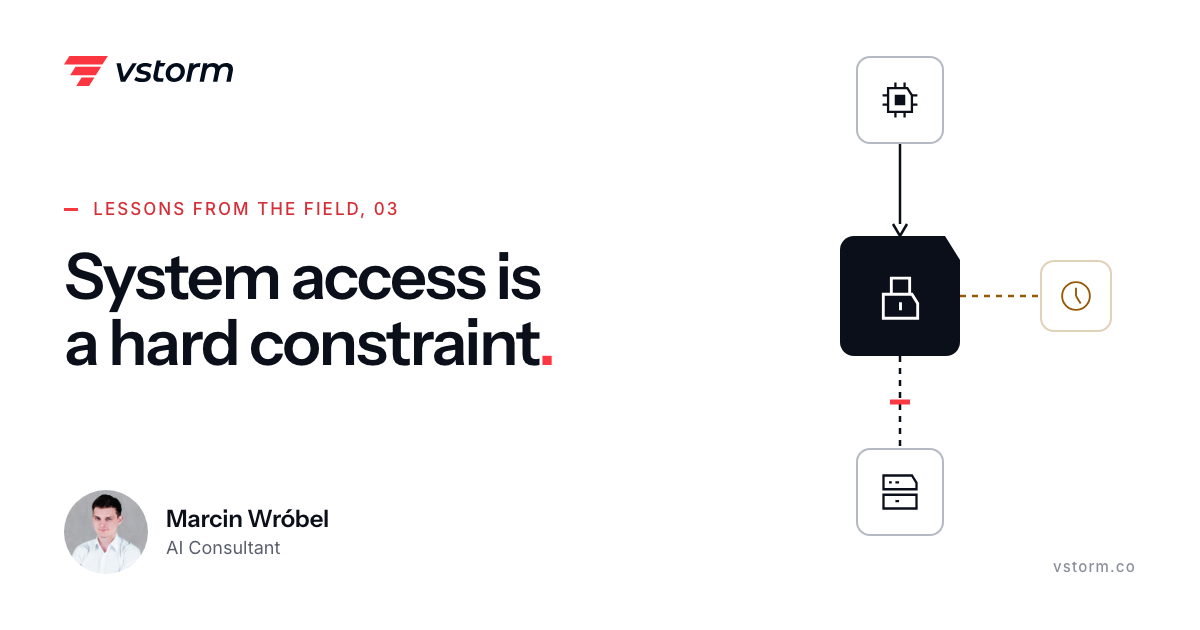
    What we do Each tool gets its own scoped credentials.

  2. 02

    Where it stallsFree text goes straight into your systems.

    What we do Inputs are checked before every call.

  3. 03

    Where it stallsA timeout retry creates a second order.

    What we do Retries do not duplicate; failures undone or flagged.

How we integrate

Each tool limited to the job it does

We start from your systems as they are, API or not.

  1. 0103

    Your systems, inventoried

    We list every system the workflow touches and rate each action by what a mistake would cost.

    • Systems and access paths
    • Approvals per risky action
    • A route without an API
  2. 0203

    Tools with contracts and limits

    Each tool checks its inputs before the call and can touch only what its job needs.

    • Typed contracts and MCP servers
    • Safe retries and rollback
    • Triggers from your systems
    Mixam's product advisor acts through tools; conversion to a final sale rose from about 20% to about 40%.
  3. 0303

    Every call on the record

    Each call is logged with its run, inputs, result and approver; credentials stay in your secret store.

    • Connector code and MCP servers
    • Runbooks for the next system
    • Audit log your team reads
Engineering in the open

We help build what agentic AI runs on

Open standards, open-source tooling and published research, all public, so you can check our engineering before you hire us.

Shaping agentic AI

The first agentic AI engineering company to join the Agentic AI Foundation

The Linux Foundation formed it around Anthropic's MCP, OpenAI's AGENTS.md and Block's goose. AWS, Google and Microsoft are platinum members. In its own words: “Together, we're shaping the future of agentic AI.”


Open source

We build open-source agent tooling that other engineering teams install

9M+ PyPI downloads
3,900+ GitHub stars
31 public repositories

Framework contributors

When the framework breaks, we fix it at the source

We maintain our own open-source agent framework and contribute fixes to the frameworks our agents run on, through official partnerships with their teams. Breaking changes reach us before they reach your codebase.

Research

Our engineers and PhDs publish peer-reviewed research

Peer-reviewed papers on agent architectures, evaluation and AI security, and an open benchmark anyone can rerun against our results.

Track record

Frontier AI teams now build on what we shipped first

Our client agents were in production before most of today's agent frameworks had a stable release. You get a team that already knows what breaks between a promising demo and a system people rely on every day.

Engagement models

Ways to start

Each path starts with a free call with a founder or senior AI engineer. A build goes ahead only after its Proof of Value meets the agreed threshold.

FAQ

Questions about AI agent integration

What does AI agent integration include? +
An inventory of the systems and actions the agent touches. Then typed tool contracts or MCP servers, scoped credentials per tool, retries and rollback for failed writes, event triggers, and an audit trail of every call. Connector code and runbooks stay with your team.
Which systems can you connect an AI agent to? +
Any system the agent can reach through an API, a database, an event stream, files or, as a last resort, its user interface. The usual ones are CRMs, ERPs, ticketing and service desk tools, email, document stores and internal databases.
What is an MCP server, and do we need one? +
The Model Context Protocol is an open standard for describing tools and data to AI agents. An MCP server wraps one of your systems so any compatible agent can use it through the same contract. It pays off when several agents or teams will use the same system; for a single agent, a direct typed tool is often simpler.
Can an agent work with a legacy system that has no API? +
Yes. We look for a database view, a scheduled export or a file drop first. If none exists, the agent can work through the system's interface, with tighter checks and a person reviewing the writes, because that path breaks more easily when the screen changes.
How do you control what the agent is allowed to do? +
Each tool gets its own credentials and the narrowest scope that does the job. Reading and writing are separate tools, and actions that are hard to undo, such as payments, deletions or messages to customers, can wait for a person's approval before they run.
What happens when a call fails halfway through? +
Writes are made idempotent, so a retry does not create a second record: idempotency keys where the API supports them, a lookup before the write where it does not. Rate limits are respected with backoff. When a change that spans several steps fails partway, the earlier steps are reversed with compensating actions or flagged for a person. The run is logged either way.
Where does the integration run, and who owns it? +
In your environment, with credentials in your own secret store. The connector code, MCP servers, tool contracts and audit logs stay with your team, together with runbooks for adding the next system.
Connect one system

Pick the first system your agent connects to

Bring the workflow and its systems; we show how each one connects.