01
Product configuration guidance
An agent narrows stock, binding, and finishing choices against what the customer actually needs, across catalogs too large for a static configurator to cover.
Agents that navigate a billion product combinations.
We build agents that recommend the right product configuration, check it against real supplier capacity, and dispatch the job, so a customer's request becomes a printable order without a human resolving every edge case.

Three-agent product advisor guiding customers through print-order configuration.
Read case study
Supply chain intelligence agents reducing manual coordination overhead.

Production AI workloads moved to new hardware for on-prem LLM deployment.

AI agent implementation for a global automotive enterprise.

Text-to-workflow agents building validated node graphs inside the platform.
Read case study
HIPAA-compliant guideline-executing triage — 44% to 98% on the open 50-scenario benchmark.
Read case studyA print-on-demand catalog can span a billion valid combinations of stock, format, binding and finishing, far past what a rules engine or a static configurator can branch through cleanly. Customers abandon the funnel at the first dead end; operators absorb the cost of a job routed to a supplier that cannot actually deliver it. Closing both gaps takes an agent that reasons across product, capacity and customer intent together, and escalates only the cases it genuinely cannot resolve.
Workflows with a bounded decision space, a real fallback, and a cost to getting it wrong.
An agent narrows stock, binding, and finishing choices against what the customer actually needs, across catalogs too large for a static configurator to cover.
Before a job is confirmed, the agent checks it against real facility uptime and capacity, and dispatches to whichever partner in the network can actually deliver on time.
Files are inspected for bleed, resolution, and format issues before they reach the print floor, flagging or fixing what it can and routing the rest to an operator.
Customers get a real answer on delay, reprint, or delivery questions because the agent reads the same order and capacity data the operations team does.
These numbers come from our shipped print-on-demand engagement — not industry averages. Every figure below links to the case study behind it.
Agents do not commit a job the network cannot deliver. They narrow, check live capacity, and dispatch — and escalate to a human operator whenever confidence drops.
Mixam's customers faced paper stock, format, binding, and finishing decisions across a billion-plus combination catalog — with static filters and support tickets as the only guide.
The published figure is scoped to one market on the first day the assistant was live. We state the scope because a single-market day-one number is not a sitewide annual result.
Mixam's own finding about its customers, not an outcome we delivered: gutter, bleed, paperweight and coating are not things a book author is expected to know. That share is the reason a guided path exists at all.
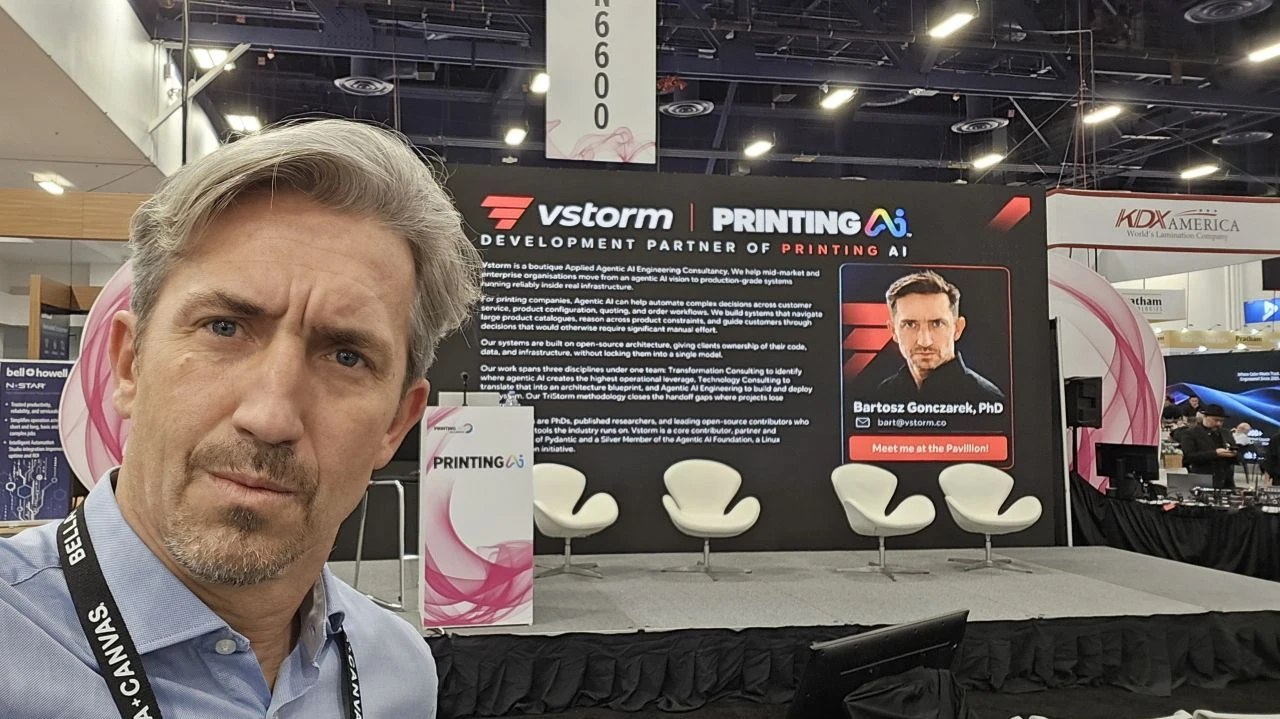
At PRINTING United Expo in Las Vegas, Vstorm appeared as the development partner of PRINTING AI at its stand in the North Hall. Bartosz Gonczarek, PhD, brought the engineer's view: what agentic AI already does for printing companies, based on production work such as the Mixam product advisor.
Read the Mixam case study ↗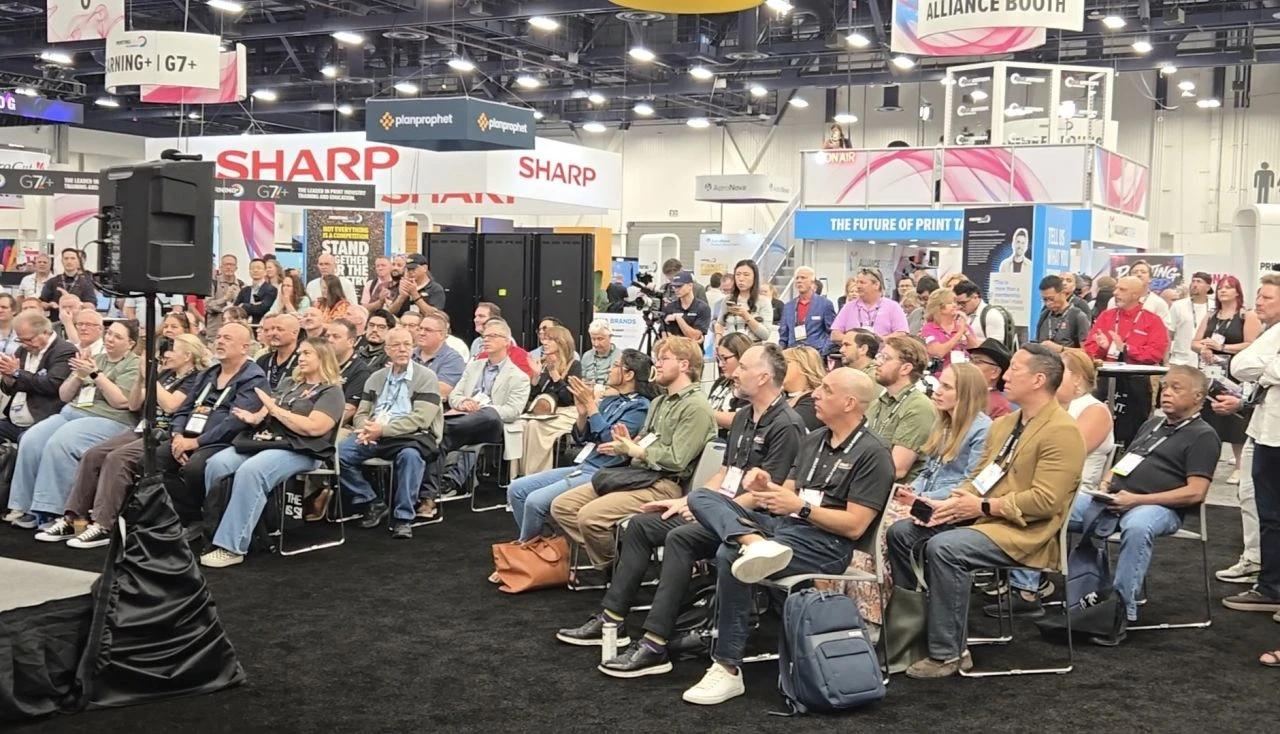
Three themes came up in the audience questions. Cut through the buzz and show what AI already does in print operations. Keep every conversation grounded in real client use cases. Help companies change how they approach adopting agentic AI.
Read Bartosz's notes on LinkedIn ↗TriStorm keeps the highest-friction step in your funnel or fulfillment chain the first thing we prove out, not the last.
We audit where customers stall in configuration and where jobs get misrouted, then map the product, supplier, and capacity data the agent will need to reason over.
We implement against real product and order data, with an evaluation suite scored before any recommendation or routing decision reaches a customer or the print floor.
Production rollout with monitoring and audit logging on every recommendation and dispatch decision, handed off with a runbook your operations team can run independently.
Talk directly to our founders and PhD AI engineers. We will show you real results from 30+ agentic projects and walk through how to apply them to your own product configuration and order workflows. Every example is something already running in production.
Your team owns what we build. We work on open-source foundations, and the agent logic, the integrations and the evaluation harness transfer to you at the end of the engagement.
A 30-minute call identifies where an agent can act on its own, where it must escalate, and a realistic path to a working system in production.