TriStorm methodology

How we work — agentic AI from plan to production with clear gates.

After 30+ production deployments, we codified what separates production systems from failed experiments into three phases with clear go/no-go gates — so we can guide you past known pitfalls to measurable ROI.

Why TriStorm

Methodology built from production

Most agent projects fail before production because scope, evaluation and ownership were never settled. TriStorm front-loads those decisions so build work starts only when the case is clear.

Pilots stall when scope, evaluation and ownership are settled last. Our engagements are built to become operating capability.

of generative-AI projects are abandoned after proof of concept

30%

Gartner projected that at least 30% of generative-AI projects would be abandoned after proof of concept by end of 2025 — on poor data quality, unclear business value and weak controls. TriStorm front-loads exactly those decisions.

Gartner (2024)

30+

Production deployments behind the framework

TriStorm distills patterns from production deployments across healthcare, print-on-demand, fintech and enterprise SaaS.

Case studies

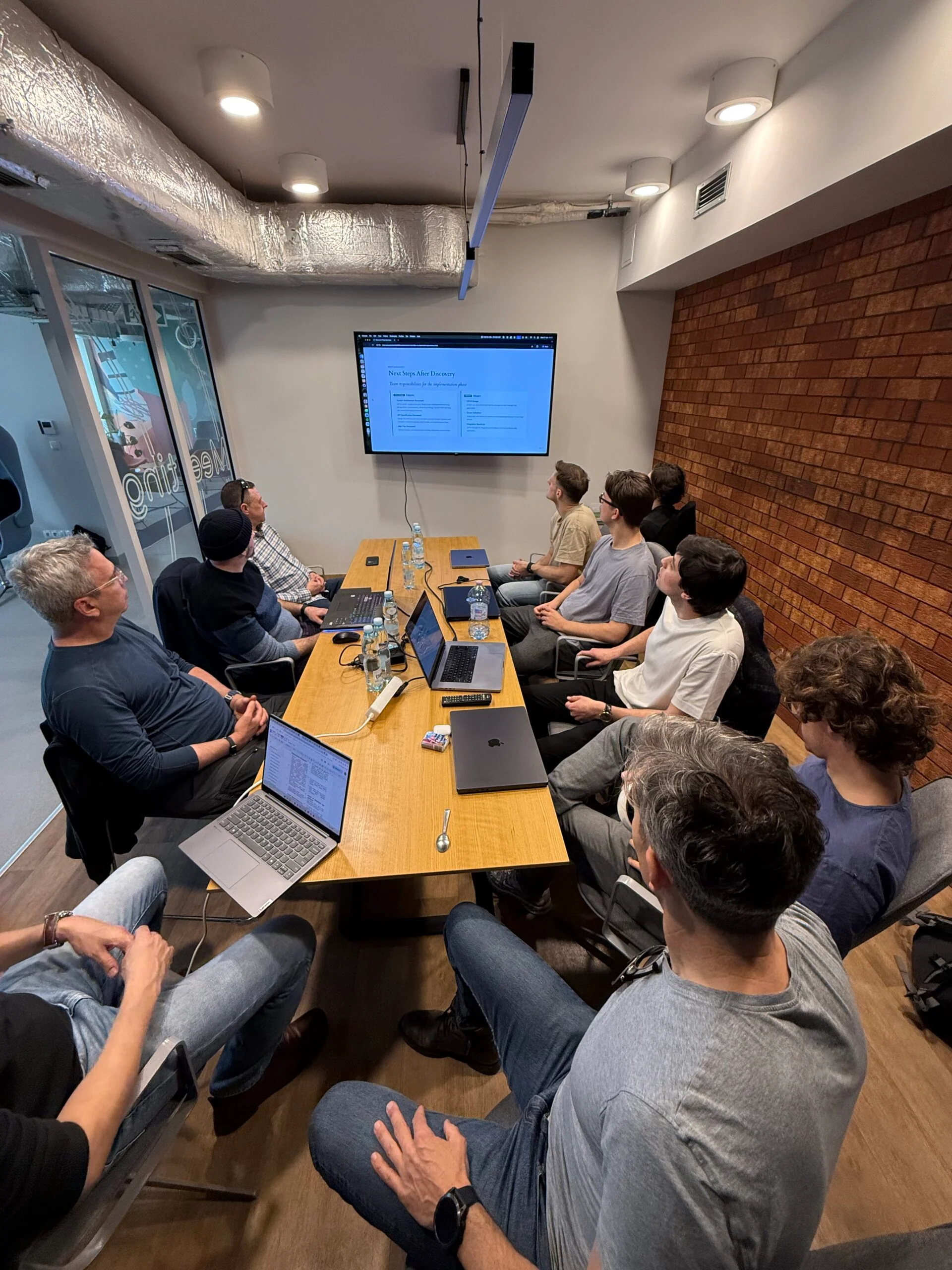
Vstorm team reviewing an agentic AI implementation plan in a workshop

“We are where agentic AI is transforming business workflows”

At Vstorm, we realize the transformational potential of agentic AI and the impact it can make on every industry and market around the world. Focusing on what really matters and leveraging years of our tech and business experience, we designed the TriStorm methodology, which guides our partners on their way from the raw idea and intention, through tech implementation, to transformative business paradigms.

The TriStorm methodology

The TriStorm process

The TriStorm method, an end-to-end agentic AI implementation framework, starts from business consultation followed with tech implementation through a data-fed feedback-development loop, and continuing with knowledge and ownership transfer, delivering bespoke agentic AI services to mid-market challengers.

Strategize

A consulting-led planning phase converts AI ambitions into a concrete, prioritized implementation plan. We work with stakeholders to agree on the business outcomes to pursue, assess the feasibility and risk of candidate use cases, and map current workflows against the target operating model — defining what the agent should do, what information it needs, and when it must escalate to a human. We also evaluate data and knowledge readiness, identifying sources of truth and the minimum structure required for reliable, compliant outputs.

  • Prioritized implementation plan
  • Workflow and operating-model map
  • Data and knowledge readiness assessment

Build

A rapid, agile delivery phase that turns the selected use case into a working Proof of Value and iterates toward a production-ready MVW — a Minimum Viable Workflow, not a product, because what goes live is a workflow your business already runs. Proving value before full-scale rollout. With success metrics defined in Consulting, we build in small, decisive increments, each sprint delivering a testable capability validated against real users and real data, surfacing data gaps and process assumptions before they become costly. As the Proof of Value stabilizes, Technology Engineering adds guardrails, evaluation tooling, human escalation paths, and the integrations required to complete the workflow end-to-end. Where the client has an internal AI or IT team, we work embedded alongside them, combining Vstorm's agentic engineering patterns with the client's domain knowledge to ensure the solution fits operational reality from day one.

  • Working prototype on real workloads
  • Evaluation suite and guardrails
  • Production-ready MVW path

Transform

The phase where agentic AI becomes a real operating capability. We embed alongside your team to drive adoption, standardize how the agent fits into day-to-day workflows, and ensure accountability and governance are in place from the start. Crucially, this phase does not close the loop, but opens it. The deployed agent generates operational data that Building's Proof of Value could not: real usage patterns, edge cases, and measurable performance gaps that feed directly back into the next cycle of value creation, giving the next use case a sharper scope and a more accurate business case. The phase concludes with a structured ownership transfer; documentation, runbooks, and technical enablement; so your team controls the code and infrastructure with no vendor lock-in, and no dependency on Vstorm to keep the system running or to scale it further.

  • Production rollout and adoption
  • Governance and accountability
  • Ownership transfer and runbooks
Approach

What makes TriStorm different

Strategy and engineering in one thread from first workshop through production handoff.

01

Strategy before build

Business outcomes, workflow fit and ROI assumptions documented before engineering budget is committed.

02

Proof of Value gate

Working prototype on your data with eval suites — go/no-go signal before full production scope.

03

Embedded delivery

Same team from planning through deployment — agile sprints inside TriStorm, not a handoff between consultancies.

04

Ownership transfer

Runbooks, monitoring and documented decisions so your team operates and extends the system without permanent dependency.

FAQ

TriStorm methodology, answered

What is TriStorm methodology? +
TriStorm is Vstorm's three-phase framework for agentic AI transformation: Strategize, Build, and Transform. It covers consulting, engineering, deployment and knowledge transfer — not just software delivery. It is based on patterns from 30+ production deployments.
What is the difference between TriStorm and methodologies like Scrum, Agile, and comparable? +
Scrum and Agile optimize software delivery within a defined scope. TriStorm starts earlier — aligning business outcomes and validating agentic fit — and continues through production operations and ownership transfer. Agile sprints still run inside TriStorm phases; TriStorm does not replace them.
Is TriStorm replacing Scrum or other methodologies in Vstorm? +
No. TriStorm is the outer transformation framework. Inside each phase we still use agile delivery practices where they fit. The difference is that strategy, evaluation and handoff are first-class phases — not afterthoughts.
Where can I get trained or certified in TriStorm methodology? +
There is no public certification program. TriStorm is applied through engagements — workshops and delivery embedded with your team, not classroom training sold separately. Contact us if you want a workshop on the TriStorm methodology for your leadership team.
When should we use TriStorm? +
When you want measurable business transformation with agentic AI — not an isolated technical project. Ideal when leadership needs clarity on ROI, risk and sequencing before committing engineering budget.
When is TriStorm not necessary? +
Purely technical tasks with a fixed, well-understood scope may not need the full methodology. We still recommend a short alignment session to avoid building the wrong thing efficiently.
How do Vstorm's agentic AI consulting services differ from what a generalist AI development agency offers? +
A generalist AI development agency typically scopes a project, delivers code and disengages. TriStorm starts earlier and ends later: Strategize converts AI ambition into a prioritized, risk-assessed implementation plan before a line of code is written, Building validates each sprint against real users and real data with the same team, and Transforming closes with a structured ownership transfer so your team controls the codebase without vendor dependency. The business transformation part is not an add-on — it is the frame the engagement runs inside.
What deliverables come from each phase? +
Strategize: readiness assessment, workflow map and prioritized implementation plan. Build: a working Proof of Value on real workloads, an evaluation suite and the path to a production-ready MVW. Transform: production deployment, monitoring and runbooks, with ownership transfer to your team.
Can we start with just one phase? +
Yes. Many engagements begin with Strategize or a Build sprint. Phases are designed to stand alone or chain into full delivery with the same team.
How does TriStorm avoid vendor lock-in? +
Open-source foundations where possible, documented architecture decisions, and ownership transfer throughout — runbooks, monitoring access and rationale for every tooling choice your team can maintain.

Start with structure

Move from agentic ambition to production with clear gates.

Book a 45-minute discovery call — we will map one workflow and identify which TriStorm phase is the right entry point.