
Shaping agentic AI
Agentic AI Foundation
Vstorm was the first agentic AI engineering company to join the Agentic AI Foundation and received its 2026 Open Agentic AI Innovation Award.
Read the announcementMCP servers that keep the rules on your side
MCP server development for your APIs and data: tools any MCP host can call, with permissions, approval for irreversible steps and logs enforced in the server, tested on the hosts your people use.

Three-agent product advisor guiding customers through print-order configuration.
Read case study
HIPAA-compliant guideline-executing triage — 42% to 98% on the open 50-scenario benchmark.
Read case study
Text-to-workflow agents building validated node graphs inside the platform.
Read case study
Supply chain intelligence agents reducing manual coordination overhead.

AI agent implementation for a global automotive enterprise.

Bilingual English/Arabic agent inside ARIJ's Moodle environment, answering only from ARIJ's own knowledge base.
Hosts differ in how they call tools, show results and ask before acting. A server tuned to one breaks in the others.
Where it stallsEach host calls the same tool its own way.
What we do Every release tested on the hosts you use.
Where it stallsThe model decides when a payment goes out.
What we do The server confirms every irreversible step.
Where it stallsThe whole catalog lands in the model's context.
What we do Search tools return only what the task needs.
The rules sit in the server, and every release is tested where your people work.
We pick the actions agents need from your systems and design tools around tasks, with typed inputs and short outputs.
Permissions, limits and confirmation of irreversible steps run in the server, so they hold whatever the host or model does.
Each release runs the same cases in every host your team uses, then ships versioned, monitored and documented.
Open standards, open-source tooling and published research, all public, so you can check our engineering before you hire us.
Shaping agentic AI
Vstorm was the first agentic AI engineering company to join the Agentic AI Foundation and received its 2026 Open Agentic AI Innovation Award.
Read the announcementOpen source
Framework contributors
We maintain our own open-source agent framework and contribute fixes to the frameworks our agents run on, through official partnerships with their teams. Breaking changes reach us before they reach your codebase.
Research
Peer-reviewed papers on agent architectures, evaluation and AI security, and an open benchmark anyone can rerun against our results.
Track record
Our client agents were in production before most of today's agent frameworks had a stable release. You get a team that already knows what breaks between a promising demo and a system people rely on every day.

The agent drafts each workflow and checks it in several steps before it runs, so engineers skip the manual setup.
Up to 1 hrto prepare a workflow by hand
~2 minto create one with the agent

Three agents and 15 tools walk customers through print-order configuration, across more than a billion product combinations.
~20% → ~40%conversion to a final sale
96%+web-to-print orders handled end to end
The model answers the assessment questions. The guideline decides the disposition, the same way every time.
42% → 98%accuracy, raw LLM vs guideline-executing
96%weighted F1 across 566 scenarios
Each path starts with a free call with a founder or senior AI engineer. A build goes ahead only after its Proof of Value meets the agreed threshold.
We map one workflow with your experts and agree a success threshold before any build.
Best whenYou want the success test agreed before you commit to a build.
Bring one system you want agents to use. We map the tools, the risky steps and the hosts to test.
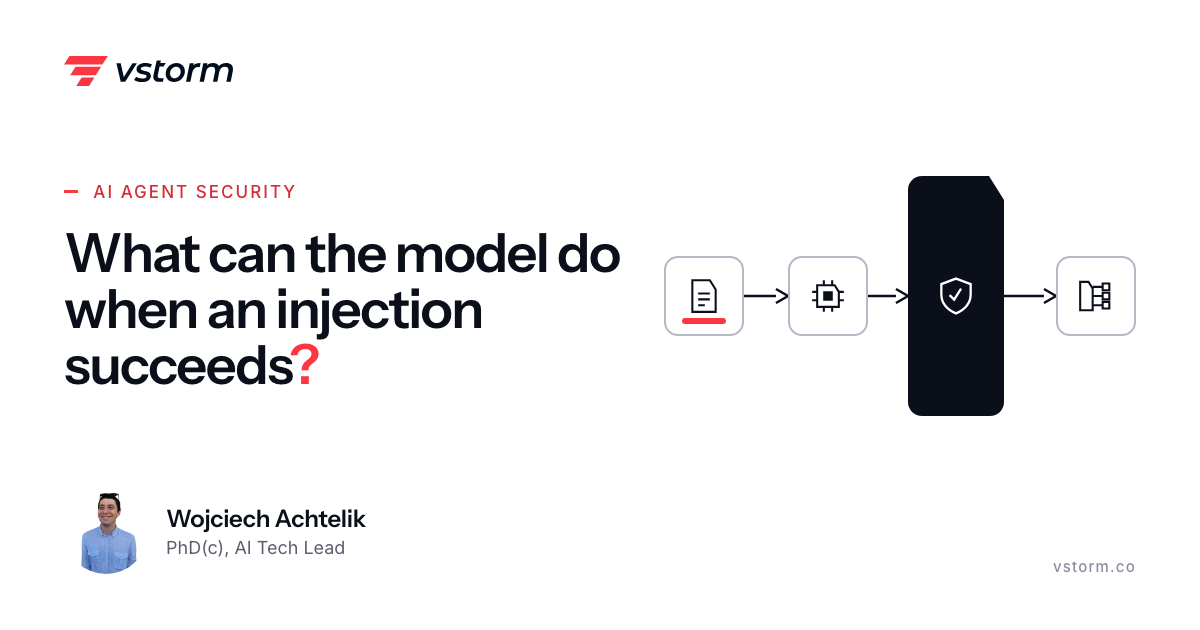
Prompt injection will get through. AI agent security depends on what the agent can do when it does: break the lethal trifecta and enforce limits in code.
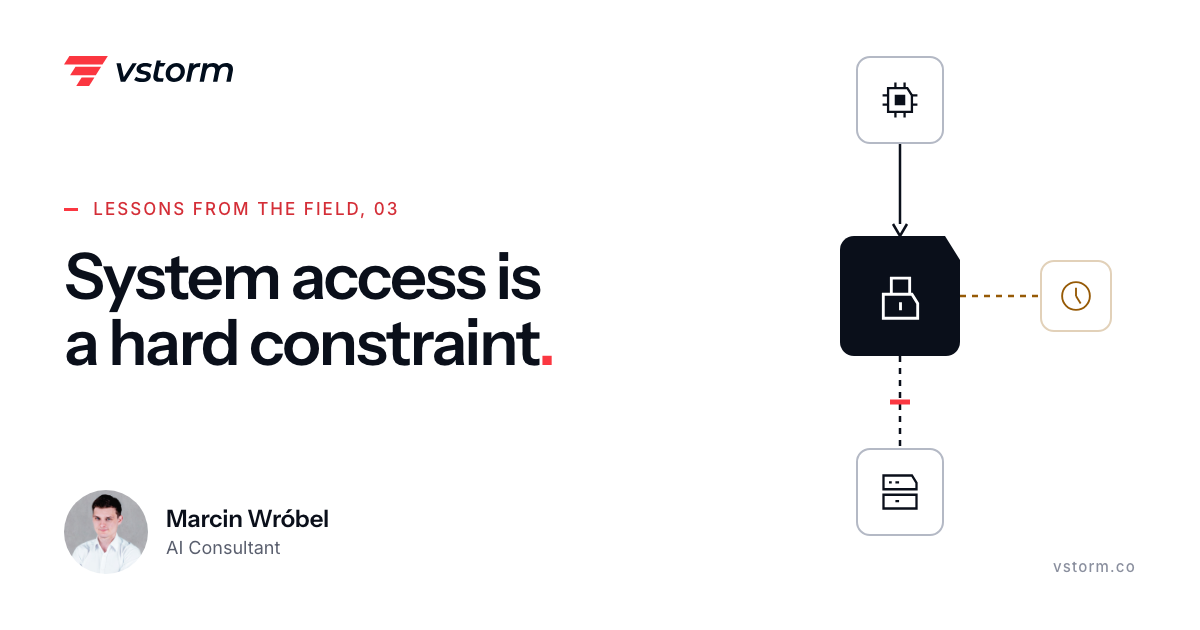
Why system access (VPNs, API keys, ERP exports) belongs on the critical path of an agentic AI project, with a named owner and deadline.
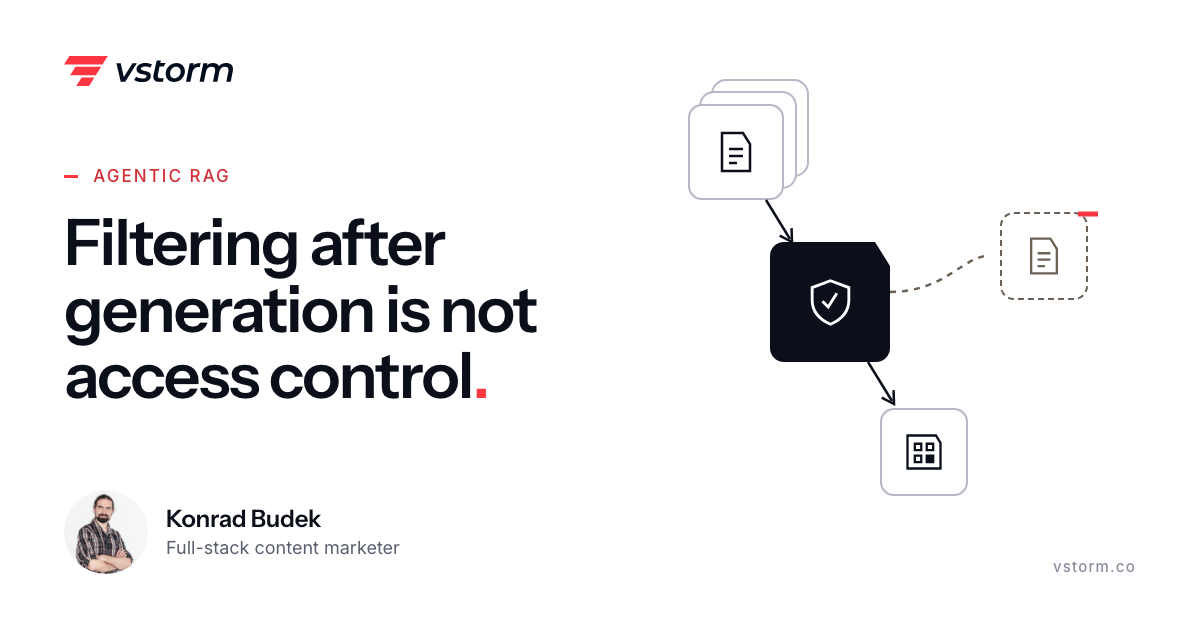
How agentic RAG changes architecture, knowledge and access control: corrective vs self-reflective designs, what they cost, and where permission checks belong.