Top 8 AI chatbot development companies in 2026
Eight AI chatbot development companies scored on published projects, grounding and testing, deployment, certification and team size, with each fact linked.

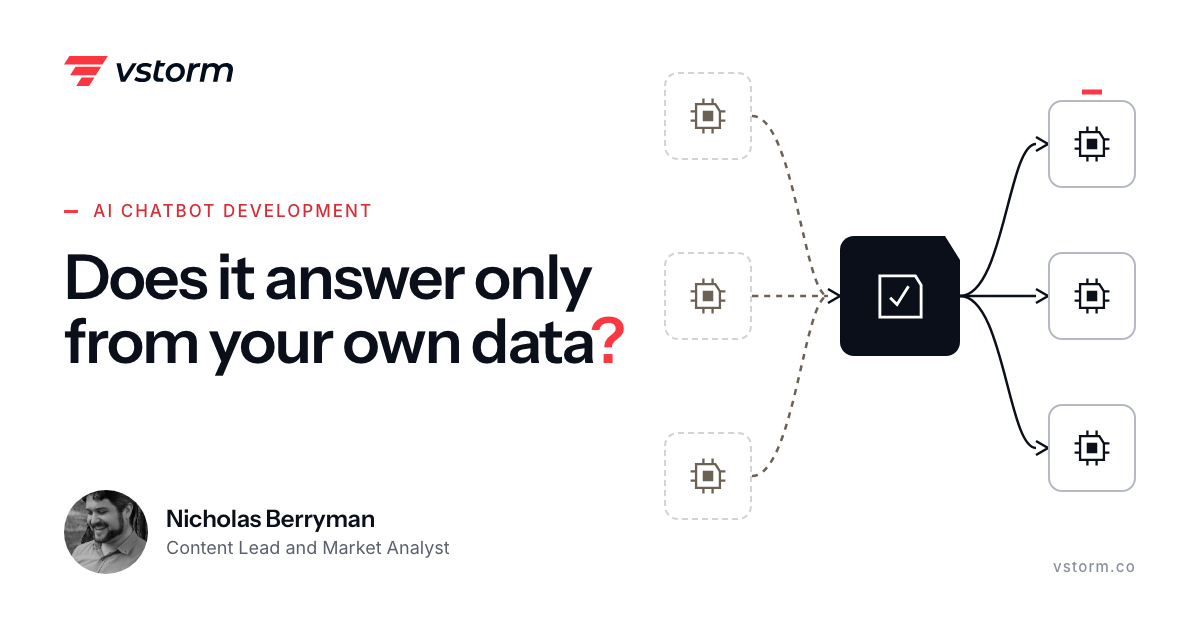
The eight AI chatbot development companies in this comparison use similar language models. They differ on two questions: does the chatbot answer only from the client's own data, and does it hand the conversation to a person when it should? Master of Code Global scores highest, with 76 of 100. Vstorm follows with 69, and BotsCrew is eighth with 45.
Vstorm publishes this list and is one of the firms scored. The safeguards are published scoring levels, the same rules for every firm and a link for every fact. For an FAQ bot on a single website, a platform subscription will cost less than any firm here, as the section on platforms explains.
Each firm's own pages and its Clutch profile were read on October 29, 2026. Figures a firm publishes about its own work are labeled as vendor-reported.
How companies answer customers today #
Most customer questions still reach a person, a script or a search box. Support teams work a ticket queue by hand. Older chatbots follow decision trees and fail as soon as a question leaves the script. FAQ pages and site search leave customers to find the answer themselves.
The manual version is common outside customer service as well. Before ARIJ Network introduced its training assistant, staff answered every question from journalists in 22 countries by hand (ARIJ Network case study). An inbound call center that Vstorm later automated had people verify and route each call, which slowed down at peak hours (call center case study).
Customers have found their own way around company bots. In a Gartner survey of 3,566 customers, people were about three times more likely to have used ChatGPT, Gemini or Copilot in their last service interaction than the company's own chatbot (Gartner, August 4, 2026).
Where chatbots fail once customers rely on them #
Three public cases show what a production chatbot has to get right.
In February 2024, a British Columbia tribunal ordered Air Canada to compensate a passenger after its website chatbot described a bereavement-fare refund that the airline's policy did not allow. Air Canada argued that the chatbot was a separate entity responsible for its own statements. The tribunal rejected the argument and held the airline responsible for everything on its website (American Bar Association).
Cursor, the AI coding tool, saw users announce cancellations on Reddit after its support bot said a subscription covered only one device. No such policy existed, and a company representative corrected the answer about three hours later (CX Today).
Klarna said in February 2024 that its AI assistant handled two-thirds of its customer service chats in the first month (Klarna announcement, via VKTR). By May 2025, its CEO told Bloomberg that the company was hiring human agents again so that customers could always reach a person (Entrepreneur, May 9, 2025).
Customers expect that option. In the same Gartner survey, 87% said a company using generative AI for service must give them a way to reach a human agent. The scoring below follows from these cases: answer only from approved sources, test before launch, and know when to hand over.
How the AI chatbot development companies on this list were scored #
Each firm is scored from 0 to 4 on five criteria, using only what it has published. The weights favor evidence, so a firm that shows a working chatbot with measured results gains more than one that describes good practice.
| Criterion | Weight | Level 4 | Level 3 | Level 2 | Level 1 |
|---|---|---|---|---|---|
| Published chatbot evidence | 30 | Two or more chatbot projects with measured results, one for a named client | One chatbot project with a measured result | A chatbot project with no measured result | Chatbot capability described, no project |
| Grounding and evaluation method | 20 | Level 3, plus a technical guide or an in-depth project write-up | Grounding design and evaluation method both described | One of the two described | Grounding mentioned without detail |
| Deployment and data control | 20 | Level 3, plus self-hosted models and a published project deployed that way | On-premise deployment stated | Private cloud, client cloud account or hybrid stated | Public cloud only |
| Security and compliance | 15 | Three or more audited security or privacy standards stated | Two audited standards stated | One audited standard stated | Compliance described, no certification |
| Delivery capacity | 15 | 10,000 or more people | 1,000 to 9,999 people | 250 to 999 people | 50 to 249 people |
Level 0 means that nothing was found, or that the firm has fewer than 50 people. Team size comes from each firm's Clutch profile, so every firm is measured against the same source. ISO 9001 and ISO 13485 are quality standards and do not count toward security.
Grounding means that the chatbot answers from the client's documents and systems, not from what the model learned in training. The method criterion also counts limits on what the bot may promise, the handoff to a person and the tests run before launch.
One requirement sits outside the score for buyers in the EU. Since August 2, 2026, Article 50 of the AI Act has required a chatbot to tell users that they are talking to an AI system unless that is obvious. The Digital Omnibus did not delay this rule, and fines reach €15 million or 3% of worldwide turnover (Goodwin).
Eight chatbot development services compared #
Master of Code Global leads because it has published two chatbot projects with measured results and describes how it tests them. Vstorm matches it on evidence and method and loses points on security certification and team size. Markovate shows strong results but almost no published method. Itransition has the largest team, and LeewayHertz states the most certifications. The table compares the eight chatbot development services on all five criteria.
| Rank | Company | Evidence | Method | Deployment | Security | Capacity | Score (of 100) |
|---|---|---|---|---|---|---|---|
| 1 | Master of Code Global | 4 | 4 | 3 | 2 | 1 | 76 |
| 2 | Vstorm | 4 | 4 | 3 | 1 | 0 | 69 |
| 3 | LeewayHertz | 2 | 4 | 2 | 4 | 1 | 64 |
| 4 | Itransition | 3 | 2 | 2 | 2 | 3 | 61 |
| 5 | Markovate | 4 | 1 | 3 | 2 | 1 | 61 |
| 6 | ScienceSoft | 2 | 2 | 3 | 3 | 2 | 59 |
| 7 | Azumo | 3 | 2 | 1 | 2 | 1 | 49 |
| 8 | BotsCrew | 3 | 2 | 1 | 1 | 1 | 45 |
Scores are the weighted sum of the five levels, rounded to whole points. Itransition and Markovate both score 61.25 and are listed alphabetically.
The eight companies, ranked by score #
Each profile covers what the firm has published and ends with what its public record lacks.
1. Master of Code Global, 76
Master of Code Global, founded in 2004, has offices in Redwood City, California, and Winnipeg, Canada, and lists 50 to 249 employees on Clutch. For a US wellness platform, it built a HIPAA-compliant health companion that answers from more than 2,000 clinical documents. The pilot had to pass set gates before the full build, and the firm reports 74% of queries resolved without escalation across 18,500+ patients in 90 days. For the named client BloomsyBox, 60% of users who engaged with a generative AI campaign bot completed its quiz. The firm deploys in the cloud, hybrid or on-premise and states ISO 27001.
The health companion's client is not named, and no published project runs on a client's own servers.
2. Vstorm, 69
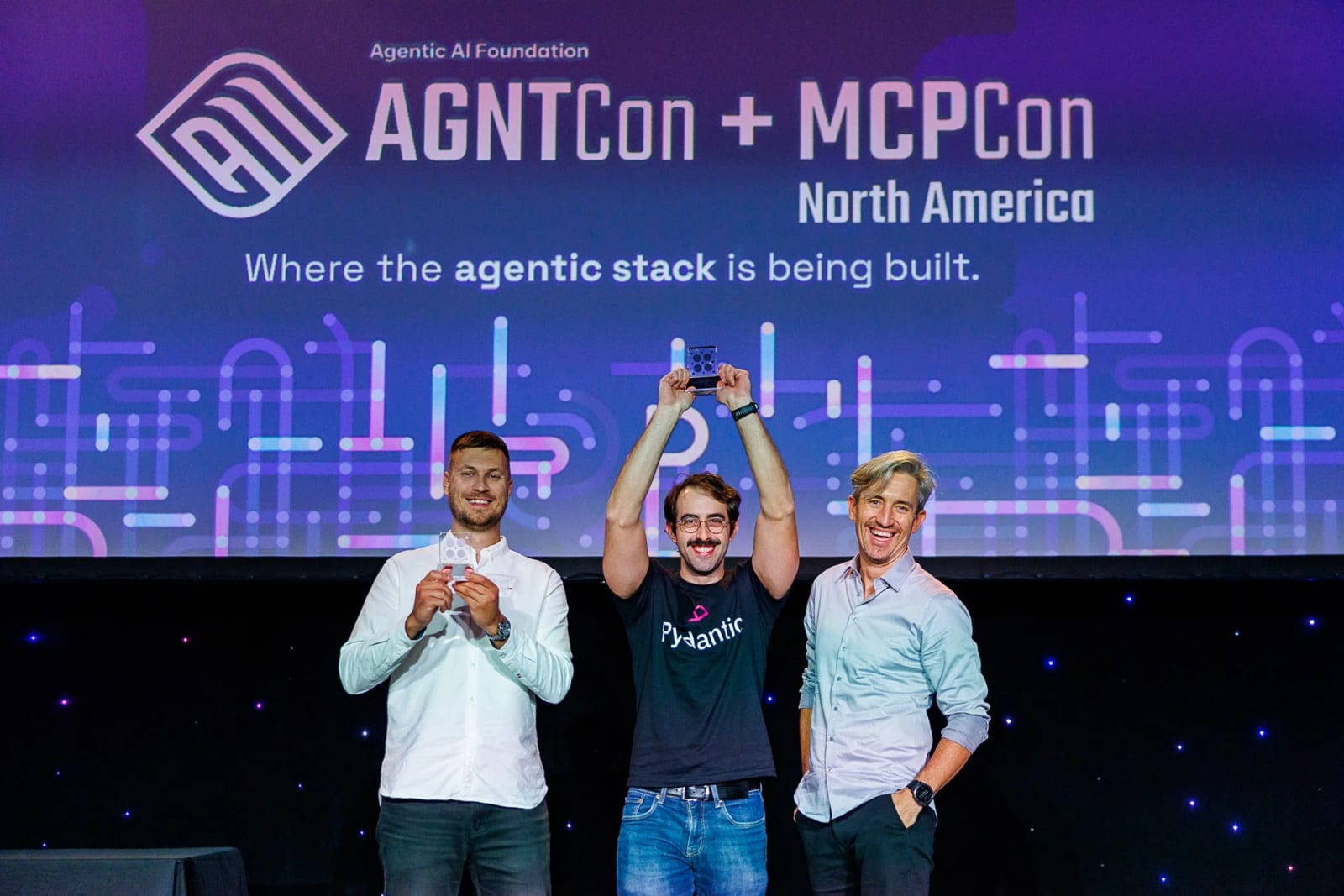
Vstorm is an agentic AI engineering firm in Wrocław, Poland, founded in 2017, that hands the finished system to the client's team. For the UK printer Mixam, its conversational ordering agent reached a 95.4% workflow success rate at launch, and conversion to a final sale rose from about 20% to about 40%. For ARIJ Network, it built a chatbot that answers journalists in English and Arabic only from ARIJ's training materials. For Synera, a plain-language prompt now builds an engineering workflow in about two minutes instead of about two hours. In October 2026, the Agentic AI Foundation named Vstorm one of three recipients of its Open Agentic AI Innovation Award.
Vstorm states no security certification, lists 10 to 49 employees on Clutch and publishes no performance figures for ARIJ.
3. LeewayHertz, 64
LeewayHertz, based in Gurugram, India, according to Clutch, has been part of The Hackett Group since September 2024 (Business Wire). For Rackspace, it built an internal support assistant in Microsoft Teams that answers from a ServiceNow knowledge base, checks answers with NeMo Guardrails and opens a ticket when a request is beyond it. Its guide to advanced RAG covers hybrid search, reranking and query rewriting. It states ISO 27001, ISO 42001 and SOC 2 Type II, the most certifications on this list, and its ZBrain platform runs in private cloud or hybrid setups.
The Rackspace case publishes no result figures, and on-premise deployment is not stated.
4. Itransition, 61
Itransition, founded in 1998 and based in Decatur, Georgia, lists 1,000 to 9,999 employees on Clutch, the largest team here. Its chatbot page reports three projects with results: a shopping assistant for a US online store that fully handled 30% of conversations, a medical copilot that cut physicians' administrative time by 60%, and an onboarding assistant that halved onboarding time at a US insurer. Answers are grounded with retrieval-augmented generation (RAG), which searches the client's documents before the model writes, and the onboarding assistant links each answer to its source. The firm states ISO 27001.
None of the three clients is named, and the page describes no evaluation method and no on-premise option.
5. Markovate, 61
Markovate, founded in 2015 and based in San Francisco, lists 50 to 249 employees on Clutch. Its chatbot page names two clients with results: LegalAlly, whose legal assistant cut research time by 64%, and NVMS, whose customer chatbot reduced workload by 49%. Its Trust Center states ISO 27001 and offers on-premise and air-gapped deployment for export-controlled data.
The chatbot page does not describe how answers are grounded, tested or handed to a person, and the results are vendor-reported.
6. ScienceSoft, 59
ScienceSoft, founded in 1989 and based in McKinney, Texas, lists 250 to 999 employees on Clutch and states 750+ specialists. It holds ISO 27001 and ISO 27701, and its chatbot page offers deployment on Azure, AWS, Google Cloud or on-premises. Its case studies include a HIPAA-compliant voice agent for appointment scheduling and a document assistant that grounds its answers with hybrid RAG. It is also the only firm here that publishes price ranges for chatbot work.
The conversational case studies report no measured results, and their clients are not named.
7. Azumo, 49
Azumo, founded in 2016 in San Francisco with engineers in Latin America, lists 50 to 249 employees on Clutch. It built a supplier registration chatbot for Facebook in eight weeks. Its most detailed case is its own AI receptionist, which answers Azumo's phone line, routes calls through Slack and reports a median response time of 1.7 seconds over 512 measured turns. It states SOC 2 compliance.
The Facebook case reports no results, the receptionist serves Azumo itself, and deployment in a client's own environment is not stated.
8. BotsCrew, 45
BotsCrew, building chatbots since 2016, lists 50 to 249 employees on Clutch, with offices in San Francisco and Lviv, Ukraine. For the online store GsmServer, its bot automated 72% of customer requests within six months of its March 2021 launch, and agents could join any conversation through live chat. For S&B Filters, it built an order-status assistant on NetSuite data. The firm describes a model-agnostic setup with Claude, GPT, Llama or open-weight models.
The S&B Filters figures are labeled as projections, the site lists SOC 2 as "aligned" and ISO 27001 without a status, and deployment options are not stated.
What changes when the chatbot can take actions #
A chatbot that only answers can mislead a customer. An agent that reads the order record and issues the refund can also act on its mistake. Gartner predicts that by 2029 agentic AI will resolve 80% of common customer service issues without a person, with operating costs 30% lower (Gartner, March 5, 2025).
Several systems on this list already act. Vstorm's agent for a US Medicare Advantage payer contacts patients by SMS and voice before appointments and writes new information back to the patient record, saving each doctor more than five hours a week (case study). The BotsCrew assistant for S&B Filters reads order data from NetSuite, and the Rackspace assistant from LeewayHertz opens tickets.
Once a bot can write to a system, the buyer has to decide which systems it may change, up to what amount, and who approves the rest. Those limits work best outside the model, as a check that reads each proposed action before it reaches the production system. Vstorm's customer service page describes this difference between a support chatbot and an agentic support system.
When a platform beats custom chatbot development services #
Every firm on this list builds to order, and that costs more than a subscription. A chatbot platform fits when the bot serves one website, answers from a stable FAQ and writes to no other system. Setup takes days, and the vendor runs the hosting, the updates and the model.
Custom chatbot development services earn their cost when the bot must read several systems, act in them, run where the client decides, or answer in a regulated field where every answer needs a source. They also matter when the company wants to own the code and the decision logic, so that a vendor's change of price or model does not force a rebuild.
Neither route moves responsibility for the answers. Air Canada used its own website chatbot and still paid for what it said.
What chatbot development costs and what to ask before you sign #
Few firms publish prices. ScienceSoft gives indicative ranges, which it says are not official pricing and exclude licenses, hosting and model usage: $20,000 to $70,000 for an FAQ bot with little integration, $80,000 to $250,000 or more with CRM, ticketing or scheduling integrations, and $250,000 to $700,000 or more for multi-agent platforms (ScienceSoft). Itransition starts proofs of concept at $5,000 and puts a pilot at $10,000 to $20,000 (Itransition). Clutch shows the minimum project each firm accepts.
| Company | Minimum project | Hourly rate | Employees | Clutch rating |
|---|---|---|---|---|
| Master of Code Global | $25,000+ | $50 to $99 | 50 to 249 | 4.7 (37 reviews) |
| Vstorm | $10,000+ | $100 to $149 | 10 to 49 | 4.9 (22 reviews) |
| LeewayHertz | $10,000+ | $50 to $99 | 50 to 249 | 4.7 (9 reviews) |
| Itransition | $25,000+ | $25 to $49 | 1,000 to 9,999 | 4.9 (42 reviews) |
| Markovate | $50,000+ | $50 to $99 | 50 to 249 | 5.0 (12 reviews) |
| ScienceSoft | $5,000+ | $50 to $99 | 250 to 999 | 4.8 (46 reviews) |
| Azumo | $10,000+ | $25 to $49 | 50 to 249 | 4.9 (27 reviews) |
| BotsCrew | $10,000+ | $50 to $99 | 50 to 249 | 4.8 (40 reviews) |
Five questions follow from the scoring criteria:
- Which two chatbot projects can you show with measured results, and can we speak to one of the clients?
- Which sources will the bot answer from, and what does it do when they do not cover a question?
- Which test set will you run before launch, and what score must it pass?
- Where will the system and its data run, and can we change the model later?
- Who owns the code, the prompts and the conversation logs after handover?
This ranking reflects what each firm had published on October 29, 2026. Vstorm publishes it and places second. A stated security certification would raise its score to 73 without changing its place. Firms that publish new projects or certifications can be rescored on the same rules.