AI change management: how roles shift after go-live
AI change management after go-live: how roles move from doing the work to supervising it, with examples from a furniture retailer and a marketplace.

When an accounting team first sees an automation run on its own invoices, the first question is rarely about accuracy. It is whether the system just took the bulk of their work. How a company answers that question decides whether the system gets used.
AI change management is the work of answering it: making the case for the change, giving the affected team an owner and a say, and designing the jobs people will do once the system runs. This is the third article in our series on where AI adoption gets stuck. The first two covered choosing a workflow from the records it leaves and building on imperfect data; this one covers what happens after the build, when integrating AI into daily work becomes the task.
A system that works can still go unused #
Most companies roll out a new artificial intelligence (AI) system the way they roll out any other software: a training session, a go-live email, and a support channel for questions. For a tool that changes how a team spends its day, that is rarely enough.
We have seen the cost of it. At an automotive dealership and service group, a contract-matching system we built has run on the production servers since September 2026, yet the accounting workflow does not call it, because no one in that team owned it. The second article in this series tells that story.
The worry behind such stalls is widespread. In a Pew Research Center survey of US workers, 52% said they were worried about the future impact of AI at work, and 32% expected it to mean fewer job opportunities for them (Pew Research Center, February 2025). Leaders tend to misread where their people stand, even as many employees already use AI tools at work. McKinsey found employees three times more likely than their leaders realize to expect AI to take over 30% of their work within a year, while a large minority, 41%, were apprehensive and would need more support (McKinsey, Superagency in the workplace).
The result is what Antoni Kozelski called the adoption cost: a system that works and is not used, which ends up in the books as a sunk cost (The real cost of skipping transformation consulting).
AI change management uses the playbook of any other change #
Nothing about AI integration requires a new theory of change. The models that have guided ERP rollouts and reorganizations for decades still apply to generative AI and to agents. John Kotter's eight-step model, for example, starts with a sense of urgency, then builds a guiding coalition and plans for short-term wins (Kotter's 8 steps, Splunk summary).
What changes is how each step should be framed for a team that fears for its jobs.
Urgency framed as growth
"Adopt AI or fall behind" tells a team it is the problem. A better case is the one we made to the dealership group: the business wants to handle more invoices, orders or requests without growing the back office at the same rate, and the system is how the current team does that.
A coalition that includes the affected team
The guiding coalition cannot be IT and the vendor alone. It needs the person who owns the outcome in the department where the system will run, and ideally someone from the team who will use it daily. Involving employees this way is the most direct lever for employee AI adoption we have seen. It also lifts employee engagement, because the team helps shape the system instead of receiving it.
Wins the team can see
The first win should be one the people doing the work can see for themselves, because that is where trust starts. In a drafting pilot, that is the first week in which staff choose to send the drafts the system prepared. Voluntary AI usage of this kind tells you more than any training attendance figure.
Our recommendation to the dealership group followed these lines, because in our experience successful AI adoption depends on them more than on the model. That work is still in progress, so we report the approach here, and the outcome when there is one.
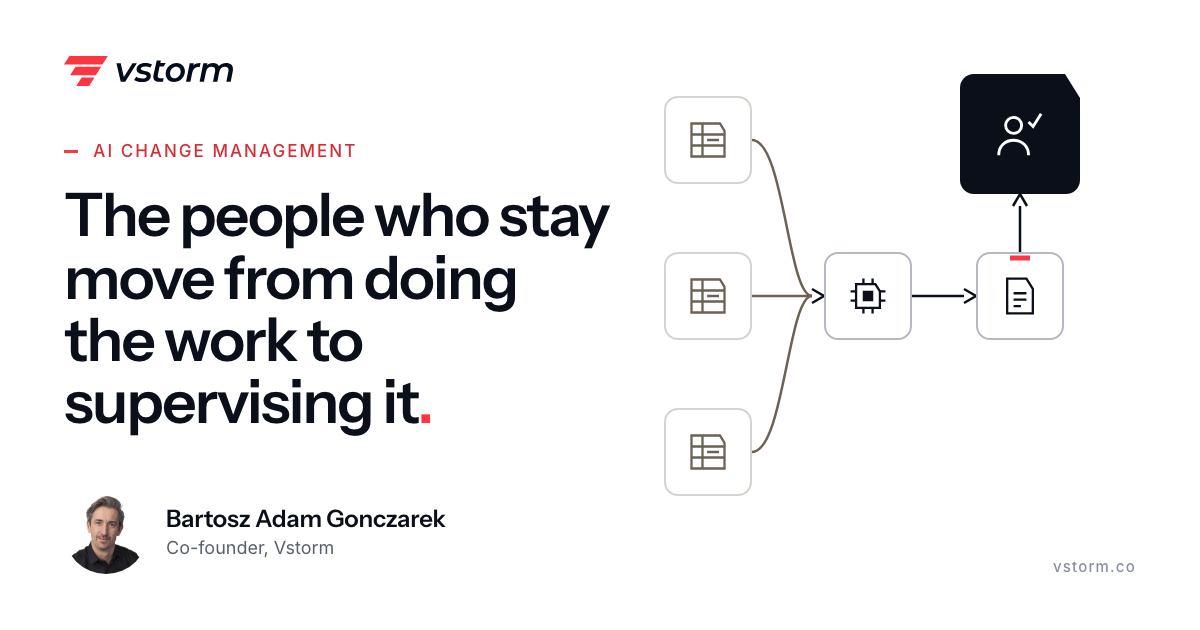
The people who stay move from doing the work to supervising it #
The fear behind most resistance is that the system replaces the person. In the projects we have delivered, the system has replaced part of a role, and the role has changed around what is left.
"There has never been a case where AI took over 100% of what was being done. Say you automate 80% of the routine tasks. You still need a person on top of the 20% of edge cases, and someone to oversee the 80%. It is a different duty, but it is still a job." Bart Gonczarek, Co-founder and Chief Transformation Officer, Vstorm
A US furniture retailer shows what that looks like in practice. Before the project, six auditors checked about 700 of roughly 2,700 delivery orders a day, about 27%, largely from memory of the rules. Now a system scores every order against 34 rules, 12 of which are judged by a language model, and sends auditors only the orders it flags. In one batch on July 30, 2026, it checked 2,060 orders in under three minutes and flagged 313 of them, 15%. On a sample of 32 orders, its verdict matched the auditor's in 31.
The auditors did not disappear. Their job moved from checking a quarter of the orders to reviewing every order that looks wrong, which is closer to what the business needed from them in the first place.
This is human oversight of AI agents in its plainest form: a person reviews what the system produces, applies human judgment to the cases it cannot decide, and is accountable for the result. For high-risk AI systems, the EU AI Act makes this kind of oversight a legal requirement (Article 14). The people best placed to do it are the ones who did the work before, because they know the edge cases. They also become the people who drive continuous improvement of the system: they see patterns across flagged cases and can tell the engineers which rule or data source is wrong.
"The people who do best shift gears. They monitor the system and improve it, because they are the experts in the edge cases." Bart Gonczarek
We made a related argument about where people outperform models, at the edges of the distribution, in 4 Lessons from failed AI adoption ideas.
Automation removed contractor work, and the internal team kept its shape #
In some mid-market companies we work with, the work an automation takes over is not done by the internal team at all.
A US home-services marketplace sends each of its clients a package of invoices. External contractors prepared those packages by hand. Since October 2025, an automation has done it: it pulls the data from the company's system, takes the invoice numbers from QuickBooks, builds the PDFs and emails each client. There is no AI in it. The internal team's structure did not change; the contractor work ended.
Two points follow. When a company maps what automation would replace, it should count the contractors and outsourced work alongside its own staff, because that is often where the volume sits. And not every step needs an agent: this one needed a reliable script, and an agent would have added cost and risk for nothing.
Experts want their knowledge to scale #
The fear of replacement assumes that, when a company starts applying AI, the people involved want to keep doing the work by hand. The most experienced often do not.
The owner of a printing house we spoke to in October 2026 described her bottleneck plainly. The production floor has spare capacity. What limits growth is structuring incoming orders into jobs the floor can run, a judgment she has built over more than 20 years. Hiring helps less than it seems: new staff take quarters to learn, and few reach her level. She would rather put her rules into a system and supervise its output than train three new people.
This fits what we wrote in Lesson 4: AI agents cannot replace domain knowledge. The system carries the expert's rules, and the expert remains the authority who decides when they apply. A related, separate example: for the print-on-demand platform Mixam, we built an agent that turns customer intent into valid print-order specifications, reaching a 95.4% success rate in workflow results (Mixam case study).
New work follows automation, but not on its own #
The history of earlier automation, long before today's wave of AI, supports the people who expect their work to change, with an important caveat. Research led by MIT economist David Autor found that about 60% of US jobs in 2018 were new types of work created since 1940, and that the negative effect of automation on employment was more than twice as large from 1980 to 2018 as from 1940 to 1980 (MIT News, April 2024). For the next few years, the World Economic Forum expects 170 million jobs to be created and 92 million displaced by 2030 (World Economic Forum, Future of Jobs Report 2025).
Both things are true at once. New work appears, and some people lose work in the process. Inside a single company, which of the two a team experiences depends largely on whether someone plans the transition: who will review, who will handle exceptions, what training they need, and when.
How we plan adoption into the build #
At Vstorm, adoption is the Transform stage of TriStorm, our delivery method: hand-over, team upskilling and capability building, so the client's team can run and extend the system without us. The aim is for AI to become part of how the team works, owned by the team. In practice, three decisions come earlier than most teams expect. We ask for the business owner's name before the build starts. We design the review screen, where staff approve, edit or reject what the system produces, as part of the system from the first sprint. And we train the future reviewers on the edge cases, because those are the cases they will handle in real time.
If you are planning an AI-powered system now, name the person whose job will change and design their new job before go-live.
The rest of this series #
This article closes our series on where AI adoption gets stuck. The full set of steps, from choosing a workflow to planning the roles after go-live, is in our guide Process mapping for agentic AI: a step-by-step guide. The two earlier articles cover choosing a workflow from the records it leaves and building on imperfect data. For new articles from the Vstorm blog, subscribe to the Vstorm AI newsletter.
Sources (6)
- Pew Research Center, U.S. workers are more worried than hopeful about future AI use in the workplace (52% worried, 32% expect fewer job opportunities), February 25, 2025
- McKinsey, Superagency in the workplace (employees three times more likely than leaders think to expect AI to take over 30% of their work; 41% apprehensive), 2025
- Splunk, Kotter's 8 steps for change (summary of the model)
- EU AI Act, Article 14: Human oversight
- MIT News, Does technology help or hurt employment? (David Autor et al.: about 60% of 2018 jobs are new work since 1940; automation's negative effect more than twice as large in 1980–2018 as in 1940–1980), April 1, 2024
- World Economic Forum, Future of Jobs Report 2025 (170 million jobs created, 92 million displaced by 2030), January 2025