Lesson 4: AI agents cannot replace domain knowledge
The hardest problem in an enterprise AI project is often epistemological: the knowledge the system needs was never written down. Structuring tacit domain knowledge must be a prerequisite workstream, not something the AI figures out.

The hardest problem in an enterprise AI project is not technical but epistemological: the knowledge the system needs does not exist in a structured form. It lives in experts' heads, and no model size or expert prompting can synthesise a business rule that was never written down. In one deployment, a missing parts-compatibility matrix produced agent hallucinations that persist in production today. This final lesson in our four-part series argues that structuring tacit knowledge must be a prerequisite workstream, not something the AI figures out, given that data preparation can take up to 80% of a data scientist's time.
This article is part four of a four-part series in which we share the most valuable elements to successful agentic AI transformation. Domain Knowledge: why AI agents cannot replace what was never structured.
This is the fourth and final lesson in our series on what actually determines the success of an agentic AI implementation. The first three dealt with resources you can, in principle, plan for: expert time, data context, and system access. This lesson deals with something harder, because it cannot always be planned around, and it is one of the least discussed reasons why agentic AI projects fail once they reach production.
In complex enterprise environments, the most profound roadblock is often not technical but epistemological. The knowledge an artificial intelligence system needs to do its job simply does not exist in a structured form.
It lives in the minds of experienced people, or in spreadsheets built for human eyes rather than machine logic, and sometimes it has never been written down anywhere. However capable large language models become, they cannot read a rule that was never recorded.
There is a comfortable assumption that sufficiently advanced AI agents will bridge that gap on their own. They will not. This lesson explains why, and what to do instead.
In a recent automotive-service deployment, this proved to be the most fundamental and persistent issue. There was no structured compatibility mapping that reliably connected specific vehicle models, service operations, and required parts.
Furthermore, the client organization itself was unable to provide this matrix. This was not a failure of AI agent integration with existing systems; the existing system relied on a disparate Excel spreadsheet containing generic filters, completely lacking direct assignments to specific vehicle variants. When queried for a resolution, the client's guidance was speculative, suggesting that perhaps logic could be loosely derived at the broader "construction group" level.
The limits of the agentic approach #
There is a pervasive assumption in agentic AI implementation that a sufficiently advanced agent can deduce missing business rules. Domain knowledge that exists only in the minds of experts, or is entirely unmapped, cannot be synthesised by code or sophisticated prompting.
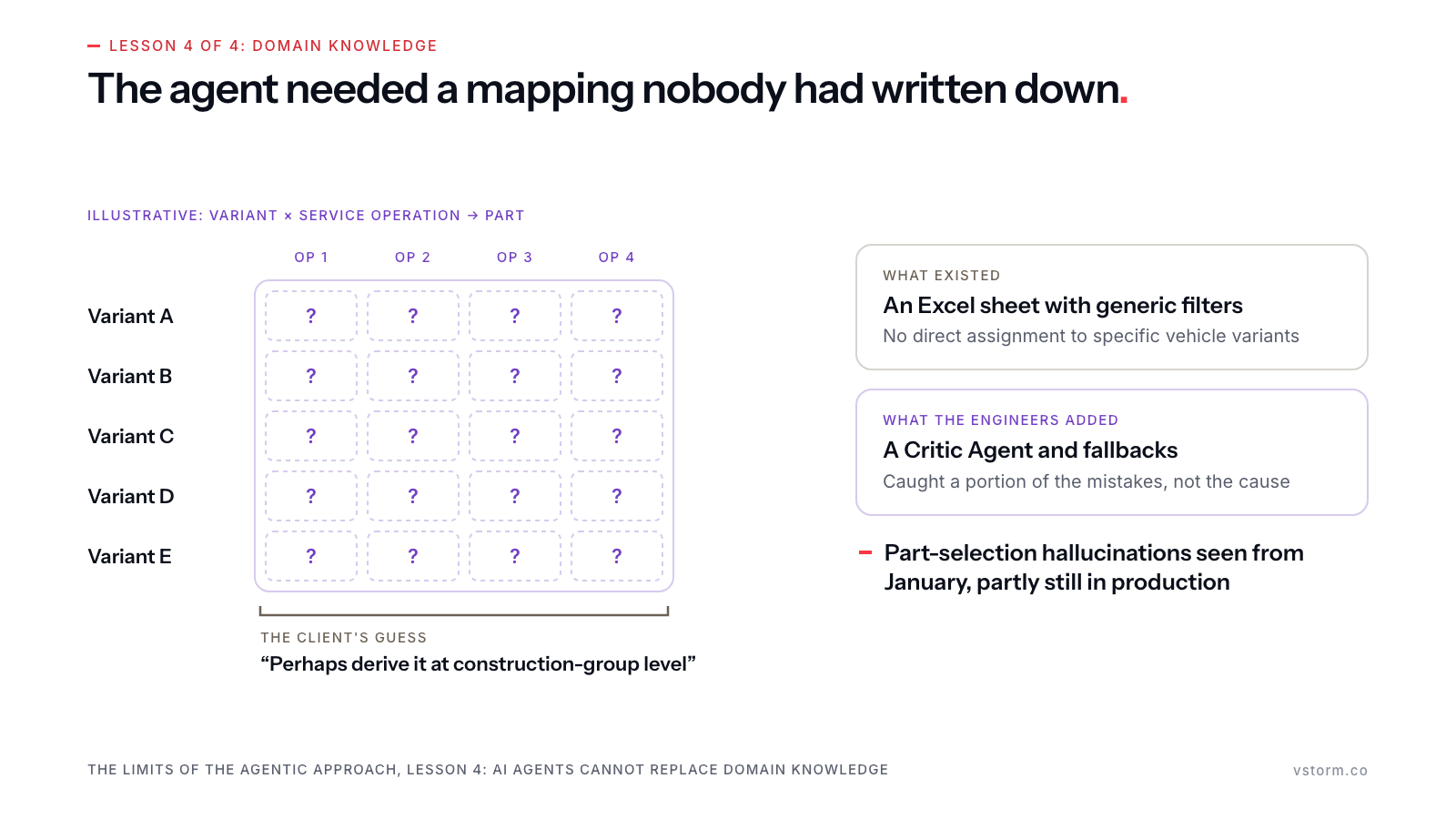
To mitigate the missing data structures, the engineering team introduced a "Critic Agent" alongside standard fallback mechanisms designed to intercept and correct erroneous recommendations.
While this architecture successfully caught a portion of the mistakes, it remained an engineering workaround rather than a root-cause solution for the agentic AI systems in production. Because the foundational ground truth was absent, agent hallucinations regarding part selection were observed as early as January and partially persist in production today.
What to do differently: structuring as a prerequisite #
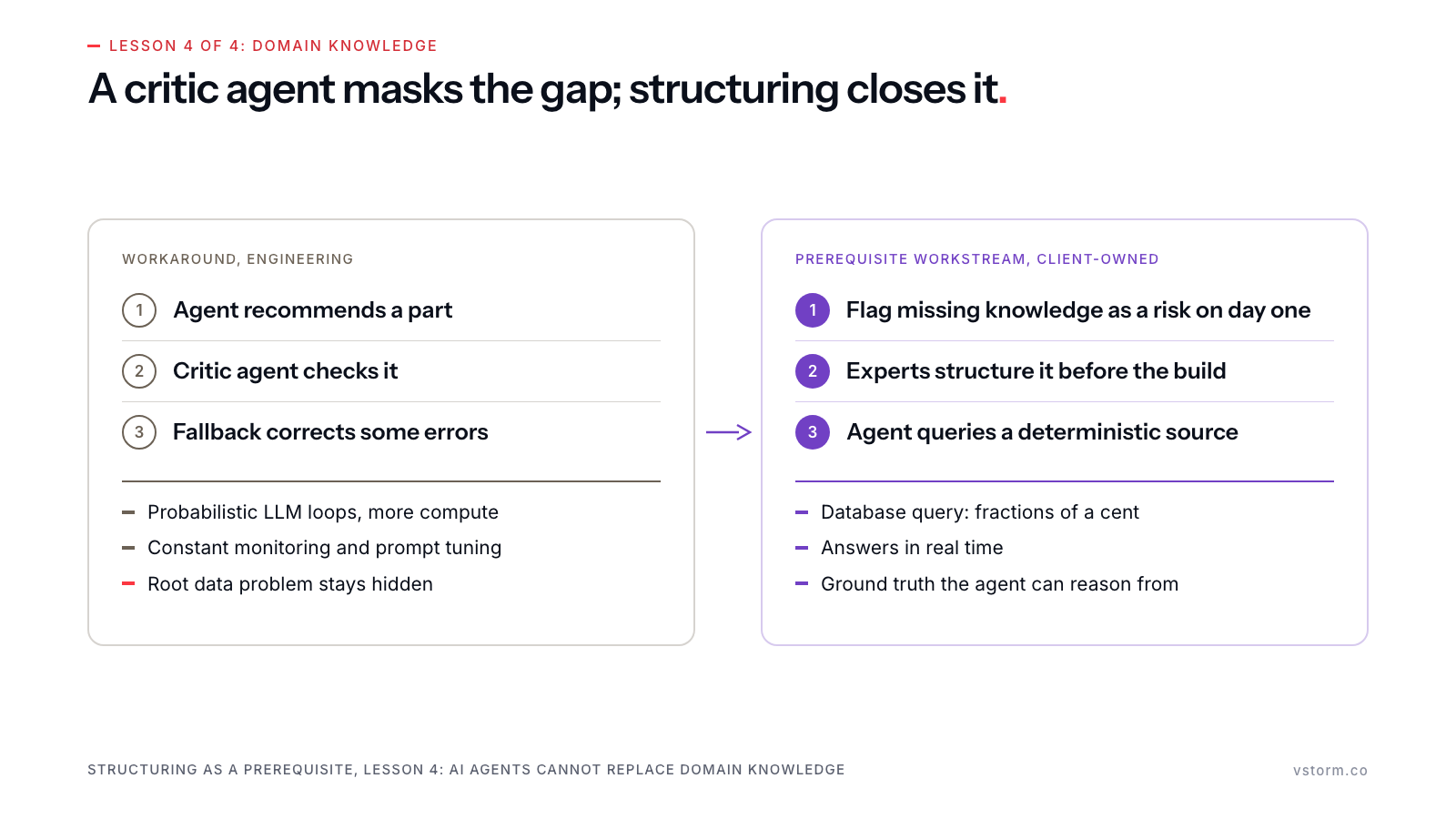
When crucial domain knowledge exists exclusively in human heads or highly unstructured formats, it must be explicitly identified as a critical project risk on day one. It cannot be categorized as an ambiguity that "the AI will eventually figure out."
The strategic response is not deploying larger AI models or engineering more complex prompts. It is not a matter of raw AI capabilities either. The answer is a separate, prerequisite workstream on the client's side, supported by subject matter experts, dedicated solely to standardising and structuring that tacit knowledge before the AI is expected to automate it.
For analysts and business: what the numbers say #
The financial implications of relying on unmapped domain knowledge extend far beyond initial deployment delays. The true cost shows up in operational inefficiencies and compounding technical debt:
- The Cost of Inaccuracy (False Positives/Negatives): In automotive service operations, an AI agent hallucinating a compatible part is not merely a theoretical error; it generates measurable downstream costs. Recommending incorrect components results in return logistics, stalled service bays, and increased mechanic downtime. The cumulative cost of these operational errors quickly eclipses the upfront investment that would have been required to manually structure the compatibility matrix.
- The Technical Debt of Workarounds: Deploying secondary fallback mechanisms like a "Critic Agent" introduces a permanent complexity tax. It requires teams to continuously monitor the system, tune prompts, and commit additional compute resources to run secondary validations. Instead of relying on a deterministic database query (which costs fractions of a cent and executes in real time), the system depends on probabilistic LLM loops, inflating operational expenditures (OpEx) while only masking the root data problem.
- The Data Readiness Ratio: A foundational and widely cited industry rule of thumb states that data preparation (collecting, cleaning, and organizing data) accounts for around 80% of a data scientist's time. When core domain knowledge is completely unstructured, and the data sources the system needs simply do not exist, the initiative ceases to be a machine learning project. It devolves into a highly expensive data-entry endeavor, executed by engineering teams billing at premium enterprise rates.
In summary #
The temptation, when knowledge is missing, is to reach for a bigger model or a cleverer prompt. Neither works, because the problem is not that the agent reasons poorly. The problem is that there is no ground truth for it to reason from. The most capable generative AI and large language models cannot infer a rule that was never recorded; they can only guess, and a guess in production is a hallucination with a cost attached.
The response is unglamorous but decisive: identify missing domain knowledge as a critical project risk on day one, and stand up a separate workstream, owned by the client, dedicated to structuring that knowledge before the AI is asked to automate it. This is not AI work, and no stack of AI tools can substitute for it. It is the data-entry and standardisation work that AI work depends on, and skipping it does not remove the cost. It defers it, at a premium, into engineering time and production errors.
That closes this series. Across four lessons, one theme runs throughout: the hardest parts of an agentic transformation are rarely the model. They are the expert time you must secure, the context your data does not hold, the access your security process controls, and the knowledge that was never structured in the first place.
Together these are the real reasons why agentic AI projects fail. Get them right, and the technology tends to take care of itself. Get them wrong, and no model will save the project.