
Shaping agentic AI
Agentic AI Foundation
Vstorm was the first agentic AI engineering company to join the Agentic AI Foundation and received its 2026 Open Agentic AI Innovation Award.
Read the announcementAgents that prepare the numbers your team signs off
Agents match invoices, reconcile accounts and draft close commentary, and a person on your team approves every payment before it goes out.
AP specialistYour team
A batch of supplier invoices came in overnight. Can the invoice agent match them before the payment run?
Invoice agentAgent
inbox.read_invoices PDFs and email attachments erp.get_purchase_orders open orders and receipts checks.three_way_match invoice, order and receipt Most invoices match. One charges more than its purchase order, so it is held until someone decides.
Ledger agentAgent
erp.post_invoices matched invoices to the ledger payments.draft_run next scheduled payment run Matched invoices are posted and added to the next payment run, with the approval note on file.

Three-agent product advisor guiding customers through print-order configuration.
Read case study
HIPAA-compliant guideline-executing triage — 42% to 98% on the open 50-scenario benchmark.
Read case study
Text-to-workflow agents building validated node graphs inside the platform.
Read case study
Supply chain intelligence agents reducing manual coordination overhead.

AI agent implementation for a global automotive enterprise.

Bilingual English/Arabic agent inside ARIJ's Moodle environment, answering only from ARIJ's own knowledge base.
Agents do the matching and preparation, and your team keeps every sign-off.
Where it stallsInvoices are keyed in and matched by hand.
What we do Agents read each invoice, match it to the order and receipt, and post it when the numbers agree.
Where it stallsThe close stalls on reconciliations and commentary.
What we do Matching rules run as code, and an agent drafts variance commentary from source data for review.
Where it stallsSimple data questions wait days for an analyst.
What we do A data agent answers questions from your ledger in plain language and shows the query behind each answer.
Whatever comes in, every project is built from the same parts below, set up for your files and your systems.
Finance work we take on
How we build it
Invoices, receipts and statements read into fields and checked against orders before anything is posted.
Matching rules in tested code, with variance commentary drafted for a controller to review.
A text-to-SQL agent answers questions from your ledger and ERP and shows the query it ran.
Payment limits and separation of duties enforced in the system, with every action logged.
Not seeing your case? Bring the finance task that eats most of your month and we start from that.
Tell us about your workflowThey work in the tools your team already uses, take on whole tasks and stop for a person where you decide.
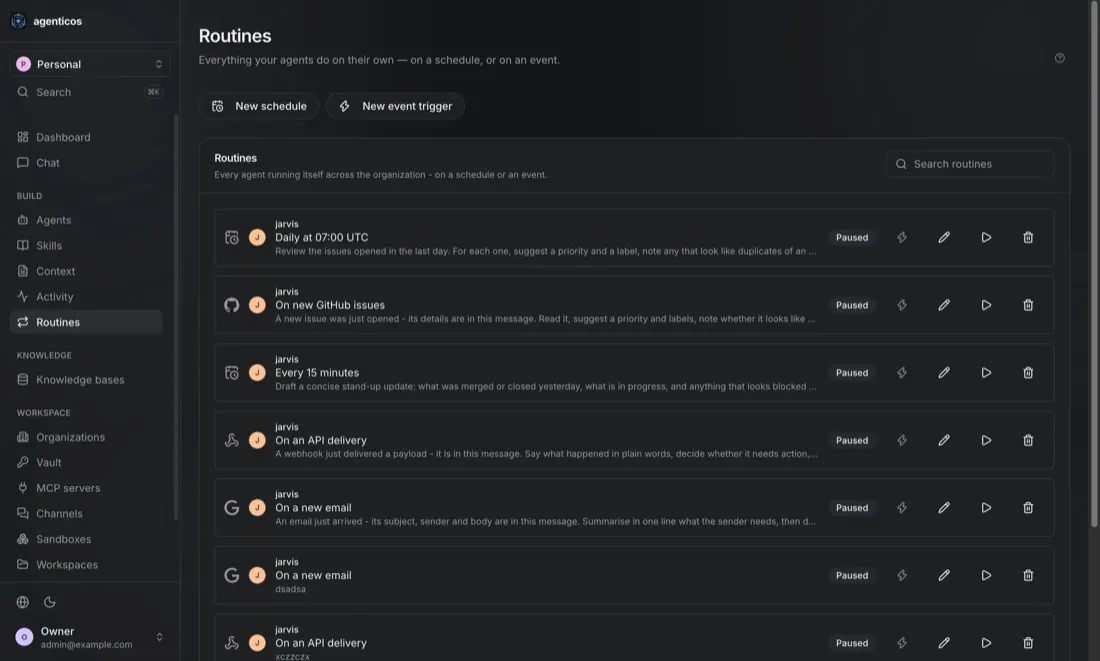
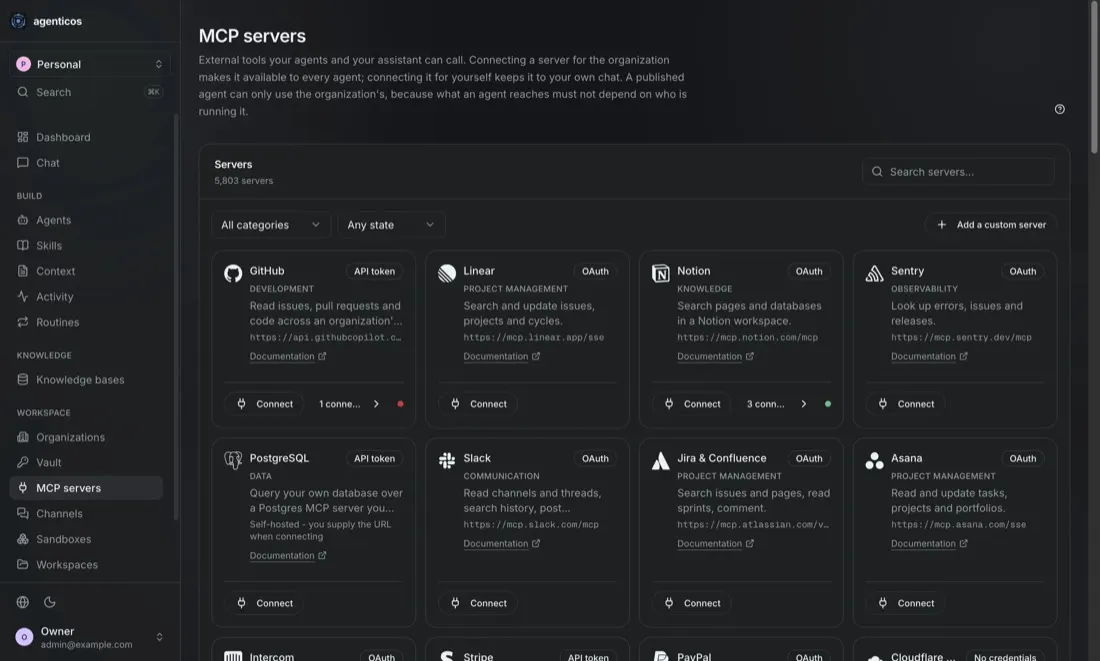
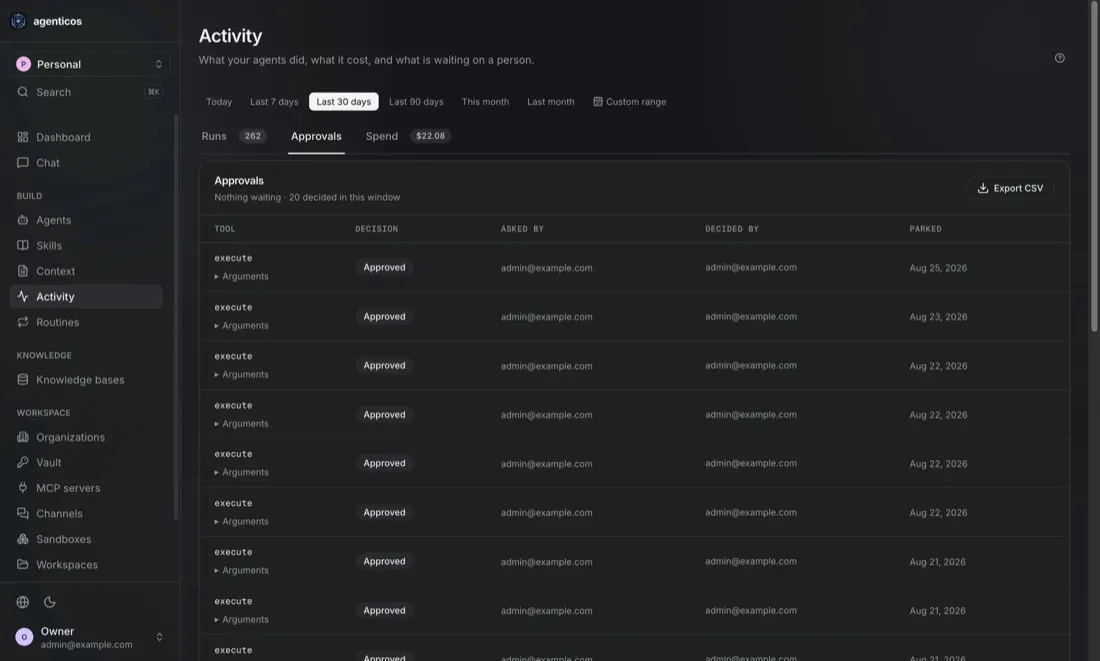
Screens from the workspace our agents run in, with example data.
Each page shows where agents fit in that industry and what we have built there.
Open standards, open-source tooling and published research, all public, so you can check our engineering before you hire us.
Shaping agentic AI
Vstorm was the first agentic AI engineering company to join the Agentic AI Foundation and received its 2026 Open Agentic AI Innovation Award.
Read the announcementOpen source
Framework contributors
We maintain our own open-source agent framework and contribute fixes to the frameworks our agents run on, through official partnerships with their teams. Breaking changes reach us before they reach your codebase.
Research
Peer-reviewed papers on agent architectures, evaluation and AI security, and an open benchmark anyone can rerun against our results.
Track record
Our client agents were in production before most of today's agent frameworks had a stable release. You get a team that already knows what breaks between a promising demo and a system people rely on every day.
Claim processing cut from 3 hours to 8 minutes, with a specialist still deciding.
Read case study

A 6-agent supervisor architecture for a UK fintech: 2 coaching agents with opposite attitudes and 1 orchestration agent.
Read case study

Conversion to a final sale rose from about 20% to about 40%.
Read case studyEach path starts with a free call with a founder or senior AI engineer. A build goes ahead only after its Proof of Value meets the agreed threshold.
We map one workflow with your experts and agree a success threshold before any build.
Best whenYou want the success test agreed before you commit to a build.
A Proof of Value shows accuracy and running costs before the full build.
How artificial intelligence in finance is moving from automation to autonomous agents — real use cases, benefits, and where firms go wrong.
Three lessons from Vstorm projects for financial institutions: earlier tech decides AI success, early adopters had it worst, structure beats authorship.

Agentic AI business cases should count two returns: economic savings and the harder-to-measure gains in decision speed, knowledge and agility.