Insurance fraud detection with AI: what works and where it fits
How insurance fraud detection works with AI and agentic systems: text analysis, cross-source correlation, identity screening and real-time claim intake.

Fraud is a threat as old as the insurance and risk-transfer business. One of the first recorded attempts dates to the fourth century BC, when a shipowner named Hegestratos was accused of taking a nautikon daneion, a loan repayable only if the ship reached its destination safely, and then planning to sink the ship.
Since then the schemes have gained sophistication, and the amounts moving from insurers to malicious actors have grown with them. The 2024 annual report from Insurance Europe estimates that detected and undetected fraud combined make up 10% of all claims. In the United Kingdom, the Association of British Insurers recorded GBP 1.16 bln in detected fraudulent claims in 2024.
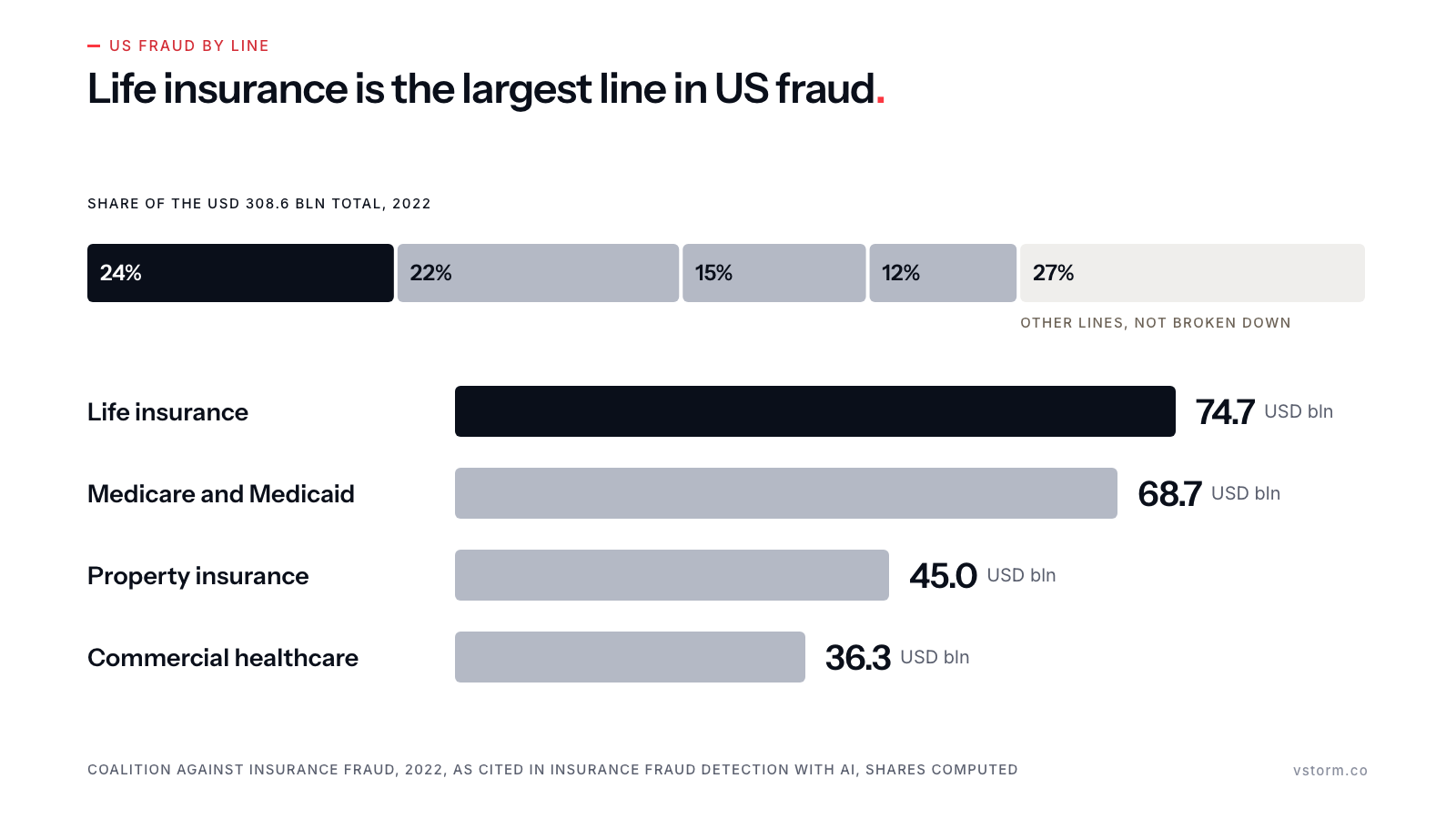
In the United States, the Coalition Against Insurance Fraud puts the total at USD 308.6 bln in 2022. Life insurance fraud accounts for USD 74.7 bln of that, followed by Medicare and Medicaid fraud at USD 68.7 bln, property insurance fraud at USD 45 bln and commercial healthcare insurance fraud at USD 36.3 bln.
The problem sharpened once convincing deepfakes and image and video alteration tools became publicly available. The Verisk State of Insurance Fraud Study found that up to 15% of people surveyed consider altering images to exaggerate damage an acceptable practice. For 13%, the same goes for adding damage that never occurred, and for 11%, altering an invoice or receipt.
AI, and agentic AI in particular, can also work the other way: helping insurers prevent and detect fraud.
How AI helps tackle insurance fraud #
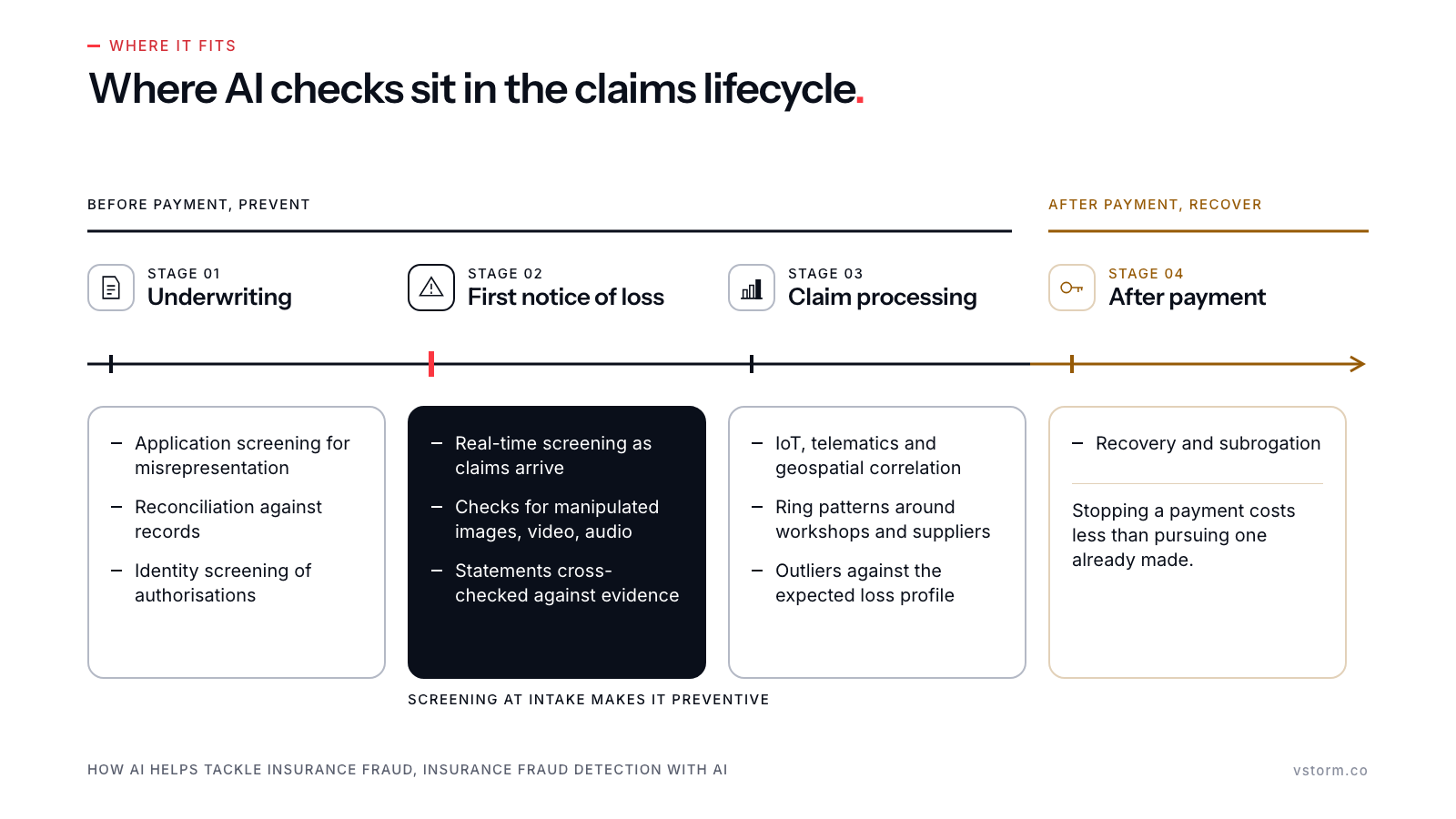
Insurance fraud detection covers a range of capabilities applied at different points in the claims lifecycle. In practice it depends on combining them rather than relying on any single technique.
Text analysis
Insurance claims are built from piles of documents, digital or physical. As our implementation for a healthcare insurance provider in the US shows, AI agents can process, prepare and assess these documents, cutting both the time and the effort a single claim requires.
Integrated with the right tools, the same system gains fraud-monitoring capability: flagging suspicious documents and pointing out inconsistencies. An image may show a car with one broken light while the claim states the whole front was damaged and both lamps needed replacing. Cross-checking claimant statements against submitted evidence is the foundation of the work, and the same tooling supports detecting fake documents through metadata inspection and comparison of invoices against reference pricing.
Multimodal data and cross-source correlation
Modern insurers hold several sources of data at once, and the useful counter depends on the line of business and the type of attempt.
Internet of things readings and geospatial data address farming, manufacturing and motor fraud. A system can correlate readings from a car's internal systems against the claim the client filed. Modern vehicles carry detectors, cameras and radar to power driving-assistance systems, and what those collect is usable evidence.
The same data supports network-level work at claim processing: spotting ring patterns where an unusual number of claims connect to a single repair workshop or parts supplier able to manipulate prices. This is where analytics moves past scoring individual claims into relationship analysis, and surfaces connections a single-claim review would never reveal.
Identity screening
Identity theft is a rising concern. A stolen identity can be used to file fraudulent claims, or to exploit someone's real circumstances, such as a medical condition, to obtain restricted medication.
Agentic AI can scan authorisations for signs of identity theft. The simplest approach analyses login attempts; more sophisticated ones look for patterns in usage.
Vstorm also works on deepfake threat mitigation. One of our researchers, Dawid Wolkiewicz, presented a paper on hierarchical margin-based audio deepfake source tracing at the APAI Workshop at CVPR 2026. The method identifies the model family and specific version behind generated audio, including generators it has not seen before.
Given the right tools, an agent can assess incoming material for manipulated images, video and audio before processing begins. Image fraud now spans reused photographs, cropped or spliced images, and fully generated damage that never occurred.
Running simulations
Insurers routinely attach exclusions and conditions to policies. Motor insurance is the obvious example, where the insured vehicle must undergo periodic checks and maintenance.
AI is well suited to gnawing through large volumes of data, extrapolating from what is already held and building scenarios for how events could unfold. For understandable reasons, scenarios of this kind sit at the core of the insurance business.
Agents can then check against those scenarios and look for outliers that do not fit: claims deviating from a policy's expected loss profile, or breaching maintenance conditions. Flagged cases go to a human team for verification.
Automated decision making
Every use case above is amplified by agents gathering evidence, cross-checking it and assembling cases on their own, with humans making the final call.
Real-time screening of incoming claims is the clearest example, with the system running checks on submitted content as it arrives. Moving detection to the point of intake rather than post-adjudication review is what makes a solution preventive rather than retrospective.
Summary #
AI and agentic AI are capable tools against insurance fraud, and the work is in applying the right one in the right place. Classical machine learning models handle anomaly detection, graph models score patterns at scale, and LLM agents investigate flagged cases: pulling records, cross-checking sources and assembling evidence for human review.
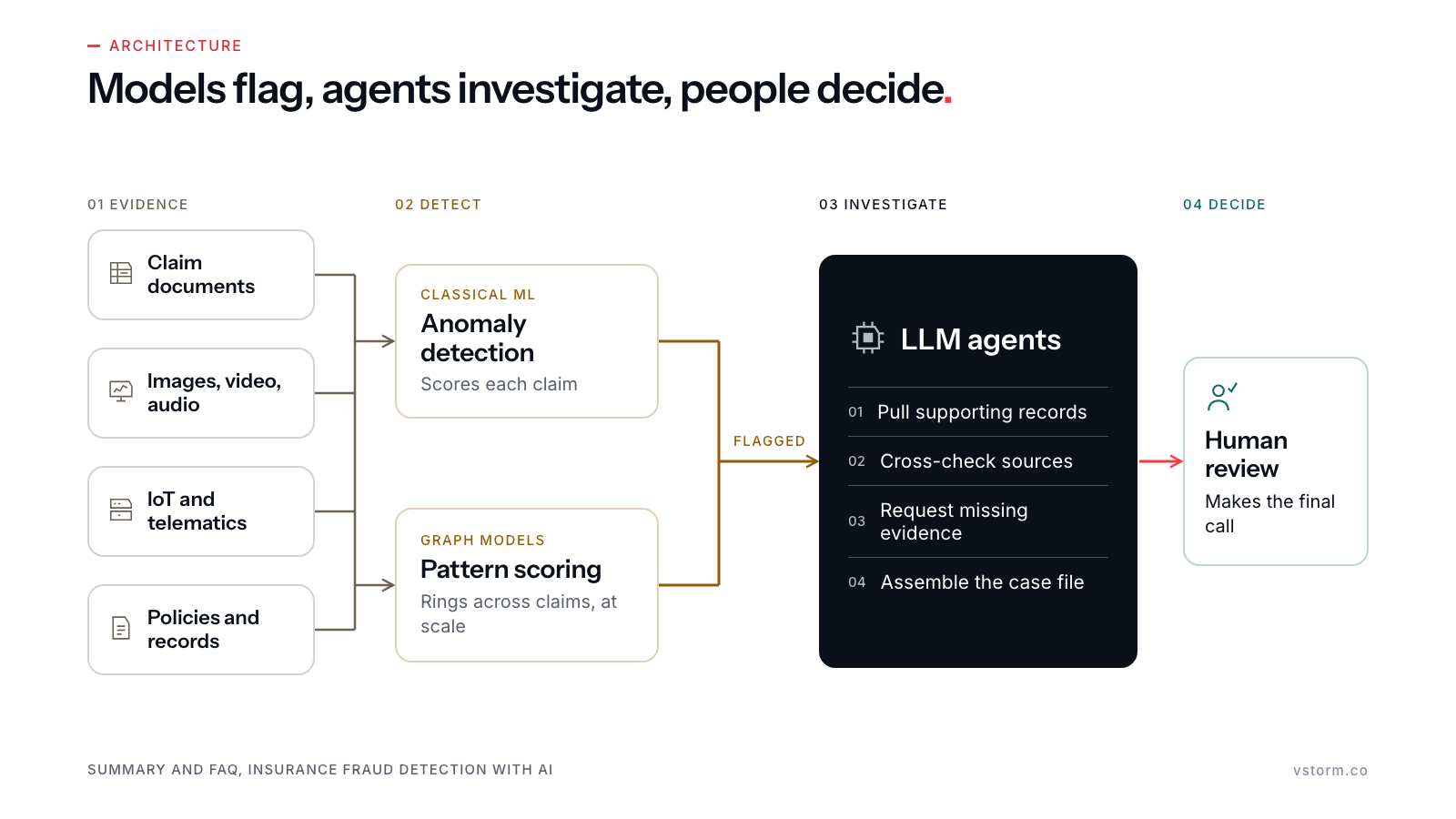
Paired, they change what is possible. Effective detection and prevention depends less on any single model than on the architecture connecting detection, investigation and decision.
Frequently asked questions #
What is insurance fraud detection software?
It refers to systems that screen policies and claims for indicators of fraud. Traditional software relies on rules engines and statistical scoring models that flag anomalies for human investigators.
Newer solutions add agentic capabilities. Rather than only producing a score, the system pulls supporting records, cross-checks external sources, requests missing evidence and assembles a case file before a human reviews it. The practical difference is where human effort goes: on deciding, not on gathering.
Which fraud detection tools suit claims processing best?
There is no single answer, because it depends on the line of business, claim volume and where fraud actually concentrates in a given book. A motor insurer facing staged accidents needs telematics correlation and network analysis. A health insurer facing provider fraud needs billing-pattern outlier detection. Any insurer accepting photographic evidence needs image authenticity screening. The more useful question is which stage of the claims lifecycle leaks the most, and what addresses that stage specifically.
Which companies use AI for insurance fraud detection?
Adoption is broad across large carriers, but public disclosure is limited, because publishing detection methodology tells fraudsters what to avoid.
The clearest documented example at scale comes from the public sector. In the US Department of Justice's 2025 National Health Care Fraud Takedown, the Health Care Fraud Unit's Data Analytics Team and its partners detected anomalous Medicare billing through proactive analysis. Acting on it, HHS-OIG and CMS prevented all but roughly USD 41 million of the USD 4.45 bln that had been scheduled for payment.
On the carrier side, most implementations arrive through specialist vendors or custom builds, without public announcement.
How does life insurance fraud detection differ from other lines?
It concentrates at two points that barely exist in property lines: the application, and the contestability period. Most life fraud involves material misrepresentation at underwriting, such as undisclosed medical conditions or misstated income and occupation, rather than a fabricated loss event. Detection therefore weights application screening and record reconciliation more heavily than claim-time evidence analysis. Life is also the single largest line in the Coalition Against Insurance Fraud's US estimate, at USD 74.7 bln.
Can AI prevent fraud, or only detect it after the fact?
Both, depending on where it sits in the process. At underwriting it can prevent policies being issued on misrepresented risk. At first notice of loss it can stop a fraudulent claim before payment. After payment it supports recovery and subrogation.
The economics favour earlier intervention, because preventing a payment costs considerably less than pursuing one already made. That is why real-time screening has become the focus of most prevention programmes.