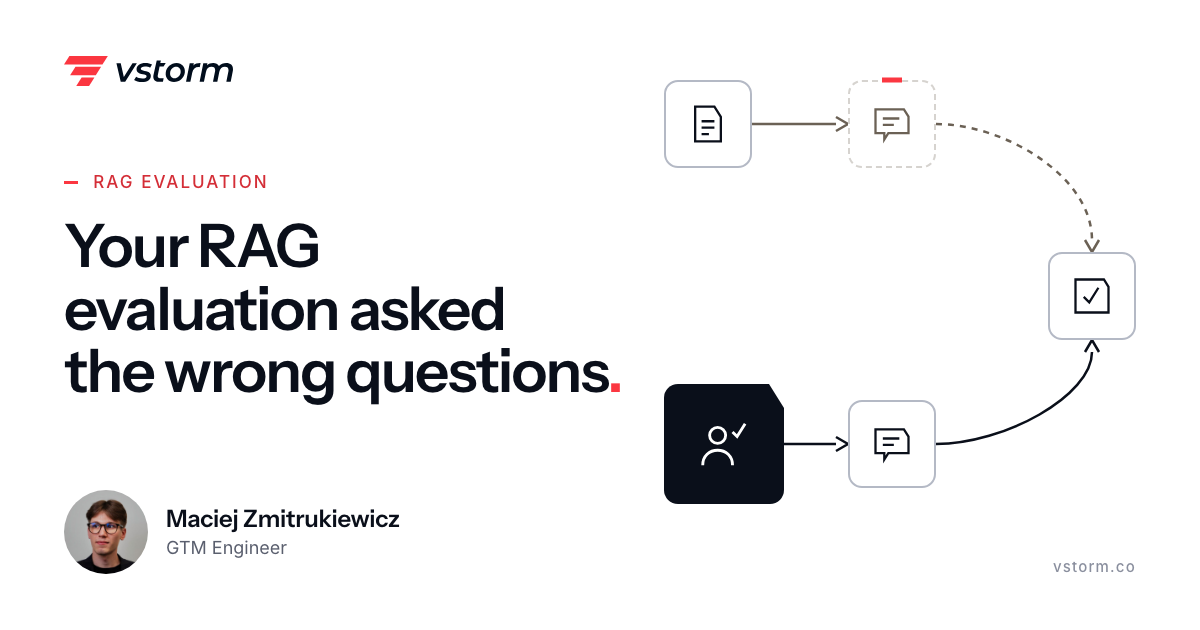
Your RAG evaluation asked the wrong questions
RAG systems pass tests and fail users when the test set comes from a document sample and guessed questions. How to build a RAG evaluation set that holds.

If your RAG system or AI agent passed its tests and still disappointed the people using it, look first at what those tests were built from. One rescue Vstorm took on was a search engine over technical documentation. The company that built it had taken the documents, put a generic retrieval-augmented generation (RAG) tool on top, and stopped there.
A RAG system searches a knowledge base of documents for passages relevant to a question and hands them, as retrieved context, to a large language model (LLM), which writes the answer. This one did not work.
The case fits a pattern Vstorm sees repeatedly in rescue work on RAG and agent engineering projects. A company hires a team to build a RAG system and shares a sample of its documents. A month or two later the product arrives.
It usually passes the builder's tests, then underperforms once the business starts using it, for two reasons. The sample did not represent the documents the system would meet in real-world use, and nobody asked the people who would use it what they would ask. The tests were written from the same sample and from the builder's guesses at the questions, so they could catch neither problem.
Why the tests pass and the product fails #
Surveys point the same way beyond our rescue work, though they show the gap between tests and real use, not its cause. In late 2025 LangChain, which sells a platform for monitoring and evaluating agents, surveyed 1,340 people who chose to take part. The results became its State of Agent Engineering report.
A third named quality as the main obstacle to putting an agent into production, by which LangChain means answers that are accurate, relevant and consistent, in the right tone and within brand or policy guidelines. Yet just over half ran offline evaluations, which test how an agent performs against a prepared set of cases instead of live traffic.
In a June 2026 VentureBeat survey of people at companies with 100 or more employees, who also chose to take part, half had shipped an AI agent or LLM feature that passed internal evaluations and still caused a customer-facing failure. The most common reason they gave for distrusting automated evaluation was poor alignment with real-world outcomes. Projects like these get run as software engineering, because the model comes already trained and sits behind an application programming interface (API).
RAND found the same timing in machine learning projects that did not use LLMs. Its researchers interviewed data scientists and engineers in 2023 and found that business stakeholders often misunderstand or miscommunicate what problem the AI should solve, and that such errors "often become obvious only after the data science team delivers a completed AI model and attempts to integrate it into day-to-day business operations."
Hamel Husain, who sells a course and consulting on evaluating AI systems, argues in "The Revenge of the Data Scientist" that the API spares a team the training but not the evaluation work, which was always most of the job. In Husain's terms, "building representative test sets from production data is Experimental Design," and "getting domain experts to label outputs is Data Collection." The projects we rescue skipped both, and putting them back is where our work on them starts.
The steps of an evaluation
- Collect the questions the system will be tested on. In the projects we rescue, these were the builder's guesses, written from a sample of the documents.
- Set the right answer to each question. In those projects, nobody from the client took part.
- Run the system on every question.
- Compare its answers with the right ones.
- Count how many it got right and decide whether it is good enough to ship.
The questions decide what gets built #
Representative questions matter because they decide what the team optimizes and what RAG evaluation metrics end up measuring. A question answered by a single passage needs precise retrieval, with a chunk size that keeps that passage whole.
When the answer is spread across several documents, the system has to find all of them and combine what they say, and a question about what changed between two releases works only if the system knows which version of a document is current.
Summaries and comparisons need synthesis, which takes longer and costs more per answer, so whether users expect a quick lookup or a considered answer also sets the latency and cost the system can afford. Without the users' questions, each of these choices is a guess.
Jason Liu, a consultant who sells a course on improving RAG systems, described a construction company whose documentation search left user satisfaction stuck at about 50%. A fifth of the questions in its logs asked the system to count objects in blueprints, such as "How many doors are on the 15th floor?" Text search cannot read that answer off a drawing.
What a guessed test set costs #
Generating questions from the documents is a standard way to start a retrieval test. Husain and Shankar's FAQ recommends it for RAG systems: take documents from the corpus, extract key facts, and generate the questions those facts would answer. Built from a sample, such a set can only ask about the sample, and the same FAQ warns that language models "often miss the structure, nuance, or quirks of specialized documents," such as technical forms. How those documents are parsed before retrieval is a separate choice, compared in the top 10 document parsing services for RAG pipelines.
Filip Kucia and Barbara Gawlik of Warsaw University of Technology showed how a generated test set can pick the wrong design in RAG evaluation. Their system was a RAG application, a chatbot built to answer questions from students about timetables, scholarships and faculty procedures.
They built two test sets, one generated from the faculty's documents with the default settings of Google's Gemini Notebook, formerly NotebookLM, and one from questions students gave in a survey. The students asked shorter questions, and almost half of theirs could not be checked at all, because they were too vague or needed personal details or real-time data that no document held. The authors used both sets to compare three retrieval setups, different ways of searching the documents.
On the generated questions, a hybrid of keyword and semantic search, which matches meaning instead of exact words, came out best on retrieval quality. On the students' questions that could be checked, all three performed about the same.
A team tuning that chatbot on the generated set would have picked the hybrid, which took up to eight times as long to search as the fastest setup, for no gain in retrieval quality on the students' questions. A test set that never meets real users can also make a system more expensive than it needs to be.
Zafar Hussain and Kristoffer Nielbo of Aarhus University studied search for the Danish National Encyclopedia, including setups that use query augmentation. In query augmentation, a language model rewrites or expands the user's query before the index is searched, for example by drafting a hypothetical answer to search with, and every query it touches costs an extra language model call and more waiting time.
On synthetic queries, augmentation looked necessary for more than 90% of them. On real-world traffic, under the policy the encyclopedia uses in production, only 27.8% needed it. A system tuned on the synthetic queries would pay for that extra call on nearly every search.
The people who know the answers have to judge them #
Real questions still leave open which answers are good. One answer is to write the experts' criteria into the requirements before the build.
Xavi Amatriain, Expedia Group's chief AI and data officer, told VB Transform 2026 that "the new PRD are the evals," meaning evaluation cases written into the product requirements document (PRD) "before you even start coding."
A small study led by Shreya Shankar at UC Berkeley found that "users need criteria to grade outputs, but grading outputs helps users define criteria." An expert who has never seen the system's answers writes down the standards they can put into words, and finds the rest when a wrong answer surprises them. Criteria written before the build are a starting point, so the client's experts have to keep judging outputs after the specification exists, whether the questions are synthetic or real. What a single accuracy number hides, and what to ask for in its place, is covered in Is higher accuracy always the goal?
How Vstorm builds the RAG evaluation set with the client #
Our RAG evaluation process starts from whatever real material the client has. If the client has the full document set and a record of the questions people actually ask, or can provide them quickly, we build the test set from those and stick to them.
If not, we write a small set of synthetic questions, built around the kinds of question we expect, which is how Husain and Shankar's FAQ on evaluation suggests starting when there is no data. We use it to get a first prototype in front of real users, whose questions then replace the synthetic ones. Their verdicts become the expected outcomes, and the set grows with each round.
On both paths, real users judge the prototype by using it, and the client's experts review cases one at a time in a simple interface we generate for each project.
We do not use spreadsheets for human review, and we keep the parts of a case together. The expert sees each case in context, for example the source image next to the content extracted from it and the system's answer, and labels it with a preset button or a short comment.
Work saves automatically, and the labels export in one step to JSON, a standard data format, which goes straight into the test set. Spreadsheets have their defenders. Alfonso Graziano of Nearform, a software consultancy, found that Google Sheets worked better for non-technical experts than asking them to open pull requests, and Langfuse, which sells LLM monitoring, warns that a custom interface adds maintenance. A spreadsheet works well for a question and a short answer. When a case pairs a drawing with the text extracted from it and the system's answer, reviewing it in a spreadsheet gets slow. Since we generate the interface quickly, it costs little to build and to throw away when the project ends.
The cases the experts approve in that interface become the acceptance test for delivery. After launch they become the regression suite, the cases every change must still pass before it ships. When production monitoring finds a new kind of failure in user queries or agent runs, examples of it join the suite, as Husain and Shankar advise, so the next release is tested against it too. How that monitoring and evaluation run after launch is described on our AI agent evaluation and observability page.
How the test set grows
- Start from the client's real documents and questions, or, when there is no real data yet, from a small synthetic set.
- Put a prototype in front of real users. Their questions replace the synthetic ones, and their verdicts become the expected answers.
- The client's experts judge each case in context, in an interface built for the project. Steps 2 and 3 repeat in rounds.
- Approved cases become the acceptance test for delivery.
- After launch, they become the regression suite every change must pass before it ships.
- When monitoring finds a new kind of failure, examples of it join the regression suite.
What to ask before the next review #
If you are about to commission a RAG system or an AI agent, give the builder documents that cover every type the system will meet, including any product data, with any record of the questions people already ask. A sample picked for the kickoff rarely does. Where personal data or access rights limit what can be shared, agree on a sample that still covers each document type and use case.
Name one expert on your side to settle disputed judgments, which Husain and Shankar call the most effective approach for most small and medium-sized companies. Ask for a prototype in front of real users early, and for the test set to grow from their questions and verdicts into the acceptance test.
It can start small. Anthropic's engineering team calls 20 to 50 simple tasks drawn from real failures "a great start."
Include questions the documents cannot answer. In the Warsaw study, almost half of the students' questions had no answer in any document. For those, the right result is a behaviour: asking the user to clarify, saying the answer is not in the documents, fetching live data or handing the case to a person. A test set without such cases cannot show whether the system will invent an answer instead.
Questions to ask the builder of a RAG system or AI agent
| Ask the builder | Why it matters | Warning sign |
|---|---|---|
| Will you work from documents that cover every type we use? | A sample picked for convenience rarely represents the documents the RAG system will meet in real-world use. | The plan starts from a sample, and nobody asks what else the full set holds, such as manuals, support tickets or product data. |
| Whose questions will the test set be built from? | The questions decide what the team optimizes, from precise retrieval to slower, costlier synthesis. | The questions were generated from the documents or guessed by the builder. |
| Who on our side judges whether the system is answering correctly? | Experts find many of their criteria only when a wrong answer surprises them. | Answers are judged only by the builder's team. |
| Who settles disagreements between our experts? | Husain and Shankar call one named expert the most effective approach for most small and medium-sized companies. | Disputed cases pile up with no one to decide them. |
| When will real users see a prototype? | Their questions replace the synthetic ones, and their verdicts become the expected outcomes. | Users first touch the system at delivery. |
| What happens to the test set after delivery? | Approved cases become the acceptance test, then the regression suite every change must pass. | The test set is archived at handover. |
| How big does the test set need to be at the start? | Anthropic's engineering team considers 20 to 50 simple tasks drawn from real failures enough to begin. | Evaluation waits until the system is finished. |
The approach changes for two kinds of project. An exploratory prototype that nobody depends on yet can wait for the acceptance test and the regression suite, though it still needs real users and someone to judge its answers. For a task with no single correct answer, the experts grade against criteria, such as answer relevance, in place of a list of expected answers.
If your system is already built, then before the next review of whether it is good enough, ask to see the cases you are judging it against, and whose questions they are. If they are the builder's guesses, that is the problem to fix first.
Frequently asked questions #
What is RAG evaluation? RAG evaluation tests a retrieval-augmented generation system against a prepared set of questions with expected answers. It checks whether the system retrieves the right passages and whether the answer it writes from them is correct. The questions in the set decide what the evaluation can catch.
Why does a RAG system pass its tests and fail with users? Usually because the test set was built from a sample of the documents and from questions the builder guessed. Real users ask different questions about documents the sample did not include, so the tests could not catch either problem.
Which RAG evaluation metrics matter most? Retrieval quality, whether the system found the passages that hold the answer, and answer correctness against the expected answer. For tasks with no single correct answer, experts grade against criteria such as answer relevance. Every metric is computed over the test set, so it measures only the questions in it.
Can synthetic questions replace real user questions in RAG evaluation? They are a reasonable way to start when no real data exists, and a weak way to choose a design. In a published study of a university chatbot, synthetic questions favoured a retrieval setup that was up to eight times slower and found the right source no more often on students' real questions.
How many test cases does a RAG evaluation need at the start? Anthropic's engineering team calls 20 to 50 simple tasks drawn from real failures a great start. The set then grows from real users' questions and from failures found in production.
Sources (13)
- LangChain, State of Agent Engineering (quality as the main obstacle to production; just over half run offline evaluations; public survey of 1,340 respondents, November 18 to December 2, 2025), page dated June 12, 2026
- VentureBeat, Carl Franzen, Enterprise AI is entering an evaluation gap: Agents are gaining autonomy faster than companies can verify them (half shipped a feature that passed internal evaluations and still failed customers; self-selected VB Pulse survey of 157 respondents, June 2026), July 10, 2026
- RAND, James Ryseff, Brandon F. De Bruhl and Sydne J. Newberry, The Root Causes of Failure for Artificial Intelligence Projects and How They Can Succeed (misunderstood problems surface only after delivery; interviews with 65 data scientists and engineers, August to December 2023), August 13, 2024
- Hamel Husain, The Revenge of the Data Scientist (representative test sets and expert labels as the core of evaluation; annotated PyAI Conf talk), March 26, 2026
- Jason Liu, Decomposing RAG Systems to Identify Bottlenecks (construction company, satisfaction near 50%, a fifth of questions about counting objects in blueprints), November 18, 2024
- Hamel Husain and Shreya Shankar, AI Evals: Everything You Need to Know (generating questions from documents; starting with synthetic data; one named expert; adding production failures to the suite), September 18, 2026, updated September 21, 2026
- Filip J. Kucia and Barbara M. Gawlik, Beyond Benchmark Scores: How Synthetic and Authentic Query Distributions Diverge in RAG Evaluation (generated versus student questions; hybrid search up to eight times slower with no accuracy gain; CIKM 2026 short paper), September 13, 2026
- Zafar Hussain and Kristoffer Nielbo, The Coverage Illusion: From Pre-retrieval Routing Failure to Post-retrieval Cascades in a Production RAG System (augmentation needed for over 90% of synthetic queries and 27.8% of real traffic; preprint, not peer reviewed), May 26, 2026
- VentureBeat, Louis Columbus, Evals are the new PRD, Expedia's AI chief tells VB Transform 2026 (Xavi Amatriain quotes), July 21, 2026
- Shreya Shankar, J.D. Zamfirescu-Pereira, Björn Hartmann, Aditya G. Parameswaran and Ian Arawjo, Who Validates the Validators? Aligning LLM-Assisted Evaluation of LLM Outputs with Human Preferences (grading outputs helps users define criteria; UIST 2024), April 18, 2024
- Nearform, Alfonso Graziano, From AI prototype to production: how to build evals for reliable agents (Google Sheets worked better for non-technical experts), March 30, 2026
- Langfuse, Abdallah Abedraba, Vibe Coding a Custom Annotation UI (a custom annotation interface adds maintenance; date from the page URL and metadata), November 25, 2025
- Anthropic Engineering, Mikaela Grace, Jeremy Hadfield, Rodrigo Olivares and Jiri De Jonghe, Demystifying evals for AI agents (20 to 50 simple tasks from real failures as a start), January 9, 2026