How does an AI agent differ from a standard program? +
A standard program executes a predetermined sequence of instructions. An autonomous agent is reactive and proactive — it makes its own decisions based on its environment and initiates actions to reach a goal rather than waiting for a command.
What is the difference between a single agent and a multi-agent system? +
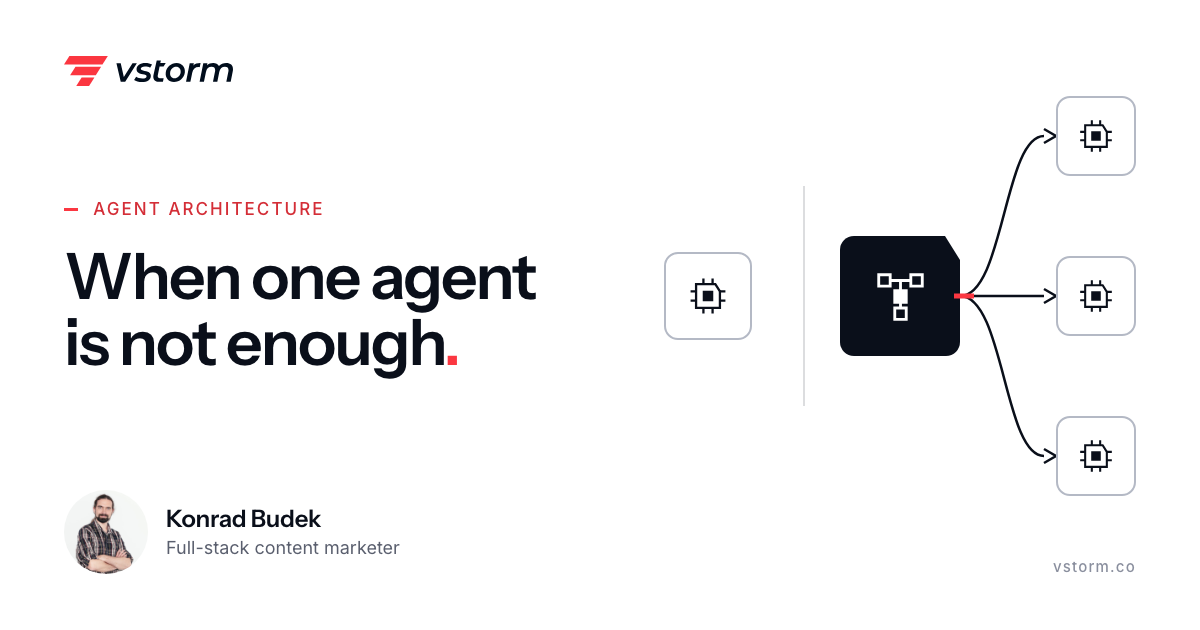
A single agent handles a workflow automation task end-to-end on its own, using tools and reasoning within one unified system. A multi-agent system distributes that work across several specialised agents coordinating with each other. Single agents are faster to build, easier to audit, and the right choice when the workflow is well-defined and contained.
How does a single AI agent use tools? +
Rather than calling on other agents, a single autonomous agent is equipped with a set of tools (APIs, databases, search functions, calculators) that it selects and calls as needed. The agent decides which tool to use, when to use it, and how to interpret the result.
What is a large language model and how does it relate to an AI agent? +
A large language model is the reasoning engine that lets an agent understand instructions, interpret data, and generate responses. In a well-architected single-agent system the model is one component among many — alongside retrieval, tools, validation logic and domain data. We design systems where the model is replaceable without rebuilding the broader solution.
What is the role of human in the loop in single-agent systems? +
Human in the loop refers to the checkpoints where a human reviews, approves or redirects the agent before it proceeds. These escalation points are defined during Phase 1 and built directly into the agent workflow, so a person checks the decisions that need it and nothing else.
What is "emergent behavior" in AI agents? +
Emergent behavior occurs when an agent produces outcomes that were not explicitly programmed — solving edge cases, combining tools in novel ways, or finding shortcuts through a workflow.
When should a business choose a single agent over a multi-agent system? +
A single custom AI agent is the right choice when the workflow is clearly scoped, the data sources are manageable, and speed of delivery matters. Multi-agent systems add value when workflows are too large or complex for one agent to handle reliably, or when parallel specialisation is needed. We assess this in Phase 1 of every engagement.
What are the main benefits of a single AI agent? +
Simplicity — one system to build, test, monitor and maintain. Speed — faster to deploy and iterate than a distributed architecture. Auditability — every decision and tool call happens in one traceable system. And deep domain specialisation in your industry's language, data and edge cases.
What are the biggest challenges in single-agent development? +
Scope definition is the hardest part. An agent given too broad a remit will underperform; one scoped too narrowly will miss value. Getting that balance right (and building in the right tools, guardrails and human-in-the-loop escalation logic) is where most of the engineering work happens.
How do you ensure a single agent stays accurate over time? +
Through continuous monitoring, structured feedback cycles, and regular model and integration updates. An agent that performs on day one can drift as your data and workflows evolve, so we build observability in from the start and maintain it as part of ongoing support.
Can a single agent run without relying on external AI providers? +
Yes. For organizations with data sovereignty requirements or a need for owned infrastructure, we deliver fully self-hosted solutions that run on your own servers — no external API dependencies, no third-party model access. The system operates in your environment, under your control.