What is agentic AI? A simple guide for small and medium businesses
What is agentic AI? A guide for SMBs: how agents work, how they differ from chatbots and RPA, where they help today and how to start.

The numbers tell a story that most business leaders recognize: nearly eight out of ten companies now use generative AI, yet just as many report no significant impact on their bottom line (McKinsey). We see this gap every day in our work, as companies try to turn AI adoption into practical results.
Agentic AI systems close part of that gap. They make decisions and pursue multi-step goals without constant supervision. Expectations are high: in a PagerDuty survey of 1,000 executives, 62% of companies expected more than 100% ROI from agentic AI, with an average expected return of 171% against 152% for generative AI.
The agentic AI market is forecast to grow from $9.89 billion in 2026 to $57.42 billion in 2031 (Mordor Intelligence).
Small and medium businesses feel the pressure most. AI agents that handle customer inquiries or manage invoices free up hours that a small team does not have.
This guide explains what agentic AI is, how it differs from technologies you might already use, and where agentic AI for small business can improve your operations today. The recommendations come from building and running these systems for our clients.
What is agentic AI? A practical definition for SMBs #
Agentic AI is an operations layer that runs a defined process end to end. It receives a goal, makes decisions within limits you set, and completes multi-step tasks without constant oversight. For small and medium-sized businesses, that changes how daily operations can be run.
“I do think of it as a workforce. This is a workforce that will conduct end-to-end processes, replacing many tasks being performed today by the human workforce.”
—Jorge Amar, Senior Partner, McKinsey & Company, in McKinsey Talks Talent, The future of work is agentic, June 3, 2025
Understanding the agentic AI definition
Agentic AI describes autonomous systems that act to achieve set goals. Traditional software also follows predefined rules; agentic systems act proactively and complete complex tasks without a person approving each step. The term “agentic” refers to the system’s agency, its ability to act on its own while staying goal-oriented.
These systems analyze situations, make decisions, reason through problems and carry out solutions with minimal human intervention. They go past generating content or surfacing insights and drive the decision itself.
For an SMB, an agentic system works like a dependable operations assistant: it learns your specific process, improves with feedback from customer interactions, and makes decisions within your business goals. It connects to your existing tools, such as your CRM, and uses your data to act on your behalf.
Agentic AI systems follow a four-step cycle:
- Perceive. Collect data from various sources and identify what matters
- Reason. Work out the tasks needed and the way to solve them
- Act. Carry out tasks by connecting to external tools and platforms
- Learn. Monitor results and use them to improve later decisions
“25% of enterprises using GenAI are expected to deploy AI agents in 2025, growing to 50% by 2027… This evolution will enable AI agents to tackle a broader range of applications, providing businesses with valuable tools to drive productivity of knowledge workers and efficiency gains in workflows of all kinds.”
—Deloitte Global 2025 Predictions Report, November 19, 2024
Traditional FAQ bots vs AI agents: key distinctions
Many businesses already use FAQ bots, automated systems that answer questions from a predefined knowledge base. FAQ bots, even those with semantic search, retrieve and present existing information. AI agents use language models to interpret a request and orchestrate several tools to complete the task.
Take a customer asking about order status. An FAQ bot can retrieve and display tracking information. An AI agent can understand the question, check several systems, spot a likely delivery problem and offer a solution or an alternative.
Key operational differences:
- Flexibility: FAQ bots are limited to their knowledge base content; AI agents interpret requests and work around edge cases
- Tool usage: FAQ bots usually query one information source; AI agents coordinate several tools and APIs in sequence
- Setup: FAQ bots need every question and answer mapped upfront; AI agents need a solid knowledge base too, and can also call tools to work past it
- Action scope: FAQ bots retrieve and display information; AI agents can run multi-step processes like modifying orders, scheduling callbacks or escalating issues
For SMBs with limited resources this matters. FAQ bots are predictable and reliable for common questions, and AI agents take on the full customer interaction and the operational workflow behind it.
How agentic AI works: the five key characteristics of agentic AI systems #
We break agentic AI down into five characteristics that decide how these systems behave in real business environments. Together they make up the autonomous decision-making that lets small and medium businesses scale.
Goal-oriented behavior
Agentic AI systems work toward specific objectives, predefined or changing over time. They break complex tasks into subtasks, prioritize them, and adjust when new information arrives.
Supply chain work shows the idea well. An agent can reroute shipments around weather disruptions while balancing inventory across warehouses, acting on the goal of keeping stock where it is needed without waiting for a person to start it (see agentic AI in supply chain).
Reasoning through planning and decision-making
These systems run a “think, act, observe” loop. The agent takes a goal from human input or from the environment, then uses a large language model to chain the tasks needed to reach it. At each step it weighs possible actions and picks the one with the best expected outcome.
This reasoning matters most in business scenarios where several variables affect the quality of a decision.
Autonomous decision-making
Once tasks are defined, agentic AI carries them out without constant oversight, which lets it handle variable, complex cases. Our Mixam printing agent, for example, turns plain-English customer requests into validated technical specifications, reconciling creative ideas with printing constraints, materials and production requirements. More than 96% of web-to-print orders are now handled end to end.
Iterative refinement
AI agents can be set up to improve over time. In practice that means tracking successful interactions, taking in human feedback and updating the system as new patterns appear. Key mechanisms:
- Performance logging to find successful and failed interactions
- Feedback loops in which human operators correct or refine responses
- Periodic retraining or rule adjustments based on accumulated data
- Pattern recognition to handle previously unseen edge cases
With this ongoing work, agents get better at reaching their goals in changing business conditions.
Multi-tool integration
Much of an agent’s value comes from using several tools and specialized AI services together. Agents work directly with business systems: they retrieve data, call APIs, trigger workflows and execute transactions, so one task can span several platforms.
We often connect several specialized agents under an orchestrator, each focused on one stage of the workflow. This modular design keeps responsibilities clear, makes the system easier to change and supports governance.
Agentic AI vs other technologies: generative AI, ChatGPT, RPA and virtual assistants #
Knowing how agentic AI differs from tools you already use shows where it fits your operations.
Agentic AI vs generative AI (ChatGPT)
The clearest way to see agentic AI vs generative AI is to compare it with ChatGPT. ChatGPT generates content from specific prompts; agentic AI systems run workflows to reach business goals.
In standard chat mode ChatGPT is reactive: a capable assistant that waits for instructions to produce text, images or code. Agentic AI is proactive and takes decisions and actions without continuous guidance.
- ChatGPT: focused on content generation, needs a prompt for every action
- Agentic AI: built for task execution, acts on high-level goals without waiting for prompts
ChatGPT helps with ideas and content. An agentic system can carry a whole workflow, from creating campaign assets to launching, monitoring and adjusting them across platforms.
Agentic AI vs traditional automation (RPA)
Traditional automation (RPA) and agentic AI both streamline operations, and they work in different ways. RPA follows fixed rules and waits for a trigger. Agentic AI assesses the situation, adjusts its actions and works toward the business objective. Each has its place: RPA suits repetitive, compliance-driven workflows where consistency comes first, and agentic AI suits work that needs adaptability.
Customer service shows the difference most clearly. Gartner predicts that agentic AI will autonomously resolve 80% of common customer service issues without human intervention by 2029, because rule-based automation cannot give the context-aware responses customers expect.
Think of RPA as a GPS that calculates the best route from existing map data. Agentic AI is closer to a driver who knows the routes, watches traffic, remembers your preferences and suggests alternatives when conditions change.
The core difference is adaptability. RPA runs on process rules, while agentic AI can:
- Access and coordinate several data sources and tools
- Plan and run multi-step processes
- Make decisions within defined parameters
- Adapt its approach when new information arrives
Traditional automation works well when processes stay predictable. Work that needs reasoning and flexibility favors agentic AI, and most RPA tools do not use large language models at all, which is where agentic AI adds something new.
Agentic AI vs virtual assistants (Siri, Alexa)
Virtual assistants such as Siri and Alexa respond to voice instructions and carry out simple, predefined tasks, like setting reminders or answering basic questions.
The difference again lies in scope. Virtual assistants act when asked and need a prompt for each action. AI agents work toward a goal with the resources available to them, on their own once they have the objective.
AI agents can also keep a record of earlier actions and use it to refine their approach. They see dependencies between tasks, so they can run multi-step processes in order, which virtual assistants cannot.
For small and medium businesses this matters when choosing tools for customer interactions. Virtual assistants give quick, simple help; agentic AI can support whole business processes as well as single tasks.
Agentic AI use cases for small and medium businesses #
Below are the areas where agents most often take on work in smaller companies:
Customer service and support automation
Agentic AI takes customer support past basic FAQ answers: it reads intent, stays available 24/7 and acts on the request. At Mixam, our AI agent raised conversion to a final sale from about 20% to about 40%.
An agent can also act before the customer asks, for example by notifying customers about delivery delays or applying a compensation discount automatically.
Sales and lead qualification
Agents can take on routine prospecting work: reading prospect behavior and qualifying leads automatically. When a prospect visits your pricing page, an agent can treat it as a high-intent signal and book a meeting through your CRM, so the sales team spends its time on the most promising prospects.
Marketing personalization
Marketing agents can run parts of the campaign cycle: monitoring ad performance, suggesting posting times and shifting budget based on results. For a small business without a marketing team, that means campaigns get adjusted every day instead of once a month.
Finance and invoice management
Manual invoice processing is estimated to cost businesses $15 to $40 per invoice (Symtrax). Agentic AI in finance cuts that cost by handling bookkeeping, expense tracking and invoicing, flagging anomalies and preparing reports for a person to approve.
IT support and troubleshooting
Agents can help a small team keep its infrastructure running without adding support staff: they spot unusual patterns such as suspicious logins, triage tickets, run diagnostics, reset passwords and hand complex issues to a technician.
Benefits of agentic AI for small and medium businesses #
Small and medium businesses expect a lot from AI: 78% of SMBs that use AI say it will be a game-changer for their company (Salesforce). The benefits below show where that expectation turns into results.
Reducing manual workload
Our own projects show the pattern. At Synera, building a workflow by hand could take up to an hour; with a text-to-workflow agent it takes about two minutes.
This shifts staff from repetitive execution to work that needs judgment. Cloud computing did the same for IT engineers, who stopped spending their hours on server maintenance. AI agents take the routine decisions, and people handle the problems that need human judgment.
Improving customer experience
Agentic AI improves first-contact resolution, so customers stop repeating their problem to several people. 34% of consumers would work with an AI agent instead of a person to avoid repeating themselves (Salesforce).
An agent that remembers context across interactions answers faster and fits the response to the customer, something traditional support systems struggle with.
Scaling operations efficiently
Agentic AI helps resource-constrained businesses do more with the same team. Among SMBs that use AI, 87% say it helps them scale operations and 86% see improved margins (Salesforce).
The extra margin can go to the bottom line or fund growth. For an SMB competing with larger companies, a small team can handle a much larger volume of work.
Enhancing decision-making with real-time data
In an IBM study of 2,900 executives, 70% said agentic AI is important to their organization’s future. AI agents analyze data to find patterns manual work would miss, such as shifts in customer behavior or market trends that affect product and pricing decisions.
They can also measure operational efficiency, find bottlenecks and suggest workflow changes, so an SMB can change course quickly, which used to need a dedicated analytics team.
What agentic AI can do for your business today #
These capabilities work in production now:
Customer support triage and escalation
Agents resolve routine customer issues and hand complex cases to people. They can spot frustration in a conversation and move the case up the queue, so complex issues get a person quickly and routine ones get an answer at once.
Automated report generation and analysis
Agents analyze data across departments, interpret trends, flag anomalies and update forecasts when the data changes. Hours spent gathering and formatting reports go away.
Document processing and workflow initiation
Agents read complex documents such as invoices, contracts and regulatory filings, extract what matters and start the right workflow. Extraction improves through feedback, and manual review becomes the exception.
Data migration and integrity management
During a migration between systems, agents map field relationships, detect inconsistencies and validate the result. In regulated sectors they can also find and mask sensitive information along the way.
Regulatory compliance and fraud detection
Agents can monitor changing requirements, flag suspicious transactions, freeze compromised accounts and prepare regulatory reports, with a person approving the actions that carry risk.
Physical world decision-making
In manufacturing, agents support predictive maintenance by monitoring equipment performance and opening service requests automatically.
What agentic AI cannot do yet #
Building agentic systems teaches you their limits. These limits shape implementation decisions and help set expectations.
Where agentic AI falls short
Complex creative strategy is still a human job. Agents can analyze performance data and suggest improvements, but campaign ideas still need human creativity. We treat agents as execution partners.
Maintenance takes real effort. In our experience, most of the work on an agentic system happens after the first deployment, and the industry still lacks clear maintenance frameworks. A small prompt change can produce a very different execution pattern, so the system needs regular monitoring.
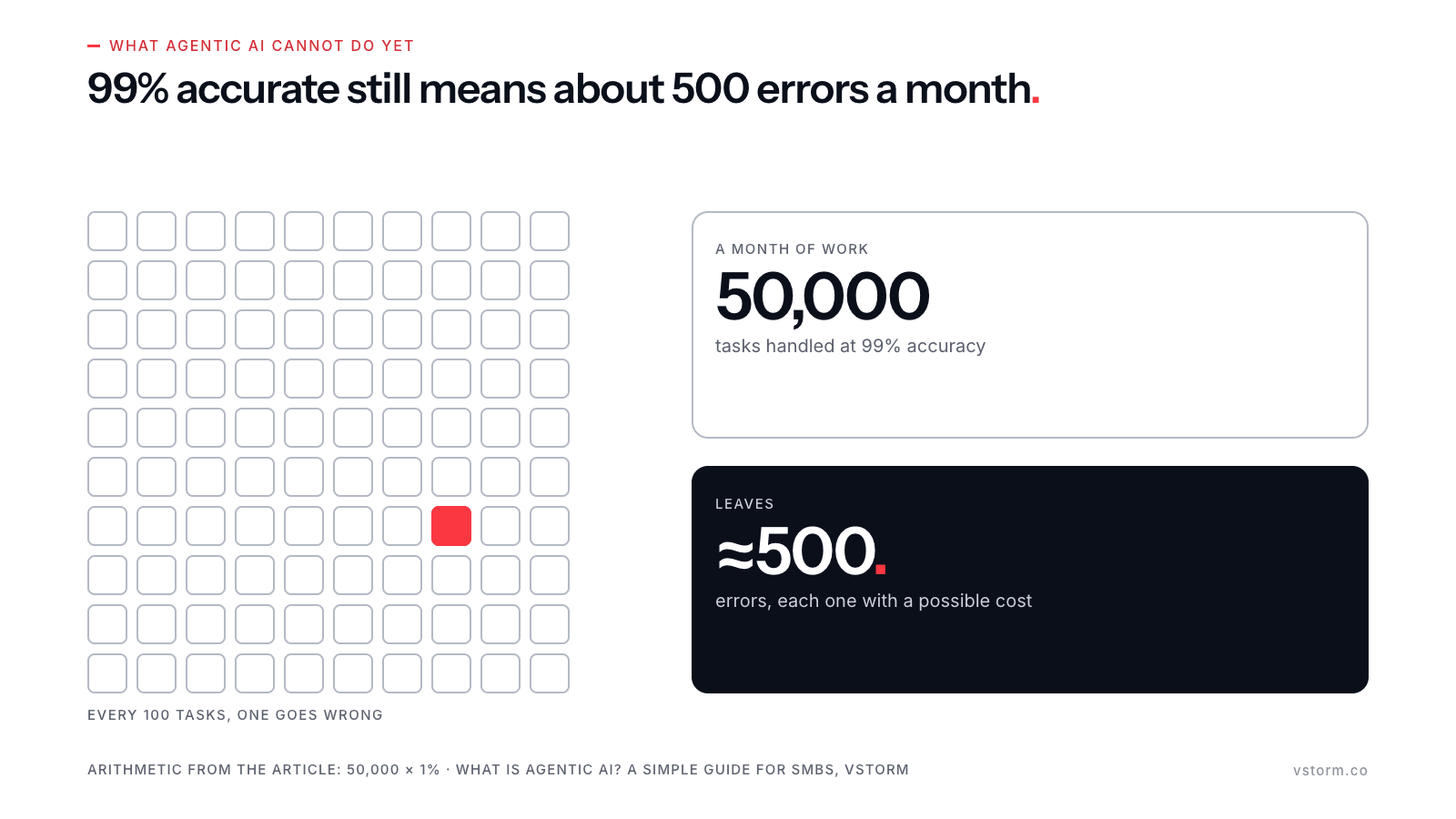
Reliability is still a challenge. Even at 99% accuracy, a system handling 50,000 tasks a month would make about 500 errors, and each one can cost money.
Governance gets harder as more people build agents. Employees creating their own agents without oversight bring risks that traditional IT governance does not handle easily.
How to get started with agentic AI in your business #
Projects that work follow a consistent pattern: they start small and practical. These are the five steps we recommend:
Identify repetitive tasks
Start by finding the tasks that eat employee time. Good candidates for AI automation are repetitive, predictable and time-consuming: chasing invoices, sorting applications, tracking compliance or answering common support questions.
Mixam’s agent, for example, started with one clear job: guiding customers through print-order configuration (Mixam case study). A narrow task gives clear success metrics and keeps complexity down in the first deployment.
Choose the right approach and partner
Choose solutions that integrate with your existing infrastructure. We suggest evaluating vendors on four criteria:
- Integration with your current systems
- Security features and compliance certifications
- Interfaces your team can use without technical expertise
- Scalability as your business grows
For the technical build, working with specialists speeds up deployment.
Start with a pilot project
Do not try to automate everything at once. Start with a small, manageable pilot, such as automating first-line customer support questions or basic sales follow-ups.
A pilot builds early wins and trust in the team. Companies that start with a well-defined use case see returns sooner, because they can measure success clearly and fix issues quickly.
Contextualize your AI agent with RAG
RAG (Retrieval-Augmented Generation) gives an AI agent access to your own business knowledge. The agent retrieves current, accurate data when it answers, so its output stays relevant.
This matters most when the agent works with your company data. We use RAG so agents know company policies, product specifications and customer history without constant retraining.
Monitor and refine performance
At Vstorm we test agents automatically. Evaluation sets check answer accuracy, and retrieval is checked against known answers, so problems show up before users report them. This is standard in the projects we deliver.
Key takeaways #
Agentic AI moves small and medium businesses from reactive automation to goal-driven systems that run routine work.
- Agentic AI acts on its own. Unlike chatbots or traditional automation, these systems make decisions, improve with feedback and pursue multi-step goals with minimal supervision.
- Start small with a pilot. Repetitive, time-consuming tasks like customer support or invoice processing are good entry points that build early wins and team confidence.
- Expect measurable gains. Among SMBs that use AI, 87% say it helps them scale operations (Salesforce), and single deployments show large changes, such as Mixam’s conversion rising from about 20% to about 40% (Mixam case study).
- Focus on integration. Choose solutions that work with your existing systems and consider a specialist partner for implementation and maintenance.
Success comes from strategic implementation: well-defined use cases, continuous monitoring and gradual scaling as your team gains confidence with the technology.
Sources #
Accessed October 20, 2026.
- McKinsey: Seizing the agentic AI advantage, June 13, 2025
- McKinsey Talks Talent: The future of work is agentic, June 3, 2025
- PagerDuty agentic AI survey (Business Wire), April 1, 2025
- Mordor Intelligence: Agentic AI market
- Deloitte Global 2025 Predictions Report, November 19, 2024
- Gartner: agentic AI will resolve 80% of common customer service issues by 2029, March 5, 2025
- Salesforce: AI agents statistics, updated May 12, 2025
- Salesforce: SMB AI trends, December 4, 2024
- Symtrax: Why manual invoice processing is costing your business more, March 13, 2025
- Process Excellence Network: IBM study on AI agents, June 11, 2025