Agentic AI doctor notes generators: ambient scribes beyond transcription
What an agentic AI doctor notes generator does beyond transcription, and the security, accuracy and compliance problems of building one for healthcare.

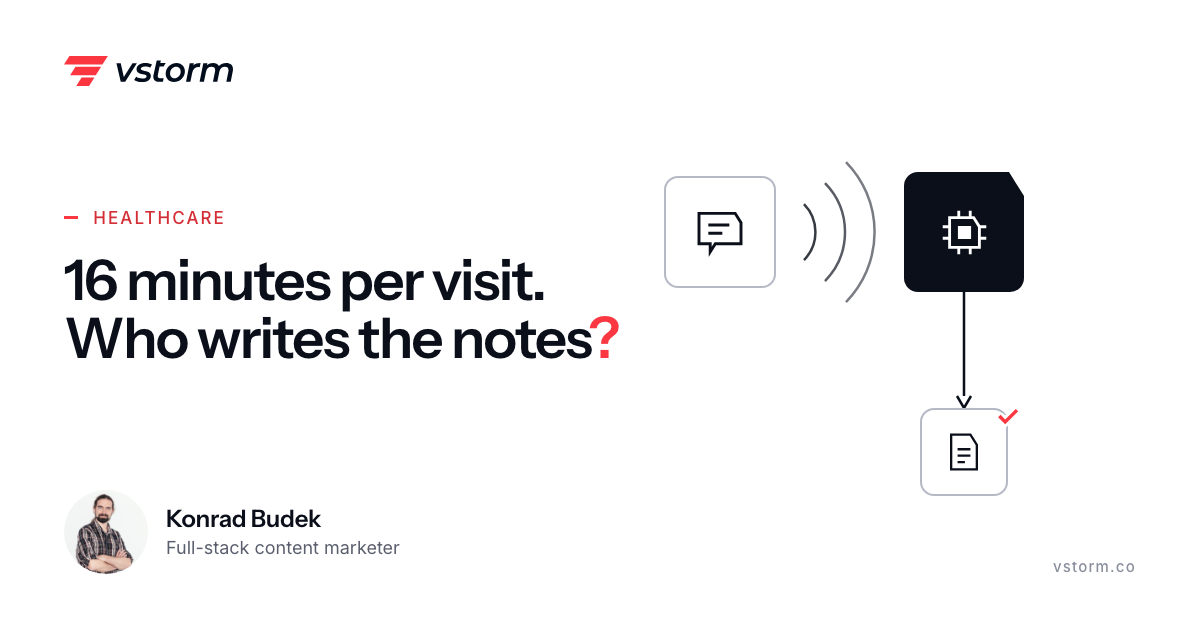
A physician spends about 16 minutes in the electronic health record (EHR) for every patient visit, according to a study in the Annals of Internal Medicine. Roughly a quarter of that, about 4 minutes, goes on writing documentation; the rest is reviewing the patient's history and entering orders and recommendations.
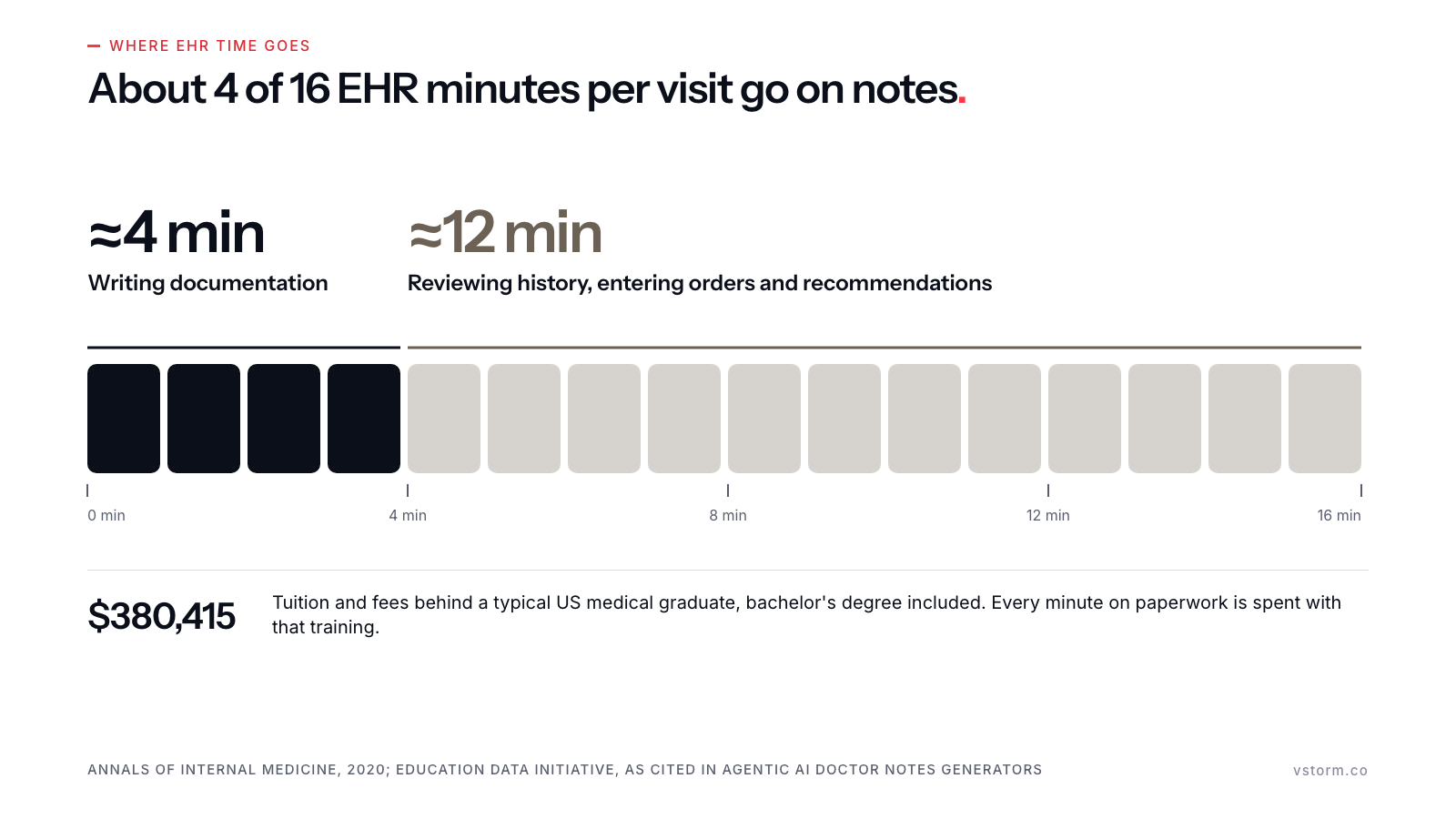
This is repetitive work that keeps a specialist away from the core of the job, and the patient spends much of the visit watching the doctor type.
It is also expensive. A typical US medical graduate has paid $380,415 in tuition and fees, including the bachelor's degree before medical school, according to the Education Data Initiative. Spending that training on paperwork is a poor use of it.
From human scribes to ambient notetaking #
The usual answer has been to move paperwork elsewhere. Nurses and registration staff complete triage and intake so the patient reaches the doctor with most of the record already filled in. Some clinics added human scribes who sit in on the visit, but that means extra staff for every doctor, and the cost adds up.
Notes taken during the examination itself mostly stayed with the doctor.
Agentic AI closes that gap. These tools take notes during the encounter, so the doctor does not have to stop and type. The category goes by several overlapping names, medical transcription software, AI medical dictation software or simply dictation for doctors, but the mechanism is the same: audio in, structured clinical notes out.
What ambient notetaking in healthcare is #
Ambient notetaking combines ambient listening with transcription. The system picks up the natural conversation between doctor and patient, with no dictation prompts and no pauses to talk to the computer, and turns it into usable clinical documentation. That makes it a form of AI clinical documentation software, and "AI scribe for doctors" has become the shorthand many vendors and clinicians use for it.
Such a system usually has three parts: speech-to-text, a summarization engine and a component that fills in the documents. Together they take over the work that pulls the doctor's attention away from the patient.
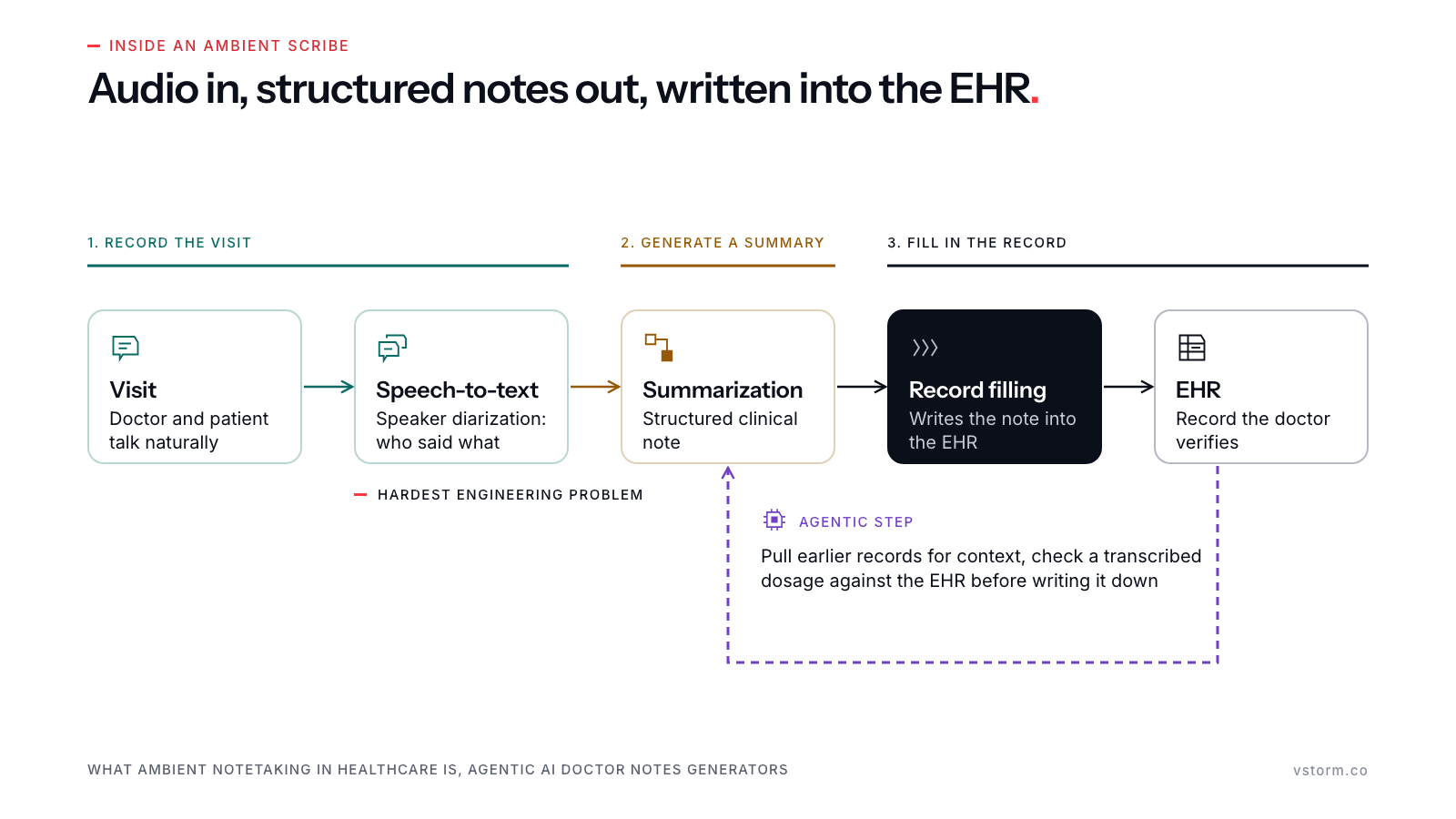
The hardest engineering problem is speaker diarization: telling the speakers apart and attributing every word to the right person. Beyond transcription, agentic setups go further. They can pull earlier records for context, or check a transcribed dosage against the EHR before writing it down.
An ambient clinical documentation system should support the doctor with three things:
- Recording the visit. The system records the whole visit in the background, so the doctor does not touch the computer while talking to the patient.
- Generating a summary. The visit is condensed into structured notes a colleague can read in seconds, the layer most people mean by "AI for clinical notes".
- Filling in the record. The system is connected to the EHR and writes the notes into it, and the doctor only verifies them. This is a doctor notes generator in the full sense: it populates the record instead of only transcribing.
Seen this way, ambient notetaking sits between two older categories: dictation for doctors, which has existed for decades, and AI for medical documentation, the newer layer that adds structure, summaries and EHR write-back on top of raw speech-to-text.
Key challenges in building agentic ambient notetaking for healthcare #
Healthcare is regulated, so these systems face a higher bar than software in most other settings.
Security
The system handles patients' health and personal data, which makes security the first priority. A leak means fines and regulatory liability, and it can also cause serious harm to the patients themselves.
Accuracy
A clinical record leaves little room for ambiguity. If the system confuses a condition or a recommendation, the error can carry into treatment, and in the worst cases the patient bears the consequences. That is why accuracy benchmarks matter when evaluating an AI clinical documentation tool: a scribe that mishears a dosage is not a minor bug.
Hallucinations
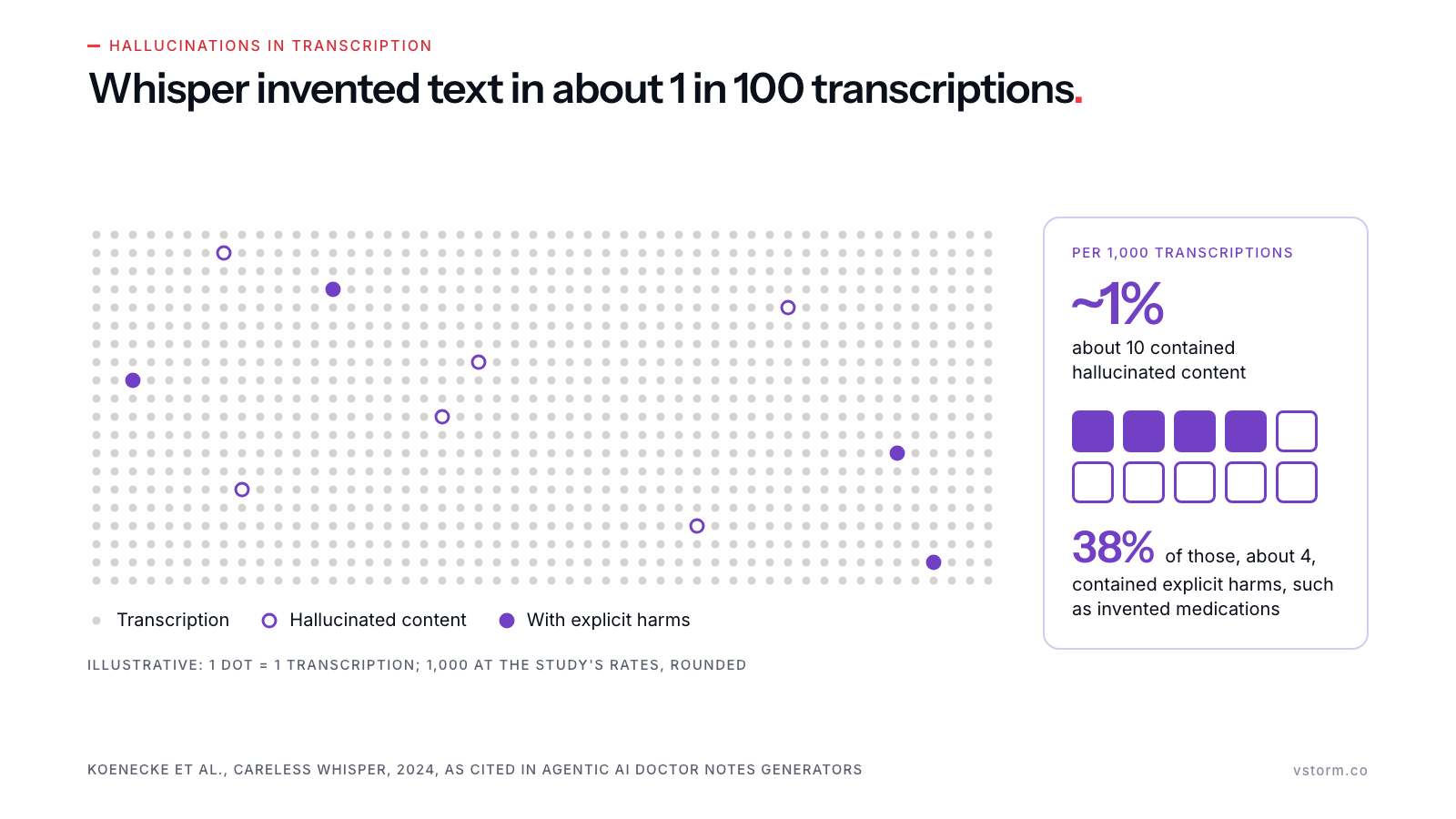
Hallucinations are the clearest example of the accuracy problem: the transcription contains sentences nobody said. A study of OpenAI's Whisper, the speech-to-text model behind several medical scribes, found hallucinated content in about 1% of transcriptions, and 38% of those hallucinations contained explicit harms, such as invented medications.
Integration
The notetaker has to fit into the systems the clinic already runs. That means EHR integration, compliance, database connections and, in some cases, pulling relevant information from existing records.
Independence
Healthcare systems have to hold up against attackers and outages. Depending on the setting, that can mean running internally hosted small language models and processing the incoming data on infrastructure the organisation owns, so the system stays under its control.
Compliance
Regulations differ from region to region. Most require informed consent and clear information about where and how the recorded data is stored and processed.
Depending on the personal and medical data rules that apply, such as GDPR or HIPAA, storing transcripts in the cloud or using SaaS tools can be restricted or come with extra conditions.
Why off-the-shelf is not enough #
Ambient notetaking is available as SaaS, but an off-the-shelf product is rarely tuned to the doctors who use it. In healthcare this shows quickly: terminology is specific and workflows differ widely between specialties.
Medicine is also deeply specialised, and general-purpose knowledge often does not help. A large general-purpose language model used out of the box can be more than a workflow needs when what it needs is precision in a narrow clinical vocabulary.
FAQ #
What is the difference between medical transcription software and an AI scribe for doctors?
Traditional medical transcription software converts speech to text, often after the visit and sometimes with a human transcriptionist in the loop. An AI scribe for doctors listens during the encounter, structures the conversation into a clinical note and, in more advanced setups, writes that note into the EHR without a separate transcription step.
Is ambient clinical documentation the same as dictation for doctors?
No. Dictation usually requires the physician to speak the notes aloud, often after the patient has left the room. Ambient clinical documentation listens passively to the conversation during the visit, which lets the doctor stay focused on the patient instead of narrating notes.
Can AI for clinical notes be used for therapy notes as well?
The same listening and summarization approach can apply to therapy and behavioural health sessions, but the requirements differ. Therapy notes need to capture more nuance about mood, risk indicators and progress over time, and the privacy bar for behavioural health data is often higher than for general medical records. A system built for general physician visits should not be assumed to work for therapy documentation without an evaluation against those needs.
What should a practice look for in an AI medical scribe?
There is no single best tool independent of context. The right choice depends on EHR compatibility, specialty-specific vocabulary, data residency and security requirements, and whether the practice needs a general-purpose tool or one tailored to a narrow clinical domain. A vendor-neutral evaluation answers this better than a ranked list.
Does an AI medical dictation system replace the doctor's clinical judgement?
No. These systems are documentation tools. They capture, structure and file the conversation, while diagnoses, decisions and recommendations still come from the physician. Their job is to remove the paperwork, not to make medical decisions.
Sources #
Physician time and cost
- Annals of Internal Medicine, Physician Time Spent Using the Electronic Health Record During Outpatient Encounters (16 minutes in the EHR per encounter, about a quarter of it on documentation), 2020
- Education Data Initiative, Average Cost of Medical School ($380,415 in tuition and fees including undergraduate study), 2026
Transcription accuracy
- Koenecke et al., Careless Whisper: Speech-to-Text Hallucination Harms (about 1% of transcriptions hallucinated, 38% of those with explicit harms), arXiv 2402.08021, 2024