Why agentic AI transformation strategy decides who wins
Strategy, not the model, separates agentic AI leaders from the 95% of pilots with no P&L impact: what to build, in what order and who owns it.

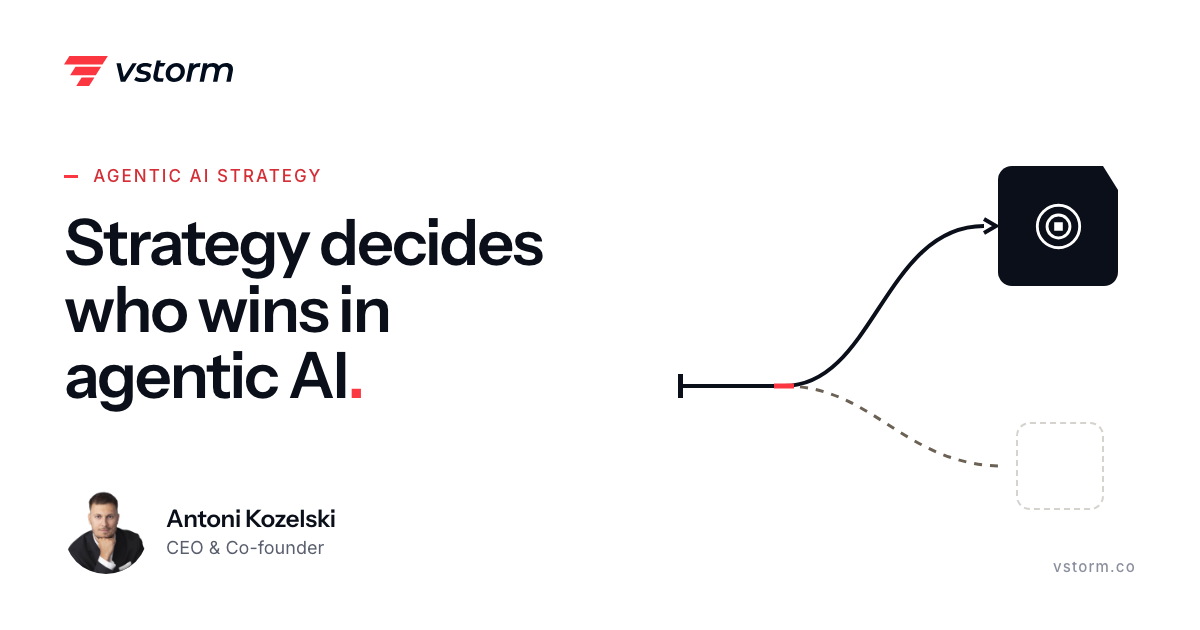
This piece expands on my Forbes Technology Council article, Why Strategy, Not Technology, Decides Who Succeeds In Agentic AI.
Agentic AI transformation strategy is the variable that most reliably separates the organisations capturing value from those writing off their investment. The reason is uncomfortable but well evidenced: this form of artificial intelligence is new, the standard playbook does not yet exist, and the gap between leaders and everyone else is already the widest in enterprise technology. BCG puts leading adopters at 1.7 times the revenue growth of laggards. MIT finds that 95% of pilots deliver no measurable impact on the profit and loss statement.
The difference between those two outcomes is rarely the model. It is the strategy that decides what to build, in what order, and how it reaches production. We at Vstorm work at that decision point every day, and this is what we see.
Agentic AI is not another software project #
The instinct to treat an agentic project like any other software delivery is understandable, and it is the first strategic error. Conventional software behaves predictably: the same input returns the same output, scope can be fixed in advance, and a proven delivery framework carries the work to completion. Agentic AI systems do not behave this way. They are non-deterministic, they reason across several steps, and they draw on several live systems at once. The certainty that ordinary software delivery assumes is absent, and that same unpredictability is why these systems need genuine human oversight, not only testing before release.
The adoption numbers show the mismatch. Only 17% of organisations have deployed AI agents, even though appetite is overwhelming, according to Gartner's 2026 analysis. The constraint is not desire. It is the difficulty of applying old methods to a new class of system.
This is why an agentic AI transformation strategy matters before a single line of code is written. The strategic questions come first: which business processes genuinely benefit from autonomy, where the system is likely to break, and who will own it afterwards. Our TriStorm methodology exists because Waterfall, Agile and the familiar delivery frameworks fall short when the technology is still shifting under the team's feet.
There is no standard playbook yet #
In web or mobile development, a team can reach for a settled reference architecture and a body of accepted practice. Agentic AI has no equivalent. The standards are being written in real time, so the question of how to build is itself a strategic decision rather than a solved problem.
The Agentic AI Foundation, hosted by the Linux Foundation and launched in December 2025, exists to coordinate the open standards the industry will run on. We at Vstorm contribute to that effort as an AAIF Silver Member. We have embedded AGENTS.md auto-generation into our open-source project template, which now carries more than 830,000 downloads on PyPI and has become one of the wider distribution channels for the standard in the Python ecosystem, as documented by the AAIF.
I share this not as a credential but to make a practical point. When the reference architecture does not exist yet, an organisation adopting agentic AI that treats implementation as a purely technical exercise is making consequential decisions by default, without recognising them as decisions. This is one of the clearest reasons why agentic AI projects fail: the strategy is left implicit. A partner involved in shaping the standards can make those choices deliberately, on the client's behalf. Our open-source initiatives reflect that approach.
The market is early, which widens the strategic window #
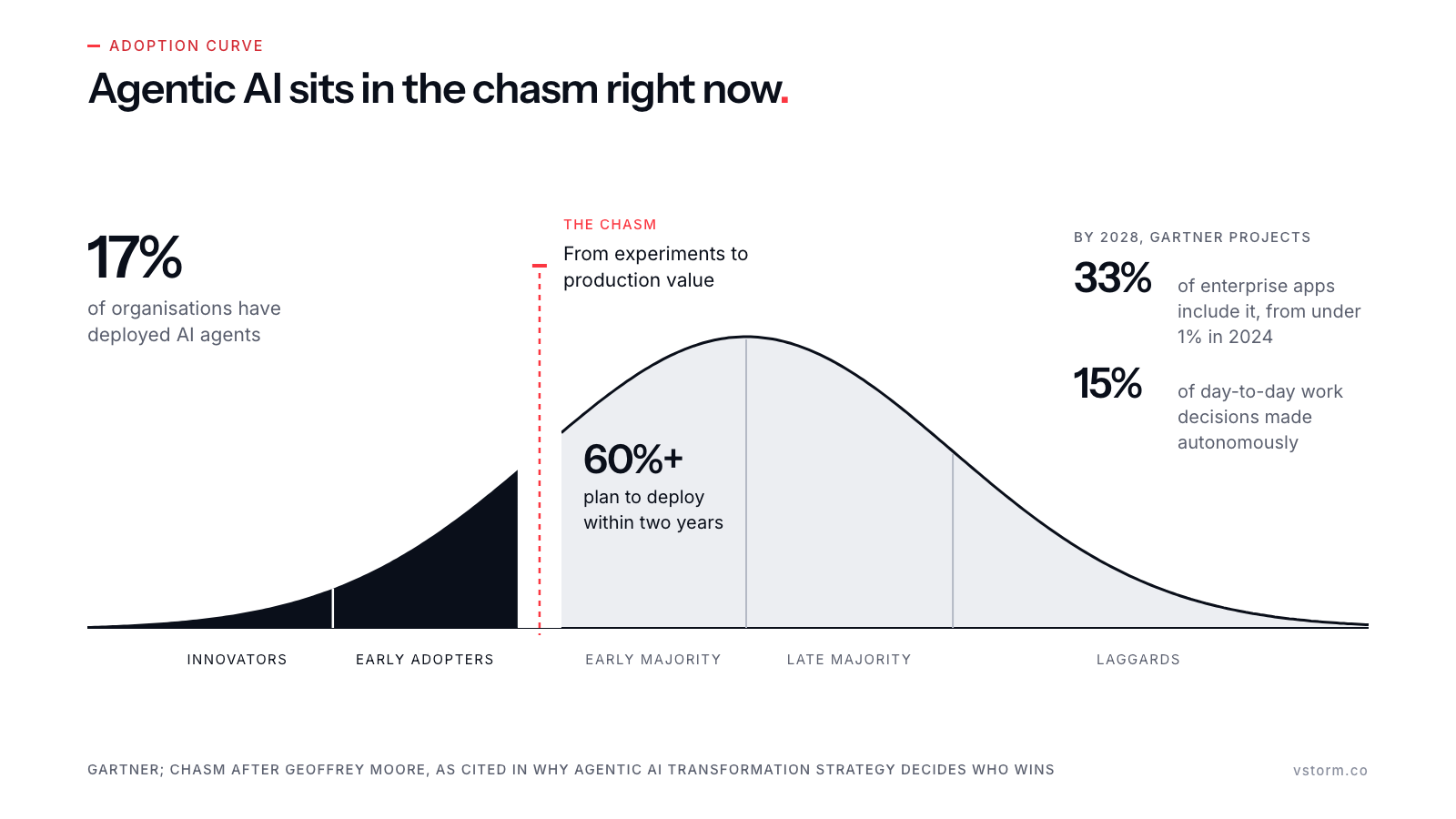
The technology adoption lifecycle is a useful map. Every general-purpose technology moves from innovators and early adopters to the early and late majority, and the most dangerous point on that curve is the gap Geoffrey Moore called the chasm: the moment a technology has to move from enthusiasts running experiments to pragmatists who demand reliable production value. Agentic AI sits in that gap now.
The numbers describe it precisely. Only 17% of organisations have deployed agents, yet more than 60% intend to within two years, which Gartner calls the most aggressive adoption curve among the emerging technologies it measures. Gartner also projects that by 2028, 15% of day-to-day work decisions will be made autonomously through agentic AI and 33% of enterprise software applications will include it, up from under 1% in 2024.
Being early is not a reason to wait. It is the reason strategy carries the most weight, because the organisations that cross the chasm do so on a small number of well-chosen, high-impact, well-scoped first use cases, not on breadth. The contrast between a borrowed playbook and a deliberate strategy is stark.
| Dimension | Borrowed software playbook | Agentic transformation strategy |
|---|---|---|
| Scope certainty | Assumed fixed and knowable up front | Treated as a hypothesis, refined through discovery |
| Primary failure mode | A working pilot that never reaches production | Deliberate use case selection to protect production value |
| Delivery framework | Waterfall or Agile, built for known technology | A transformation sequence built for non-determinism |
| Ownership | Often locked to a vendor or platform | Knowledge transfer and full client ownership |
| Typical result | Counted in the 95% with no measurable impact | Positioned for the value the leaders capture |
The window is open now. Whether an organisation uses it or watches it close is, in the end, a question of agentic AI transformation strategy.
The real cost is the opportunity you give up #
There are two costs to weigh, and most organisations only see the first. The visible cost is a failed project. The larger, quieter cost is the advantage competitors build over the long term while an organisation hesitates.
The failure figures are sobering. MIT's Project NANDA found that 95% of generative AI pilots deliver no measurable impact on the profit and loss statement, and that internal builds fail roughly twice as often as external partnerships. Gartner predicts that more than 40% of agentic AI projects will be cancelled by the end of 2027, citing unclear business value and inadequate risk controls rather than any failure of the models themselves.
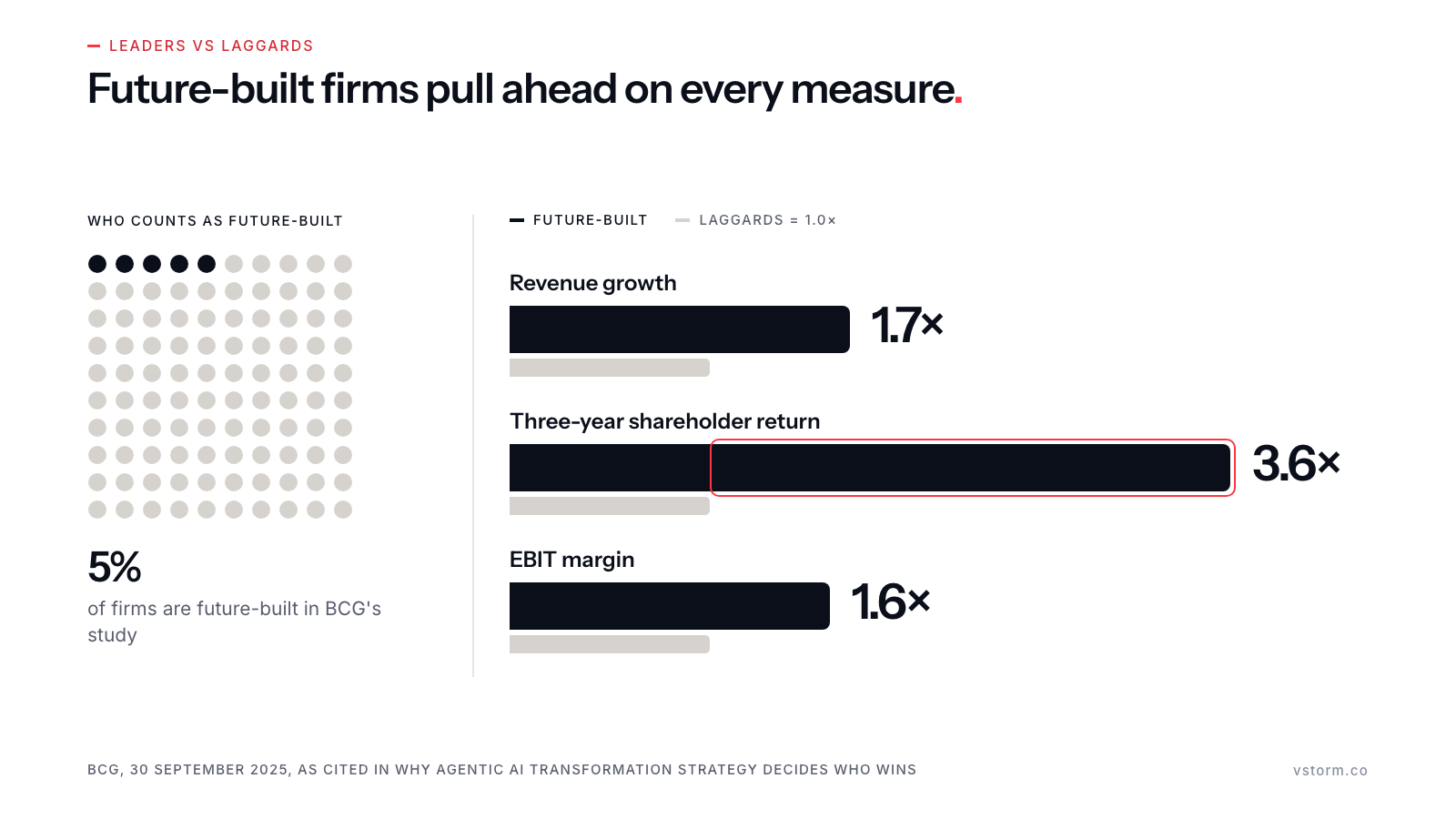
The opportunity cost is larger still, because the advantage is disproportionate. BCG reports that the 5% of firms it calls future-built achieve 1.7 times the revenue growth, 3.6 times the three-year shareholder return and 1.6 times the EBIT margin of laggards, with agentic AI as the widening force. McKinsey finds growth champions three times more likely to raise AI investment by double digits.
We see the same pattern in our own work. By our own estimate, about 70% of our clients last year came to us after a previous in-house or outsourced attempt had failed. The market data predicts the pattern and our pipeline confirms it: unfocused effort is expensive, and strategy is what focuses it.
Generic knowledge is commoditised; applied know-how is the moat #
Knowledge of how large language models work in general is now freely available, and the AI tools built on them are within nearly everyone's reach. What remains scarce, and therefore valuable, is closed, practical, hard-won knowledge of what actually ships and holds up in production.
The failure data makes the case. MIT attributes the 95% failure rate not to model quality but to a learning gap: systems that do not retain feedback, do not adapt to context and do not fit cleanly into the workflows they are meant to serve. Closing that gap is not a matter of access to a better model. It is a matter of having built the thing before and knowing where it breaks.
The model, ironically, does not determine the quality of the agentic system. Most frontier models are comparable and good enough for the majority of tasks. What clients should pay more attention to is how to build a useful harness around the model. The judgement and know-how of how to build it only comes from having shipped it before. — Bartosz Gonczarek, Chief Transformation Officer, Vstorm
This is the strategic reframe for any buyer. The right question to ask a prospective partner is not whether they understand the technology, because most do, but how many production-grade systems they have carried into operation, and what they learned when those systems met reality.
What transformational strategy looks like in practice #
Strategy here is not a deck that precedes the build and is then set aside. It is the discipline that runs through the work and decides which of the two outcomes above an organisation reaches. Our TriStorm methodology was designed for this: it sequences an engagement from identifying the right opportunity, through technical implementation, to the point where the client team owns the result and can extend it.
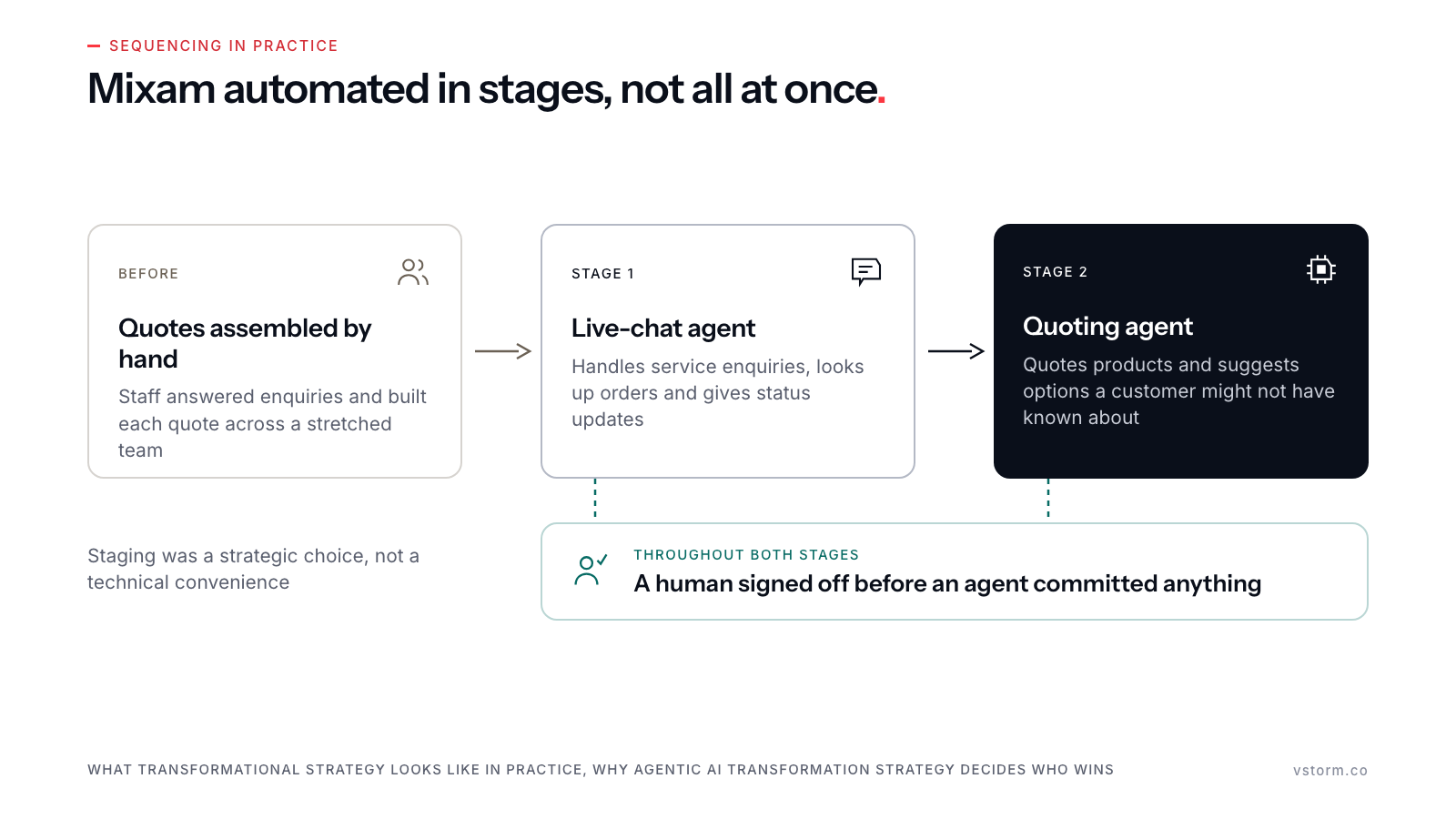
Mixam, a leading online print platform, is a clear example. Before the transformation, quoting and order handling in a traditionally conservative print industry depended on staff answering enquiries and assembling quotes by hand, and the aim was to reduce that manual effort across a stretched team. Rather than automate everything at once, the work was sequenced.
It began with a live-chat agent handling customer service enquiries, able to look up orders and give status updates, then moved to an agent that quotes products and options a customer might not have known about. Throughout, a human signed off before an agent committed anything on a customer's behalf. The staging was a strategic choice, not a technical convenience, as Lucian Puca's account of the launch and the order-completion case study describe.
The lesson applies well beyond print, and especially to agentic AI for mid-market companies, where budgets reward focus and punish scattered experimentation.
The strategic bottom line #
In a market this early, this unstandardised and this unforgiving of unfocused effort, transformational strategy is not the soft preliminary to the real work. It is the part of the work that determines the return. The technology is largely shared and the models are a commodity.
What separates the organisations capturing a disproportionate advantage from the 95% writing off their investment is the quality of the decisions made before and during the build: what to automate, in what sequence, and who owns the outcome. That is what an agentic AI transformation strategy is, and in the agentic AI world it decides everything else.
Sources #
Market and adoption data
- Gartner, Hype Cycle for Agentic AI (17% of organisations have deployed agents; more than 60% plan to within two years), 2026
- Gartner, Over 40% of agentic AI projects will be canceled by end of 2027 (also the 2028 projections for decisions and enterprise applications), 25 June 2025
- MIT Project NANDA, The GenAI Divide: State of AI in Business 2025 (95% of pilots with no measurable P&L impact), coverage via Yahoo Finance, 2025
- BCG, AI leaders outpace laggards (1.7x revenue growth, 3.6x shareholder return, 1.6x EBIT margin for the 5% future-built), 30 September 2025
- McKinsey, B2B Pulse: how growth champions rewire their playbooks with AI, 2026
Standards and Vstorm
- Linux Foundation, Agentic AI Foundation welcomes 97 new members (Vstorm as Silver Member)
- AAIF, How Vstorm put AGENTS.md into every AI agent-ready project it ships
- Vstorm, Top 5 tips from Lucian Puca of Mixam on launching agentic AI transformation
- Vstorm, AI agent for order recommendation and completion (Mixam case study)