
The TriStorm methodology Based on 30+ AI agent implementations
After successful workflow implementations for companies from ambitious SMBs to global enterprises, like Mercedes, we have identified the patterns that separate successful implementations from failed experiments. We have already solved the challenges you are about to face, and now that experience will work for you. We will guide you past known pitfalls and accelerate your path to meaningful agentic transformation.
Trusted by world-renowned brands



Why does it matter?
In the midst of the Agentic AI revolution, old ways become obsolete fast, resulting in 95% of AI projects being discontinued. We at Vstorm draw from tech and business expertise, bridging the gap between real problems and ideas, forging solutions mid-market challengers use to transform their business.

95% of GenAI projects never reach production
Generative AI is bringing operational transformations never seen before. Yet it requires expert knowledge and expertise to spot a real and profitable use case

Agentic AI field needs modern approach
Waterfall, Agile, and a plethora of existing IT project delivery frameworks, where technologies are established and transformative potential known, fall short in Agentic AI projects. The scope, the expectations, and the transformative potential of Agentic AI changes rapidly and companies need to be educated on-the go, bringing a need for new, fresh approaches.
Market is putting pressure
Companies face pressure from customers and competitors alike, with the former demanding better experiences and the latest tech to be implementing and the latter actually delivering.
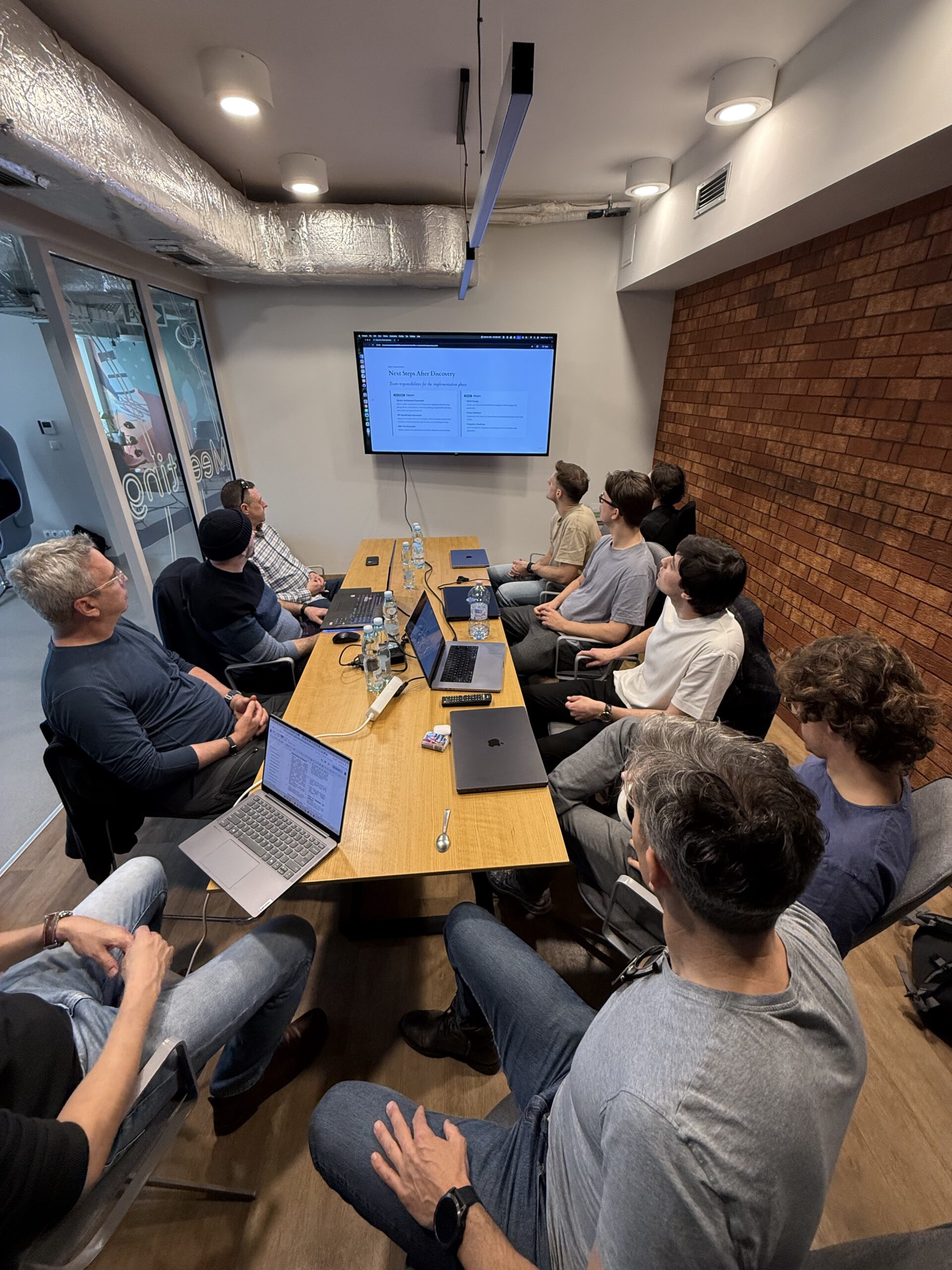
"We are where Agentic AI is transforming business workflows"
The TriStorm process
The TriStorm method, an end-to-end Agentic AI implementation framework, starts from business consultation followed with tech implementation through a data fed feedback-development loop, and continuing with knowledge and ownership transfer, delivering bespoke Agentic AI services to mid-market challengers.
Strategic alignment and planning
A consulting-led planning phase converts AI ambitions into a concrete, prioritized implementation plan. We work with stakeholders to agree on the business outcomes to pursue, assess the feasibility and risk of candidate use cases, and map current workflows against the target operating model — defining what the agent should do, what information it needs, and when it must escalate to a human. We also evaluate data and knowledge readiness, identifying sources of truth and the minimum structure required for reliable, compliant outputs.
Proof of Value
A rapid, agile delivery phase that turns the selected use case into a working Proof of Concept and iterates toward a production-ready MVP, proving value before full-scale rollout. With success metrics defined in the planning phase, we build in small, decisive increments, each sprint delivering a testable capability validated against real users and real data, surfacing data gaps and process assumptions before they become costly. As the Proof of Concept stabilizes, Technology Engineering adds guardrails, evaluation tooling, human escalation paths, and the integrations required to complete the workflow end-to-end. Where the client has an internal AI or IT team, we work embedded alongside them, combining Vstorm’s agentic engineering patterns with the client’s domain knowledge to ensure the solution fits operational reality from day one.
Process augmentation
The phase where Agentic AI becomes a real operating capability. We embed alongside your team to drive adoption, standardize how the agent fits into day-to-day workflows, and ensure accountability and governance are in place from the start. Crucially, this phase does not close the loop, but opens it. The deployed agent generates operational data that the Proof of Concept phase could not: real usage patterns, edge cases, and measurable performance gaps that feed directly back into the next cycle of value creation, giving the next use case a sharper scope and a more accurate business case. The phase concludes with a structured ownership transfer; documentation, runbooks, and technical enablement; so your team controls the code and infrastructure with no vendor lock-in, and no dependency on Vstorm to keep the system running or to scale it further.


Want a workshop on the TriStorm Method? Contact us now!
Read our blog!

Frequently Asked Questions
This section shows most common questions about popular project management methodologies in IT, along with short answers, to show how these compare to Vstorm’s TriStorm approach.
TriStorm is an internal framework that was developed by Vstorm to support partners and clients in their business transformation. It encompasses the full change management, starting from the idea and will to use an Agentic AI solution, through tech implementation, to knowledge transfer and support in business transformation.
TriStorm is an internal implementation approach that supports end-to-end agentic transformation in the client or partner company. Scrum, Agile, Waterfall and comparable tools are designed to effectively deliver software solutions, without the component of business consulting.
No. Scrum and comparable tools are designed to deliver other outcomes. Moreso, our tech teams work in sprints, implementing all principles of agile programming. So in fact, the agile approach is a part of TriStorm approach.
TriStorm is Vstorm’s internal know-how we developed from our agentic AI implementations done for our clients. We do not offer trainings or certifications.
The easiest way to get more information about TriStorm approach is to book a free consulting session with Vstorm team.
TriStorm approach is perfect to get real business transformation done with Agentic AI solutions. The methodology is perfect when the company is willing to build the competitive advantage, expand, or adapt to the modern business reality using agentic AI solution.
TriStorm may not be necessary in purely technical projects with highly defined scope of work to be done. On the other hand though we always encourage our clients and partners to run ideation and consulting sessions to make best of resources assigned for a particular project.
Scrum is an Agile framework for managing complex projects through iterative sprints with defined roles including Product Owner (prioritizes backlog), Scrum Master (facilitates process), and Developers (deliver increments).
Unfinished work does not carry over; Developers re-estimate it for the Product Backlog and the Product Owner reorders it based on current priorities.
The Daily Scrum is a 15-minute time-boxed meeting for Developers to synchronize activities, plan the next 24 hours, and identify impediments.
Agile emphasizes iterative development, customer collaboration, responding to change over rigid plans, and delivering working software frequently.
Agile is flexible and iterative with continuous feedback, while Waterfall is sequential and rigid, delaying testing until the end.
An MVP is the simplest version of a product with core features to test assumptions and gather user feedback early.
Phases include preliminary analysis, requirements definition, design, implementation, testing, deployment, and maintenance, completed sequentially.
Waterfall fits projects with fixed requirements, ample resources, established timelines, and low risk of changes.
It lacks adaptability to changes, delays testing and feedback, and often requires restarting if flaws are found late.
Kanban visualizes workflow on a board, limits work-in-progress (WIP), and optimizes continuous flow without fixed iterations.
It uses WIP limits, identifies blockers daily, and allows flexible prioritization on the board.
Lead time (from request to delivery) and cycle time (from start to completion) to track efficiency.
Scrum uses time-boxed sprints with defined roles and ceremonies; Kanban focuses on continuous flow, WIP limits, and no prescribed roles.
A generalist AI development agency typically scopes a project, delivers code, and disengages. Vstorm’s agentic AI consulting services are structured differently: the TriStorm methodology begins with a consulting-led planning phase that converts AI ambition into a prioritized, risk-assessed implementation plan before a single line of code is written. Our agentic AI consulting continues through delivery — embedded alongside your team, validating each sprint against real users and real data — and concludes with a structured ownership transfer so your team controls the codebase with no vendor dependency. This is what distinguishes AI-driven boutique consulting from commodity software delivery: the business transformation component is not an add-on, it is the frame the entire engagement runs inside.
TriStorm structures our agentic AI development services across three phases. Strategic alignment converts business objectives into a concrete implementation plan, identifying use cases by feasibility and ROI potential, and assessing data and knowledge readiness before any build begins. The Proof of Value phase delivers a working proof of concept and iterates toward a production-ready MVP in agile sprints, with each increment validated against real operational data — this is also where RAG engineering, guardrails, human escalation paths, and system integrations are introduced. Process augmentation embeds the agent into live workflows, establishes governance and accountability structures, and generates the real usage data that sharpens the scope of the next implementation cycle. The result is not a one-time project but a repeating loop of value creation.
AI automation implemented through TriStorm is explicitly designed for ownership transfer. Every deployment concludes with documentation, runbooks, and technical enablement so your engineering team controls the code and infrastructure independently. This matters because AI automation at scale requires your team to be able to modify, extend, and debug the system without routing every change through an external vendor. Vstorm uses open-source tooling throughout — LangChain open source, LlamaIndex, LangGraph — which means the codebase is readable, portable, and maintainable by any competent engineering team. We also work embedded alongside internal AI or IT teams during delivery, transferring architectural patterns and implementation knowledge as we build, rather than presenting a finished system at the end of an engagement.