
Multi-Agent System Development Company
Increase sales, reduce costs, boost customer satisfaction, and automate workflows using Multi-agent systems.
Why use Multi-Agent systems?
~12%
Order increase from day 1
Agentic AI systems smoothen the ordering process making it more comfortable, especially when products are sophisticated
1% to 100%
Response rate growth
Agentic systems deliver immediate, accurate and reliable responses that take time and effort to be prepared manually
~20%
User engagement growth
With better user experience and comfort, customers increase the interactions with the system, be it in e-commerce, patient management or education
Deploy multi-agent systems
- Multi-agent consultation
- Proof of Concept
- MVP development
- Full solution delivery
- System audit
- Deployment
- Maintenance and scalability
Multi-agent consultation
We analyse your highest-value workflows, map where multi-agent systems can drive measurable impact, and design the architecture before a single line of code is written. This includes:
- identifying automation opportunities across departments
- evaluating existing processes for agent readiness
- recommending open-source frameworks and integration patterns
- delivering a deployment roadmap aligned to your business priorities
Multi-agent system success stories
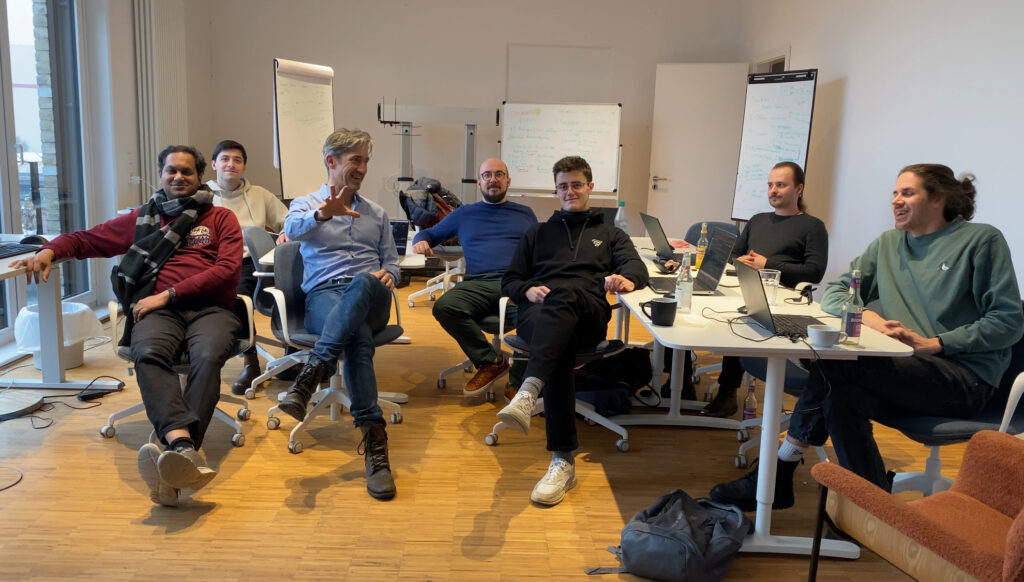



Ready to see how a Multi-Agent Development Company transforms business workflows?
Meet directly with our founders and PhD AI engineers. We will demonstrate real implementations from 30+ agentic projects and show you the practical steps to integrate them into your specific workflows—no hypotheticals, just proven approaches
The TriStorm process
The TriStorm method, an end-to-end Multi-Agent systems implementation framework, starts from business consultation, followed with tech implementation, and ending with knowledge and ownership transfer, delivering bespoke Agentic AI services to mid-market challengers
Strategic alignment and planning
A consulting-led planning phase delivered through focused workshops that converts AI ambitions into a concrete, measurable implementation plan. We align stakeholders on business outcomes to pursue, prioritize the best-fit use cases (value vs feasibility vs risk), and map current workflows (As-Is) against the target operating model (To-Be) for AI Agents—defining what the agent should do, what information it needs, and when it must escalate to humans. At this point our team determines whether the solution needs a solo- or multi-agent approach, as well as the tech stack being designed.
Proof of Value
A rapid, agile delivery phase that turns the selected use case into a working PoC and then iterates toward a production-ready MVP—proving ROI before a full-scale rollout.
With clear success metrics defined in Phase 1, we build in small, decisive increments: each sprint delivers tangible capability (e.g., one intent group, one workflow step, one integration), tested with real users and real data.
Process augmentation
The phase where AI becomes real operating capability—not a standalone tool. We embed Vstorm experts into your delivery rhythm to drive adoption, ensuring knowledge transfer and measurable outcomes. We focus on the organization as much as the technology: standardizing how teams use the agent, designing handoffs and accountability, training users, and setting up governance so the solution remains accurate, compliant, and continuously improved upon.
Ready to see how a Multi-Agent Development Company transforms business workflows?
Meet directly with our founders and PhD AI engineers. We will demonstrate real implementations from 30+ agentic projects and show you the practical steps to integrate them into your specific workflows—no hypotheticals, just proven approaches
The leaders in the field
With over 30+ real-world implementations
The first
Agentic AI Consultancy
joined the

to contribute
and co-shape
the industry trends.







We partner with and contribute
to the main
Agentic AI technologies



Insights about Multi-Agent systems development

Ready to see how a Multi-Agent Development Company transforms business workflows?
Meet directly with our founders and PhD AI engineers. We will demonstrate real implementations from 30+ agentic projects and show you the practical steps to integrate them into your specific workflows—no hypotheticals, just proven approaches
Frequently Asked Questions about Multi-Agent Systems
A Multi-Agent System is a computerized system composed of multiple interacting intelligent agents. These agents work together (or sometimes compete) to solve problems that are too large or complex for an individual agent or a monolithic system to handle.
While a standard program follows a fixed set of instructions, an agent is autonomous, reactive, and proactive. It can make its own decisions based on its environment and can initiate actions to reach a goal rather than just waiting for a command
-
Centralized: A single “leader” agent collects data and tells everyone what to do.
-
Decentralized: Control is distributed. Agents make local decisions and coordinate through communication, making the system more robust against a single point of failure.
Agents use specialized protocols called Agent Communication Languages (ACL), such as FIPA-ACL or KQML. Unlike simple data transfers, these messages often convey “speech acts” like requesting, informing, or committing to a task
Emergent behavior occurs when simple local rules followed by individual agents result in complex, sophisticated global patterns. A classic example is flocking behavior in birds or the way traffic jams form without a central cause.
Yes. While many MAS are collaborative (working toward a shared goal), others are competitive (self-interested agents). Competitive MAS are often studied using Game Theory to predict how agents will behave when their goals conflict
-
Scalability: You can add more agents as the problem grows.
-
Robustness: If one agent fails, others can take over.
-
Specialization: Different agents can be designed to handle specific niches (e.g., one for data retrieval, one for analysis).
Stigmergy is a form of indirect coordination where agents communicate by modifying their environment. Think of ants leaving pheromone trails; the next ant follows the trail not because it talked to the first ant, but because the environment was changed.
Coordination is the hardest part. Issues like communication overhead (too much talking, not enough doing), conflict resolution, and ensuring the global system remains stable are constant hurdles for developers.