Back to blog
Top 10 Agentic AI Development & Consulting companies for SMBs and Enterprises 2026

A deep dive into the top 10 Agentic AI development and consultation companies of 2026
To understand the landscape of agentic AI companies, it is crucial to first grasp the agentic definition and explore what is agentic in the context of artificial intelligence systems. Agentic AI describes autonomous AI systems that act independently to achieve predetermined goals. While traditional AI follows predefined rules, agentic systems operate proactively and complete complex tasks without constant human oversight. The term “agentic” refers to the system’s agency – its ability to act independently while remaining goal-oriented.
These intelligent AI systems analyze situations, make decisions, set objectives, reason through problems, and implement solutions with minimal human intervention. Rather than simply generating content or providing data insights, they take the initiative to drive decision-making processes through autonomous execution.
For SMBs, agentic AI functions like your most reliable business advisor – one who understands your specific challenges, learns from every customer interaction, and makes decisions aligned with your business goals. These cognitive AI agents integrate with your existing tools (such as your CRM) and actively use your data to make decisions and execute actions on your behalf.
Agentic AI systems follow a four-step operational process:
- Perceive. Collect data from various sources and identify meaningful elements
- Reason. Determine necessary tasks and find solutions to challenges
- Act. Execute tasks by connecting with external tools and platforms
- Learn. Continuously monitor results to improve decision-making
25% of enterprises using GenAI are forecast to deploy AI agents in 2025, growing to 50% by 2027… This evolution will enable AI agents to tackle a broader range of applications, providing businesses with valuable tools to drive productivity of knowledge workers and efficiency gains in workflows of all kinds. Deloitte Global’s 2025 Predictions Report
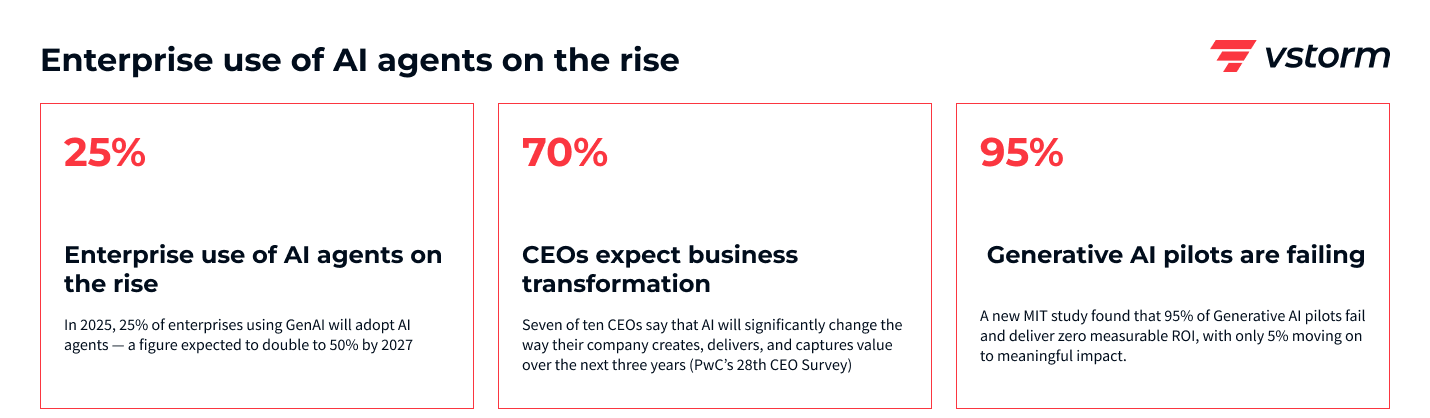
AI agent adoption rates and business impact statistics from recent enterprise studies
What is Retrieval-Augmented Generation (RAG) and why might an AI agent need it?
Retrieval-Augmented Generation (RAG) is an AI enhancing tool that revolutionizes how businesses leverage AI by integrating real-time data into decision-making processes. Unlike static AI models, RAG enhanced AI agents retrieve and synthesize up-to-date information, ensuring outputs are accurate, relevant, and actionable. This capability is critical for industries such as healthcare, finance, and legal services, where precision and up-to-date data are essential. Leveraging semantic search further enhances the accuracy and context relevance of information retrieval, improving response quality and addressing challenges related to context retrieval.
I do think of it as a workforce. This is a workforce that will conduct end-to-end processes, replacing many tasks being performed today by the human workforce. Jorge Amar, McKinsey Senior Partner, June 3 2025, on The future of work is agentic
By eliminating the need for frequent retraining, RAG enhanced AI agents reduce costs while accelerating adaptability to changing environments. Their scalability allows businesses to process large datasets and handle complex queries efficiently, making them ideal for organizations with growing data demands. Moreover, their versatility enables applications across diverse industries, from customer support to knowledge management, transforming how businesses extract value from their data through AI-driven insights and autonomous decision-making.
Ready to see how Agentic AI transforms business workflows?
Meet directly with our founders and PhD AI engineers. We will demonstrate real implementations from 30+ agentic projects and show you the practical steps to integrate them into your specific workflows—no hypotheticals, just proven approaches.
A selection of top 10 Agentic AI development and consultation companies in 2026
To aid you in your search, we have done most of the heavy lifting for you and comprised a complete list of the top 10 Agentic AI development and consulting firms in 2026 to help you choose the best match for your business needs. This list has been assembled based upon a collection of weighted criteria backed by performance data. Each provider has its unique strengths and weaknesses, but all providers meet minimal requirements in the following areas:
- Projects completed in AI Agentic Fields (real-world examples) [weighted 30%]
- Team Credentials (PhDs in team; graduate degrees; certifications) [weighted 20%]
- Services offered (complex services for AI Agent deployment or just a few features of it: LLM fin-tuning; LLMOps; NLP/ML) [weighted 20%]
- Thought leadership (publications; industry awards; open-source creation; open-source contribution) [weighted 15%]
- Technologies they work with (e.g., open-source LLMs or API-based; do they use open-source orchestration frameworks or just off-the-shelf solutions) [weighted 15%]
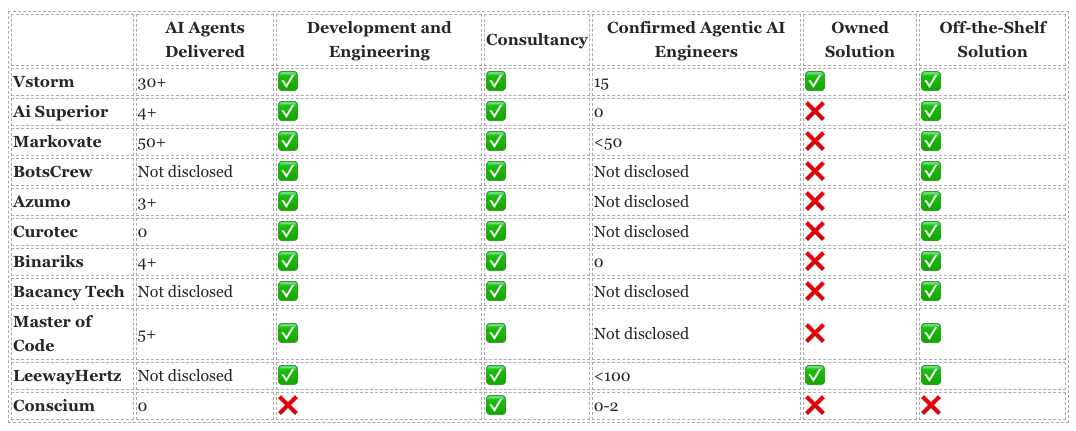
Note: The information presented here is estimated based on publicly available data. It is important to note that most companies organize their delivered case studies and AI teams by general expertise rather than by specific technologies, making complete Agentic AI specialist counts and deliveries difficult to determine. Many engineers and Agentic AI development firms typically work across multiple AI specializations rather than focusing exclusively on one area. Where this is most applicable, we’ve included company head-counts of general AI and ML engineers in the complete lists below.
Top AI Agent development and consultation providers: the shortlist
Here’s a quick overview of the top Agentic AI development and consultancy firms to consider in 2025:
- Vstorm – Agentic AI Engineering Boutique with tailored RAG, implementation and automation for SMBs
- Ai Superior – Cross sector AI integration services and consultancy
- Markovate – Generative AI consultancy and developer providing integration services
- BotsCrew – Conversational AI and Chatbot developer and consultancy
- Azumo – Nearshore development provider for the Pacific North-West
- Curotec – Proprietary AI platform provider
- Bacancy Tech – General development provider emphasising fast and cheap delivery
- Master of Code – Enterprise scale solution provider for AI/ML, Blockchain, LLM, etc.
- LeewayHertz – Enterprise scale solution developer in general AI integration
- Conscium – AI Agent verification platform provider
Agentic AI development firm #1: Vstorm
Most innovative technical approach.
Vstorm is a boutique AI Agent engineering consultancy recognized by Deloitte, EY, and Forbes and is the first agentic AI consultancy accepted as a member of the Agentic AI Foundation. We transform business operations with advanced RAG and Agentic automations that go beyond standard solutions, delivering proven ROI through practical, hands-on implementation of autonomous AI systems.
Best for: Small to mid-sized businesses looking for precisely tailored on-premise or cloud-based enterprise grade AI agents and automations
Location and development center: Wroclaw, Poland
Founded: 2017
Number of engineers in Agentic AI development: 15+ engineers with a specific focus on AI Agents
Core specialization and focus:
- Agentic AI expertise
- Precisely tailored AI
- Proven experience to reduce risks
- Cloud-based and on-premise
- No lock-in
- SMB price-friendly
- Ability to bridge vision with technology
- End-to-end AI Agents implementation
- One partner for all complexity levels
Highlights and case studies: Multi-channel AI Agent for personalized healthcare appointments dedicated to the pre-appointment phase, enabling patients to share critical updates and concerns well before seeing a doctor, the solution met strict healthcare compliance requirements while delighting patients and care teams alike.
Mapline.AI AI Agent with advanced RAG engineering built specifically for real estate due diligence, designed to fit business goals and workflow. This tool saves developers thousands of dollars per project while maintaining accuracy.
Actionable AI Agents for US telecommunication company achieved 98% automation of device activation workflows, created a scalable foundation supporting tenfold capacity expansion for multi-state operations while removing time-of-day constraints on installations, reduced error analysis and processing time with 10× efficiency improvement.
Notable Clients in the Agentic AI field: Mercedes, Intel, Viessmann, Government of Saudi Arabia, Blue Fiber Stream, Clover Health
✅ Pros
Vstorm’s specializes in the development and implementation of Agentic AI in open source, meaning you own the delivered solution. Vstorm has been a core contributor to first in field Agentic AI frameworks Langchain and Pydantic, from their beta versions.
🔻Cons
Highly specialized in Agentic AI integration and RAG implementation which will prove overkill for general or off-the-shelf needs
Agentic AI development firm #2: Ai Superior
Established multi-service provider.
AI Superior provides comprehensive services spanning strategic consulting through full implementation and emphasizes realistic AI recommendations, stating they “won’t push AI solutions unnecessarily” if simpler solutions make more sense. Their approach incorporates large language models, reinforcement learning, and natural language processing to create machine learning models.
Best for: Enterprise clients in the finance, healthcare, or logistics sectors
Location and development center: Darmstadt, Germany
Founded: 2019
Number of engineers in Agentic AI development: No dedicated specialists identified from publicly available data
Core specialization and focus:
- Generative AI
- LLM
- Generative adversarial networks
- NLP
- Computer vision
- Python
- TensorFlow
- PyTorch
- AWS
- Azure
Highlights and case studies: LLM empowered chatbot elevated internal transparency and traceability in internal communications and aided in creating knowledge centers without compromising data privacy.
Medical image classification translates medical images from one domain to another using AI Style Transfer Technique.
Notable Clients in the Agentic AI field: Not publicly disclosed
✅ Pros
Strong academic roots and data science expertise
🔻Cons
$25,000+ minimum entry budget may exclude small to medium businesses, while some negative reviews suggest the company may focus more on integration services rather than developing fully autonomous AI systems
Agentic AI development firm #3: Markovate
Best technical spread.
Markovate’s comprehensive MLOps capabilities and industry specialization across healthcare, fintech, and manufacturing distinguish them from competitors. Their focus on AI-driven automation and autonomous operations sets them apart in the field of cognitive AI agents.
Best for: Startups and enterprise tech companies in healthtech, fintech, and retail
Location and development center: San Francisco, California; Toronto, Canada
Founded: 2015 Number of engineers in Agentic AI development: No dedicated specialists identified from publicly available data, but claims to have a “significant portion” among 50+ AI engineers
Core specialization and focus:
- Machine learning
- ERP automation
- Flutter
- TensorFlow
- AWS
- OpenAI APIs
- Conversational AI
- Voice agents
- Computer vision
Highlights and case studies: AI blueprint analysis solution using computer vision and deep learning to automate the highlighting and coloring of plan sheets, eliminating manual intervention.
AI-powered insurance solution that extracts critical medical information from claims documents and generates accurate ICD-10 and CPT codes.
Notable Clients in the Agentic AI field: NVMS, CivilTakeoff, Aisle 24, AWS, CodmanAI
✅ Pros
Blends mobile development and AI innovation, enabling companies to rapidly deploy scalable applications
🔻Cons
Mid-market focus may limit very large-scale implementations, communication gaps noted in early project phases
Agentic AI development firm #4: BotsCrew
Strongest conversational AI specialization.
Despite recent acquisition by CourtAvenue, BotsCrew’s successful project deliveries and proven Fortune 500 implementations make them a top choice for conversational AI chatbots with a specialty in Ukrainian language government and market applications. Their focus on autonomous AI systems and intelligent AI systems has positioned them as leaders in the field.
Best for: Large enterprises and Fortune 500 seeking conversational AI
Location and development center: San Francisco, California; Lviv, Ukraine
Founded: 2016
Number of engineers in Agentic AI development: No dedicated specialists identified from publicly available data
Core specialization and focus:
- Conversational AI
- Chatbots
- ChatGPT API
- Node.js
- Dialogflow
- Rasa
- Twilio
Highlights and case studies: Tempuraturka, a conversational AI chatbot delivered for the Lviv municipality of Ukraine to aid users in the ongoing tracking of their health.
Kravet internal conversational AI assistant designed to sift through mountains of unstructured data and help with knowledge retrieval, achieving 90% accuracy in answers provided.
Notable Clients in the Agentic AI field: Musement, Virgin Holidays, Red Cross
✅ Pros Tested track record in implementing chatbots and conversational AI for both government and enterprise clients with a focus on autonomous execution
🔻Cons
Recent acquisition by CourtAvenue creates operational uncertainty, narrow specialization in conversational AI
Agentic AI development firm #5: Azumo
Best nearshore development model.
Azumo’s nearshore approach delivers enterprise-quality AI agents with a proven track record delivering to major tech companies demonstrating their scalability and technical adequacy in developing autonomous AI systems.
Best for: Pacific North-West enterprises seeking nearshore development partner for AI-driven automation
Location and development center: San Francisco, California; Distributed, Argentina
Founded: 2016
Number of engineers in Agentic AI development: No dedicated specialists identified from publicly available data
Core specialization and focus:
- AI chatbots
- Golang
- SOC 2 compliance
- PHP
- Unreal engine
- Game development
- Python
- Node.js
- AWS
- React
- GPT APIs
- TensorFlow
Highlights and case studies: Detailed Agentic AI related case studies with named clients are not publicly documented, though cases involving work with Meta and Google Home are mentioned in promotion material on their website.
Notable Clients in the Agentic AI field: Meta, Google
✅ Pros
Distributed development team located primarily in Argentina will smooth common time zone issues for North American clients seeking to implement intelligent AI systems
🔻Cons
$10K minimum entry budget may exclude very small businesses, geographic focus primarily North America
Agentic AI development firm #6: Curotec
Most innovative platform approach.
Curotec’s self-hosted LLM platform claims to cut development time by 70%, which represents genuine innovationin the field of autonomous AI systems, though their smaller scale limits capacity for large implementations.
Best for: Enterprises, SMBs, and startups seeking swift implementations of cognitive AI agents
Location and development center: Conshohocken, Pennsylvania
Founded: 2010
Number of engineers in Agentic AI development: No dedicated specialists identified from publicly available data
Core specialization and focus:
- Proprietary AI platform
- SOC 2 compliance
- Laravel
- Python
- AWS
- React
- Salesforce
- GPT APIs
Highlights and case studies: Detailed Agentic AI related case studies with named clients are not publicly documented.
Notable Clients in the Agentic AI field: Comcast, Philadelphia Foundation, Rescue Spa
✅ Pros Proprietary LLM platform speeds project delivery times for autonomous decision-making systems
🔻Cons
Occasional communication delays noted by clients, provides proprietary solutions so you will not own your agent
Agentic AI development firm #7: Bacancy Technology
Best scale and accessibility for SMBs.
Bacancy Technology offers an attractive value proposition for SMBs seeking cost-effective AI agent development with competitive pricing and rapid delivery. Well qualified in general AI/ML development but lacks documented cases of AI agent delivery for fully autonomous operations.
Best for: SMBs and enterprises seeking swift deployment of AI transformation
Location and development center: Ahmedabad, India
Founded: 2011
Number of engineers in Agentic AI development: No dedicated specialists identified from publicly available data, but claims to have “multiple specialists” among 80+ AI engineers
Core specialization and focus:
- Chatbot development
- Computer vision
- LLM
- OpenAI
- Langchain
- LLaMa
- AI/ML development
- React
- Python
- Laravel
- TensorFlow
- AWS
Highlights and case studies: Horizon Energy failure monitor in the oil and gas industry, monitoring remote assets to ensuring compliance with environmental and safety standards.
AI-driven Risk Management Solution for Zenith Bank operational, and market risk management framework to meet evolving regulatory requirements and market volatility risk.
Notable Clients in the Agentic AI field: Horizon Energy, UPS, Verizon
✅ Pros
Operational model prioritizes speed while keeping overall costs low for implementing AI-driven insights
🔻Cons
Lacks in depth experience with complex agent requirements, broad positioning may dilute AI specialization in autonomous execution
Agentic AI development firm #8: Master of Code
Best overall for enterprise AI Agents.
Master of Code’s enterprise-grade solutions include advanced NLP/NLU capabilities and multi-channel deployment across voice, chat, and digital platforms, focusing on developing autonomous AI systems for large-scale operations.
Best for: Enterprises and large brands, particularly of the Fortune 500 seeking comprehensive AI governance frameworks
Location of development center: Winnipeg, Canada; Cherkasy, Ukraine
Founded: 2004
Number of engineers in Agentic AI development: No dedicated specialists identified from publicly available data, but provides “Agentic AI development services” sourced from a team of 250+ developers
Core specialization and focus:
- NLP/NLU
- ChatGPT plug-ins
- Microsoft Bot Framework
- GPT APIs
- Software product development
- Dialogflow
- CRM
- Blockchain
- Mobile development
- LLM
- Node.js
- React
- ISO 27001 certified
Highlights and case studies: Zipify internal AI agent for efficient support workflows, characterized by an intelligent virtual assistant for agents and a comprehensive analytical dashboard.
Agentic AI-powered data discrepancy reconciliation tool provided via web application to expedite detection and resolution of the discrepancies. Powered by Generative AI, it provides natural language explanations for discrepancies in the ticket data.
Notable Clients in the Agentic AI field: Zipify, Tom Ford Beauty, Luxury Escapes
✅ Pros
Longest on the market means extensive experience in delivering valuable solutions for autonomous decision-making
🔻Cons
Higher cost structure, may over-engineer simple solutions, wide range of expertise as general provider may result in lack of deep specialization in cognitive AI agents
Agentic AI development firm #9: LeewayHertz
Strongest enterprise credibility through documented deliveries.
Recently acquired by The Hackett Group, LeewayHertz combines 15+ years of development with strategic consulting backing. Their ZBrain platform enables rapid enterprise AI application development using crewAI and AutoGen Studio, focusing on autonomous AI systems and intelligent AI systems.
Best for: Fortune 500 and large enterprises seeking comprehensive AI-driven automation solutions
Location and development center: San Francisco, California; Gurgaon, India
Founded: 2007
Number of engineers in Agentic AI development: No dedicated specialists identified from publicly available data, but claims “extensive Golang and LangChain expertise” among 100+ full-stack developers
Core specialization and focus:
- ZBrain proprietary platform
- AutoGen Studio
- crewAI
- Web3
- Python
- LangChain
- Solidity
- AWS
- IPFS
- GPT-4
- Chainlink
- Blockchain
- Machine learning
Highlights and case studies: No detailed AI agent applications or case studies are available in public documentation, though 50+ general AI related projects are claimed.
Notable Clients in the Agentic AI field: ESPN, NASCAR, Siemens
✅ Pros
Top AI development provider with tested solutions, market position confirmed by recent acquisition, proven focus on autonomous operations
🔻Cons
Mixed client experiences regarding project management, recent acquisition integration ongoing, lack of documentation in Agentic AI leaves the degree of specialized expertise unclear
Agentic AI development firm #10: Conscium
Best in specialized agent verification.
Conscium focuses specifically on AI agent verification, neuromorphic computing, and machine consciousness research. They offer the world’s first commercial AI agent verification platform, and their technical approach combines practical agent verification with cutting-edge research into consciousness and neuromorphic computing using spiking neural networks.
Best for: Enterprise scale needs for specialized AI Agent verification within AI governance frameworks
Location and development center: London, United Kingdom
Founded: 2024
Number of engineers in Agentic AI development: 0 Core specialization and focus:
- Renowned advisory board
- AI agent verification
Highlights and case studies: WPP verification of 28,000+ AI agents, testing AI agents for accuracy, responsiveness, fairness, explainability, and alignment.
Notable Clients in the Agentic AI field: WPP
✅ Pros
World’s first AI agent verification platform with an established and reliable track record for ensuring the quality of autonomous AI systems
🔻Cons
Extreme specialization in agent verification limits their applicable skill sets, academic research emphasis may divert resources from commercial development of fully autonomous operations
Which Agentic AI development and consultancy firm is right for you?
Vstorm, Master of Code, Markovate and LeewayHertz demonstrate the greatest overall experience in Agentic AI delivery, with the highest number of documented case studies and the greatest measurable business impact. Meanwhile, the AI Agentic development landscape shows clear deployment and specialization tiers:
- Best enterprise scale solutions: Master of Code, LeewayHertz, BotsCrew, Markovate and Vstorm represent the most robust technical options with proven enterprise deployments and academic credentials capable of providing scalable AI solutions to meet advanced AI enterprise requirements for autonomous decision-making and AI-driven automation.
- Top general providers: Bacancy Technologies, Master of Code, LeewayHertz, and Azumo offer solid general capabilities in AI systems with comprehensive service portfolios and documented client success for mid-tier and enterprise solutions, including the development of intelligent AI systems.
- Highly specialized and in-depth providers: Conscium, Binariks and Vstorm provide highly specialized solutions for their market niches, with Vstorm implementing more deeply specialized and highly tailored custom AI agents for a variety of needs, focusing on cognitive AI agents and autonomous execution.
To get the best results out of integrating Agentic AI, businesses should prioritize their choice of AI agent development services by considering demonstrated production deployments, published technical work, and team credentials which best match their complexity requirements, rather than focusing on general software development experience. Read more on our dedicated agentic AI consulting page.
Vstorm is a boutique consultation and engineering firm capable of designing fully tailored solutions without limitations on technologies. With advanced RAG enhanced AI Agents, we can unleash the full potential of AI capabilities, achieving high accuracy and full integration with your software and workflows, providing true autonomous AI systems for your business needs.
Ready to see how Agentic AI transforms business workflows?
Meet directly with our founders and PhD AI engineers. We will demonstrate real implementations from 30+ agentic projects and show you the practical steps to integrate them into your specific workflows—no hypotheticals, just proven approaches.
Summarize with AI
The LLM Book
The LLM Book explores the world of Artificial Intelligence and Large Language Models, examining their capabilities, technology, and adaptation.