Back to blog
A Commentary on Deloitte’s “State of AI in the Enterprise”

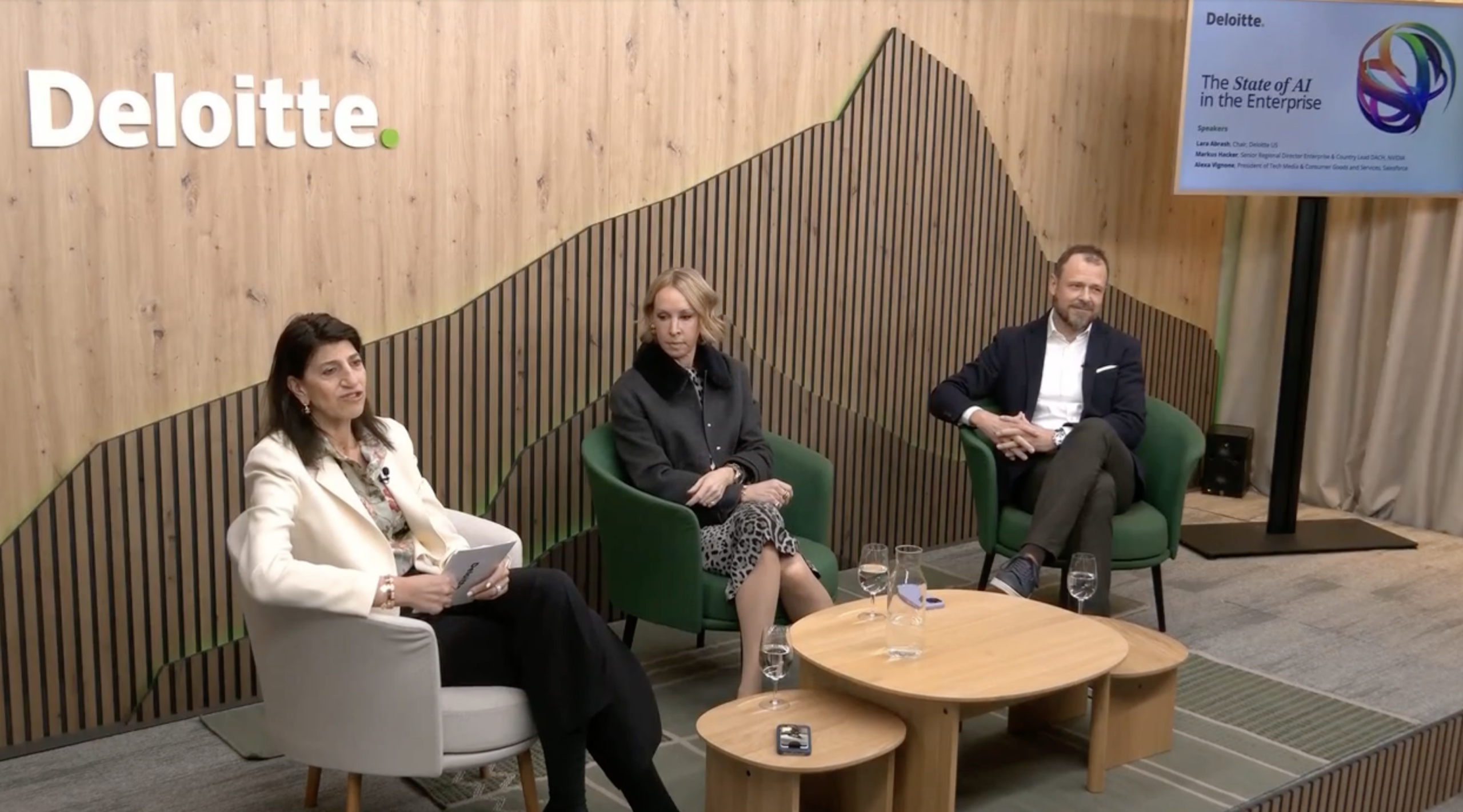
On January 21, 2026, Deloitte publicly unveiled their State of AI in the Enterprise report during the World Economic Forum Annual Meeting in Davos, Switzerland. The discussion, which can be found here on LinkedIn, took place between Lara Abrash, Chair of Deloitte US; Markus Hacker, Senior Regional Director Enterprise & DACH of Nvidia; and Alexa Vignone, President of Tech at Salesforce, in which they spoke about the current state of the market and their observation that most organizations stand at the untapped edge of AI’s potential.
And while we at Vstorm agree with this observation, we take a very different stance when in comes to their key points of discussion. In short:
- Firstly, their proposed key for avoiding the proof-of-concept trap lies in top-down AI strategy adoption. In this we disagree, as we have found the key to AI success comes from the bottom-up (we ellaborate on this below).
- Secondly, they suggest that AI adoption impacts general productivity but fails to deliver transformative value, and again we disagree, as we have found that this is just the beginning of the journey and that it is through productivity increase that the potential for transformative value is revealed.
- Thirdly, that AI agents and applications are scaling faster than oversight and security, representing a rising danger, again our findings suggest the opposite, showing that investment in guardrails and oversight is led by midmarket adopters.
- And finally, they claim that AI’s purpose is not to replace but to enhance human productivity, and in this we align.
The observations shared by the experts in this discussion may adequately reflect market wide adoption patterns, but a focused look at midmarket competitors paints a very different picture. In the sections below, we will discuss each of these claims and how our observations and experience differ from the findings of Deloitte.
Claim 1: Navigating the proof-of-concept trap
On page 9 of the report, Deloitte states “If there is no coherent AI strategy in organizations, you are likely to see pilot fatigue. You’re chasing the next shiny object, pressured to do something with AI without a real plan.” But we, at Vstorm, disagree. Over the course of our 30+ projects, we have not seen any single instance of an AI strategy that would be insightful enough to scale up pilots.
This top-down approach, which Deloitte advocates for obvious reasons, is simply not how transformation happens in midmarket companies. The transformation starts bottom-up, where successful proofs-of-concept shine light on what is actually possible, opening the path to new ways of doing business, which is then taken in gradual steps.
In other words, the quest is not for a guiding strategy. The most effective path forward is to test the viability of AI in use first, learning from the results of applied use-cases and leveraging their outcomes to inform new goals and objectives. With new insights providing greater objectives only becoming clear after 4-6 months of AI implementation.
The difference in numbers:
- The Deloitte survey suggests that only 16% of companies have redesigned jobs or the nature of work itself around AI capabilities.
- Our experience in the middle market flips this on its head. 72% of Vstorm in-flight projects actually do redesign workflows around AI capabilities.
- The Deloitte survey shows that only around 25% of respondents have moved some of their AI experiments into production. That is not what we observe at Vstorm, where that 67% of AI experiments are heading towards or have been deployed in production.
Claim 2: AI is delivering productivity for most, but business reimagination for few
This is a direct quote from the Deloitte report, but again our experience at Vstorm shows a very different pattern. The initial investment in AI usually begins with the hope of a productivity increase in some area, but changes quickly once the potential of fundamental transformation is revealed. Our claim is therefore that an increase in productivity sets the springboard for redefining business processes.
The reason for this difference in observation may arise from our addressing different market sectors. While Deloitte performed their survey on Enterprise scale companies, Vstorm mostly works with middle market challengers, where decisionmakers are more hands-on with processes and have a quicker impact on how business is done.
As such, while the enterprises surveyed by Deloitte can be seen, on page 8 of the report, to have “growing sanctioned access to AI tools” and are now expecting to see a general productivity boost; SMB’s have been quicker to prepare and deploy tailored agentic AI solutions that are integrated into some core process. Thus, the tailor-made solution becomes a necessity for business scale, not an option for general support.
The difference in numbers:
- Deloitte reports that workers with access to AI tools use them 60% of their time in their daily workflow.
- Vstorm sees that tailored AI, baked into successfully redefined processes, are used in up to 96% of work time.
Claim 3: AI agents are scaling faster than the guardrails
As the report states on page 21, “In some organizations (..) AI models have been deployed into production without formal oversight or monitoring processes.” And we believe this demonstrates a grave misunderstanding.
Production-grade AI is a result of significant investment of time and capital, and, without proper oversight and guardrails, can easily leak intellectual property (prompts and methods). Although data privacy and security tops the list of worries in the report, it seems to us that the respondents have not really lived through the experience of taking Agentic AI into production.
Our experience at Vstorm shows that the moment of decision to go live, and particularly with customer-facing models, is the start of the race to protect the competitive edge achieved with Agentic AI. All of the companies that have done so with Vstorm have taken it very seriously, making significant investments to stay on the forefront of guardrails and oversight to maintain their advantage.
The difference in numbers:
- Deloitte reports that the list of worries is topped by legal and IP risks with 73% of respondents being concerned.
- Vstorm sees that, for publicly-available agents, IP risks are everyone’s worry, as prompts and employed methods are seen as a new and valuable asset.
- Deloitte reports that only 21% of companies currently have a mature model of governance for autonomous agents.
- Vstorm sees that deploying agents for production is a catalyst for maturing governance models in all cases, reflected in 100% of our clients cases.
Claim 4: The goal isn’t to replace humans, but to create complementary working relationships between humans and AI
And here we finally converge. Vstorm observes that even if an AI project begins with an idea to streamline the team, over the course of our engagement with our clients, the goal shifts. The preliminary results, in the POC phase, illustrate that successfully implemented agentic AI projects make it possible to tap into growth potential without increasing or decreasing employment.
In the majority of cases, the teams stayed the same size, but their scope of work changed and their impact on the business grew. The pattern we have observed is that when technology handles the simple stuff behind the scenes, human capability migrates upwards. We take on more complex ambitions and spend our attention on higher-order problems.
Final Remarks
Our work at Vstorm positions us to better observe the midmarket reality thanks to hands-on exposure. In our projects tailored agentic AI systems have been making the deepest impact, providing unprecedented scalability and unlocking transformative potential. A sharp contrast to the general and enterprise level findings of Deloitte.
With a growing track record of dramatic business transformations through the application of the TriStorm development process, we at Vstorm have been privileged to take part in a very different reality than that painted by Deloitte’s report. Our clients have often achieved transformative change through the implementation of agentic AI, defying market trends and tapping into the real potential of AI, beyond the edge.
Summirize with AI
The LLM Book
The LLM Book explores the world of Artificial Intelligence and Large Language Models, examining their capabilities, technology, and adaptation.